Labuan Maritime Museum
The cement was meant for a sultan's palace. A cargo ship was hauling it across the South China Sea to Brunei when something went wrong, and the vessel sank with its load, settling onto the seabed off Labuan island. Divers still call it the Cement Wreck, and it is one of four sunken ships that have turned these waters into one of Southeast Asia's notable diving destinations. The Labuan Maritime Museum exists because this small island sits at a crossroads where human ambition and the ocean have been colliding for centuries. Built in the shape of a seashell within the International Sea Sports Complex, the museum opened on 26 January 2003 to document what lives beneath the surface of Brunei Bay and the surrounding seas, from the coral reefs sustaining hundreds of species to the rusting hulls of vessels that never completed their voyages.
Four Ships on the Seafloor
Labuan's waters hold four principal wrecks, each with its own story of misfortune. The Australian Wreck was originally a Dutch passenger and cargo steamer built in 1900. When the Japanese invaded in 1942, the Dutch scuttled the ship to keep it out of enemy hands. The Japanese salvaged it anyway, renamed it Imabari Maru, and pressed it back into service as a cargo vessel. In 1944, fleeing Borneo toward the Philippines, it struck a mine and sank 23 kilometers southwest of Labuan, reclaimed at last by the sea the Dutch had offered it to. The American Wreck tells a similar wartime tale. The Blue Water Wreck was a Philippine fishing trawler that caught fire and sank in 1981 with no loss of life, now resting in the clear waters that gave it its name. And the Cement Wreck lies where it fell, its cargo of building material slowly becoming part of the reef it settled on, an artificial foundation for the marine life the museum celebrates upstairs.
A Museum Shaped Like the Sea
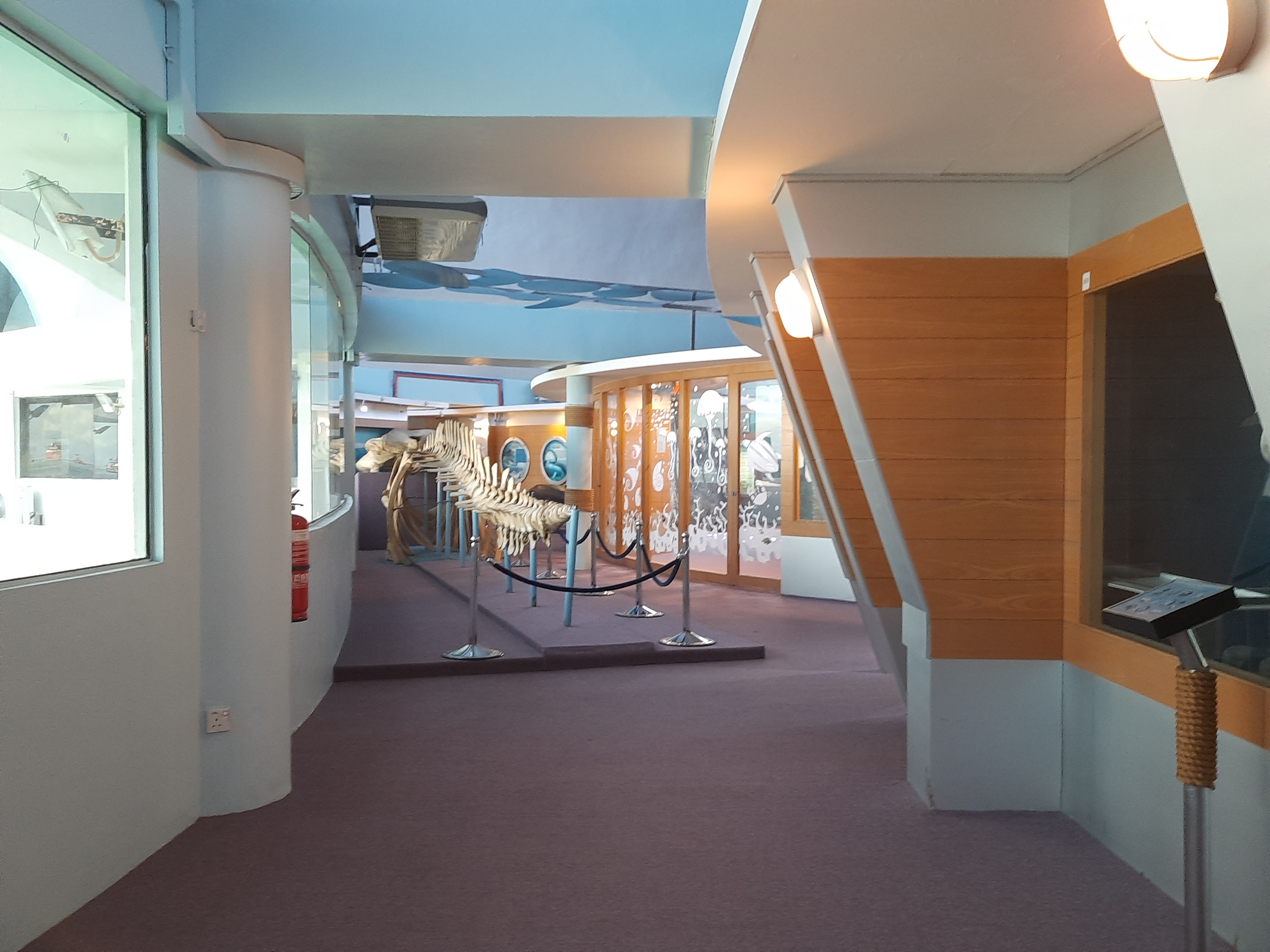
The two-story building is divided into sixteen galleries spread across its upper and lower levels. Downstairs, fourteen aquariums hold local fish species found in Labuan's waters, and a touch pool lets visitors handle marine creatures directly. Exhibits on this level document the four famous wrecks, showing divers what awaits them and non-divers what they are missing. Sections on fish biology and coral ecology provide the scientific framework for understanding why these waters support such diversity. The upper level shifts focus to the broader marine ecosystem. Galleries cover the biodiversity of coral reefs, invertebrate marine animals, and the larger patterns of ocean life around Borneo. A collection of diving gear traces the evolution of how humans have entered this underwater world, from rudimentary equipment to modern apparatus. Traditional fishing tools sit alongside their modern counterparts, and a display of devices used to catch dangerous marine creatures reminds visitors that the relationship between islanders and the sea has always required a measure of courage.
Where Borneo Meets the Sea
Labuan occupies a position in the South China Sea where warm equatorial currents sustain some of the most biodiverse marine environments on Earth. The island sits within the Coral Triangle, the global epicenter of marine biodiversity, where more species of coral and reef fish exist per square kilometer than anywhere else. This is not an abstract ecological fact for Labuan's residents. Fishing has sustained communities here for generations, and the reefs surrounding the island remain both a food source and an economic engine through dive tourism. The wrecks have become artificial reefs in their own right, their steel hulls colonized by hard and soft corals that attract schools of fish and the divers who follow them. The museum captures this relationship without sentimentalizing it. The tools on display are working tools. The fish in the aquariums are local species, not exotic imports. The story it tells is of a community whose existence depends on understanding the water that surrounds it.
Open Doors
The museum operates every day from nine in the morning to six in the evening, closing only for the first two days of Eid al-Fitr and the first day of Eid al-Adha. Admission is free. These details matter because they reflect a deliberate choice: the knowledge inside belongs to everyone, and the barriers to entry are as low as the institution can make them. For an island with a population under 100,000, maintaining a purpose-built marine museum with sixteen galleries and fourteen aquariums represents a significant commitment. The museum was officiated by the Minister of Tourism, Arts and Culture, signaling national-level interest in preserving and sharing Labuan's maritime heritage. What visitors find inside is less a collection of curiosities than an argument, delivered through glass tanks and exhibit panels, that the waters around this island are worth knowing and worth protecting.
From the Air
The Labuan Maritime Museum is located within the International Sea Sports Complex on the southern coast of Labuan island (5.27N, 115.26E), facing the South China Sea. From the air, the distinctive shell-shaped building is visible near the waterfront. The four shipwreck sites are scattered in the waters surrounding the island, with the Australian Wreck located approximately 23 kilometers to the southwest. Labuan Airport (WBKL) is on the island, roughly 4 kilometers north of the museum. Brunei International Airport (WBSB) lies across Brunei Bay to the southwest.