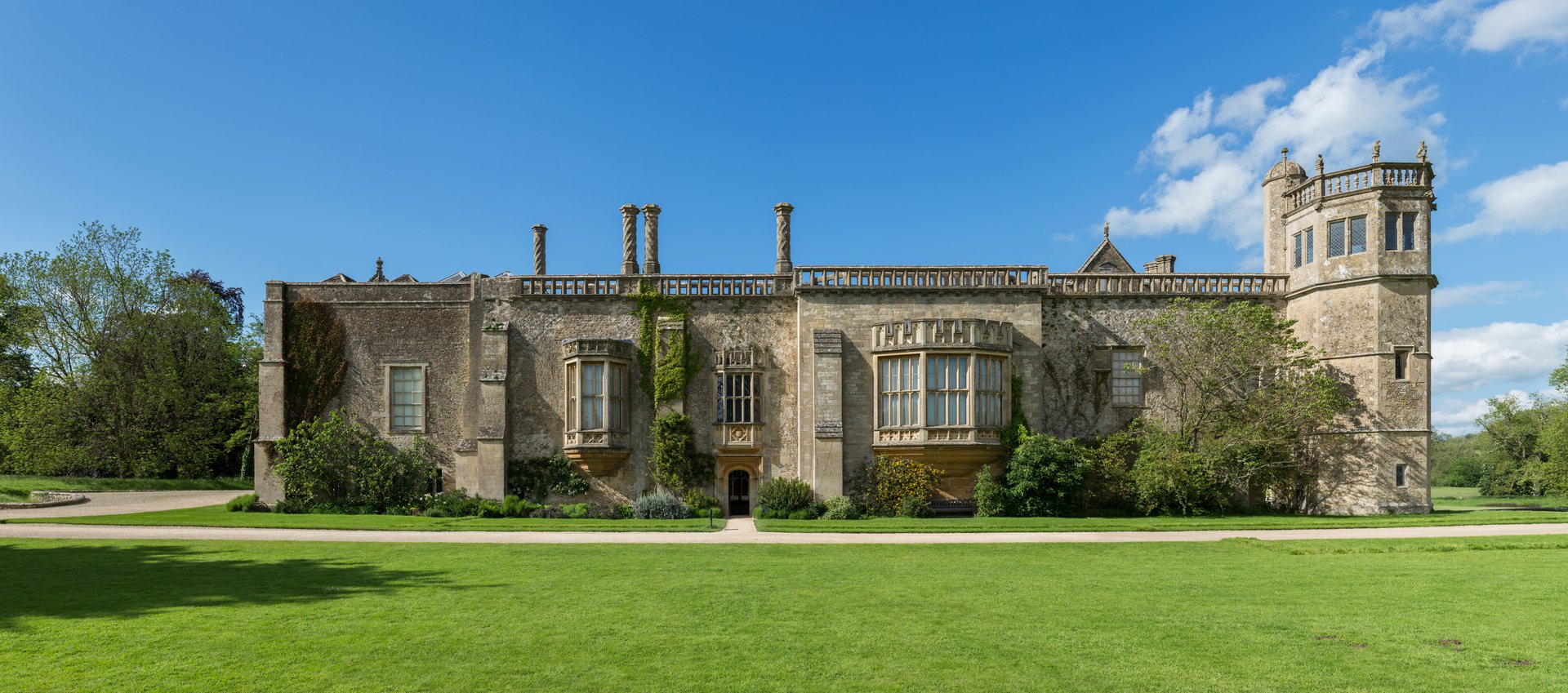
Lacock Abbey
In the summer of 1835, William Henry Fox Talbot placed a small wooden camera in a window of Lacock Abbey and exposed a sheet of writing paper treated with silver chloride. The result, a tiny image of the oriel window's latticed panes, may be the oldest surviving photographic negative made in a camera. That a revolution in human perception began in a converted thirteenth-century nunnery in a quiet Wiltshire village is one of those improbable coincidences that make English history feel scripted.
A Countess and Her Convent
Lacock Abbey was founded in 1232 by Ela, Countess of Salisbury, widow of William Longespee, who was an illegitimate son of Henry II. Ela laid the first stone in Snail's Meadow near the village of Lacock on 16 April of that year. She established it as an Augustinian nunnery dedicated to St Mary and St Bernard, and in 1238 she joined the community herself, eventually becoming its abbess. The abbey prospered throughout the Middle Ages on the wealth of its surrounding farmlands, particularly from wool. The cloisters and vaulted rooms -- sacristy, chapter house, warming house -- survive largely unaltered from this period, their stone arches cool and quiet beneath the living quarters added centuries later.
The Gentleman Collector's Tower
When Henry VIII dissolved the monasteries in the 1530s, he sold Lacock Abbey to Sir William Sharington for 783 pounds. Sharington demolished the abbey church, using its stone to extend the remaining buildings into a residence, but left the cloisters and medieval basement remarkably intact. He built the main rooms on the first floor above the old cloister passages, creating the curious arrangement that persists today: a house you cannot enter from the cloisters, and cloisters you cannot see from inside the house. Around 1550, Sharington added an octagonal tower containing two chambers with central stone tables carved in Renaissance ornament -- one for displaying his treasures, the upper one for banqueting, accessible only by walking across the roof leads.
Capturing Light
The house passed through generations until it reached the Talbot family. William Henry Fox Talbot, polymath and frustrated sketcher, turned his inability to draw during an Italian holiday into scientific obsession. Back at Lacock, he experimented with light-sensitive chemicals and wooden cameras he called "mousetraps." His 1835 negative of the south gallery's oriel window -- barely an inch square -- was the beginning. By 1841, he had developed the calotype process, a paper negative technique that, unlike the daguerreotype, could produce multiple prints from a single exposure. Photography as a reproducible medium was born in these rooms. The Fox Talbot Museum on the ground floor now houses exhibits on his life and the early history of the art he invented.
Stone, Screen, and Survival
Lacock Abbey's layered history has made it irresistible to filmmakers. The medieval cloisters doubled as Hogwarts corridors in several Harry Potter films, and the abbey has served as a backdrop for productions ranging from Pride and Prejudice to Wolf Hall. The village of Lacock itself, largely untouched by modern development, looks so convincingly period that entire streets serve as ready-made sets. In 1944, the artist Matilda Theresa Talbot gave the abbey and the surrounding village to the National Trust, preserving both as a unified whole. The result is a place where thirteenth-century stonework, Tudor ambition, the birth of photography, and twenty-first-century tourism coexist in the same corridors, each era leaving its layer without erasing the ones beneath.
From the Air
Located at 51.415N, 2.117W in the village of Lacock, Wiltshire. The abbey complex and its grounds are visible among the preserved village streets. Nearest airports: Bristol (EGGD) approximately 20nm west, Colerne Airfield nearby. Best viewed from 2,000-3,000ft to appreciate the relationship between the abbey, village, and surrounding farmland.