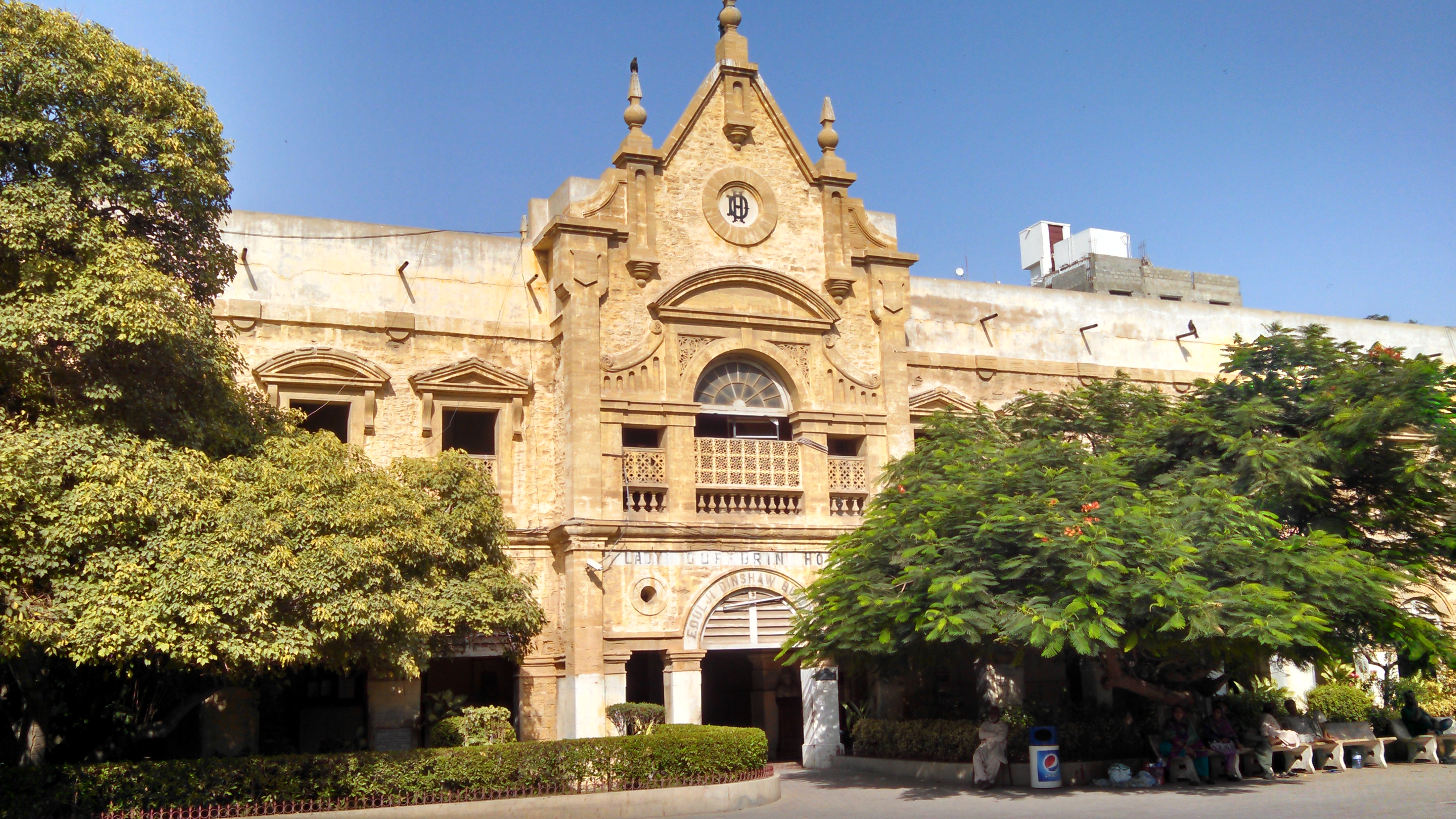
Lady Dufferin Hospital
Dr. Elizabeth Stephens Imprey never arrived at the hospital she was appointed to lead. In 1915, she boarded the P&O liner SS Persia as a first-class passenger in Tilbury, London, bound for Karachi. Off the coast of Crete, a German submarine torpedoed the ship on December 30, 1915. More than 340 passengers drowned, Imprey among them. The hospital she would never see, Lady Dufferin Hospital, was already two decades old and would go on to serve the women of Karachi for another century and counting.
A Queen's Concern
Before Lady Dufferin departed Britain in 1884 to take up her role as Vicereine of India, Queen Victoria asked her to investigate the possibilities of providing medical relief to Indian women. Lady Dufferin's conclusion was stark: "Taking India as a whole, its women were undoubtedly without that medical aid which their European sisters are accustomed to consider as absolutely necessary." She established the National Association for Supplying Female Medical Aid to the Women of India, training women medical staff to tend to patients who were not permitted to see male doctors. Dufferin Hospitals were established in Karachi, Quetta, Shikarpur, Hyderabad, Delhi, Nagpur, Calcutta, and the Burmese capital Rangoon.
Built by Philanthropists
The Karachi hospital was made possible by a princely donation from the Parsi philanthropist Eduljee Dinshaw, who contributed 50,000 rupees, a sum equivalent to several million dollars today. The foundation-laying ceremony was performed on November 12, 1894, by Lady Elgin, and the building was completed in 1898. Dr. Catherine Arnott served as the first medical officer in charge. The Katrak Maternity Wing followed, with its foundation stone laid in August 1914 and the building completed by June 1915 at a cost of 70,000 rupees. The hospital grew through continued philanthropy: Nadirshaw Eduljee Dinshaw, son of the original benefactor, endowed a nursing school in 1912.
Where a Future Prime Minister Was Born
In 1988, Benazir Bhutto, who would serve twice as Prime Minister of Pakistan, gave birth to her son Bilawal Bhutto Zardari at Lady Dufferin Hospital. The event connected the hospital's mission across nearly a century: an institution founded to give Indian women access to medical care delivered the child of the first woman to lead a Muslim-majority country. Today the hospital operates 300 beds across four operation theaters, with prenatal and postnatal wards, a neonatal intensive care unit, and a full outpatient department. The Cowasjee School of Midwifery, built by the Cowasjee Foundation and completed in 2011, maintains a 98 percent success rate on qualifying exams.
Continuity Through Upheaval
Lady Dufferin Hospital has outlasted empires, survived the trauma of Partition, and adapted through decades of political change. The Isardas Asonmal Dispensary Building, a stone structure built in 1911 and renovated in 1933 with Sindh Flood Relief Fund money, housed outpatient services for decades before space constraints forced a move in 2009. Renovation of the main building began in 1999, with the groundbreaking performed by former Sindh Governor Moinuddin Haider, and was completed in 2005. Through it all, the hospital has maintained its founding principle: quality care irrespective of a patient's financial status, a commitment that has made it one of the most reputable maternity hospitals in Pakistan.
From the Air
Located at 24.858N, 67.008E in central Karachi. The hospital complex occupies a substantial footprint in the urban core. Jinnah International Airport (OPKC) is approximately 14 km to the east. Nearby landmarks include St. Patrick's Cathedral and the Sind Club area.