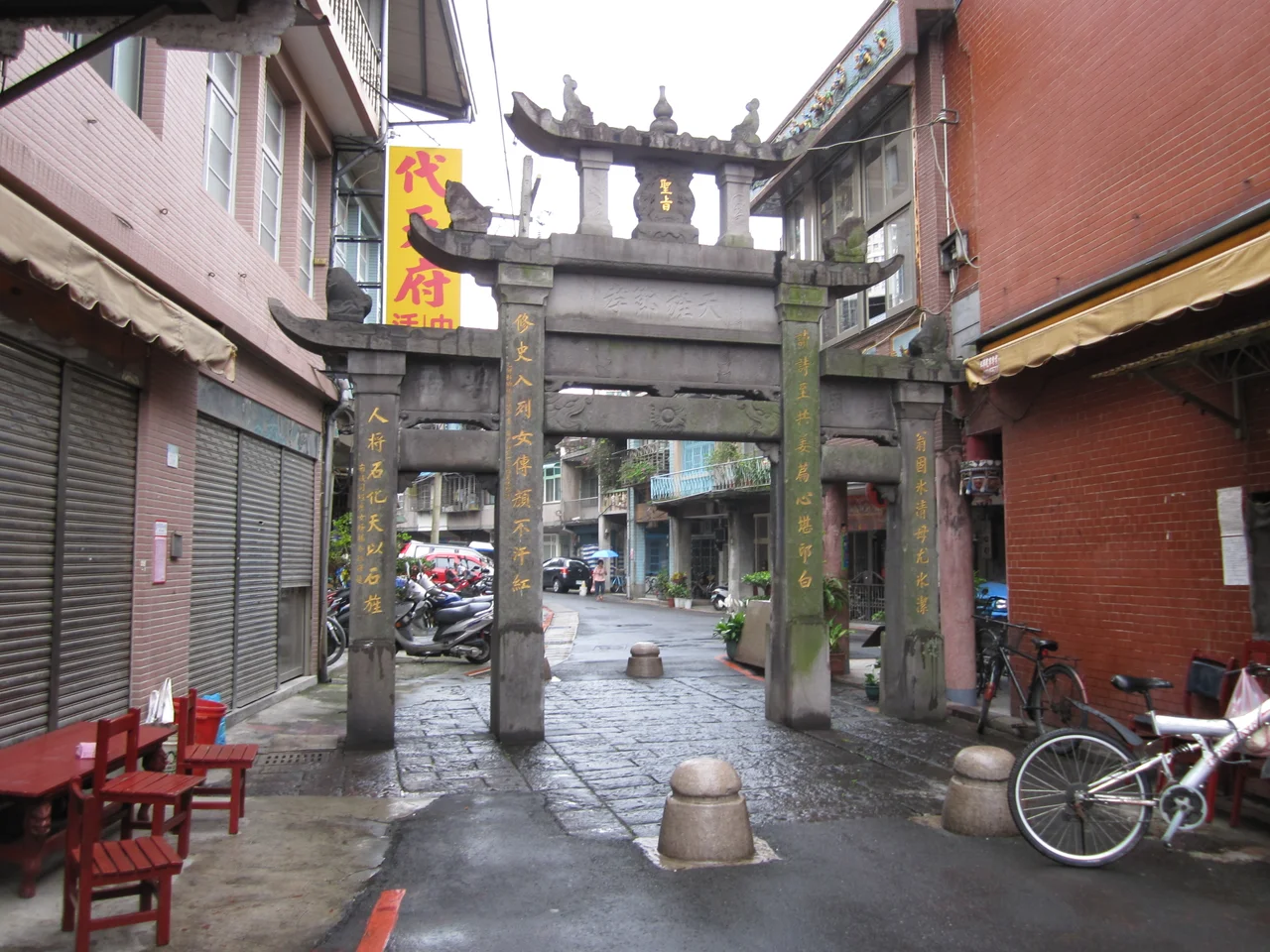

Lady Zhou's Memorial Gate
She was born in 1788, widowed young, and spent the rest of her life raising her children and caring for her parents-in-law. When Lady Zhou died in 1846, no monument marked her grave. But her reputation had spread, and four years after her death, the Governor-General of Zhejiang and Fujian proposed that she be commemorated. Construction of the memorial gate was completed in 1861, fifteen years after she died — the Qing imperial bureaucracy moving at its characteristic pace. What resulted was a paifang: an ornamental arch of the kind erected throughout China and Taiwan to honour individuals whose lives embodied particular virtues. Lady Zhou's gate still stands in Beitou District, Taipei, a physical argument in stone that a life of quiet devotion deserved to be remembered in permanent form.
A Life That Earned a Gate
The paifang tradition in Chinese culture was intimately bound up with Confucian ideals of virtue, particularly for women. A chastity arch — one of the categories of paifang — was erected to honour widows who did not remarry and who demonstrated exemplary filial piety and family devotion. Lady Zhou fits this pattern. Widowed at a young age, she did not take another husband. She raised her children independently and maintained the care of her parents-in-law, fulfilling what the moral framework of her era defined as the highest duties of a woman in her position. The decision by Governor-General Liu to propose the gate in 1850 meant that the Qing government had concluded her life met the standard for official commemoration — a determination that required documentation, local testimony, and bureaucratic review before any stone was cut. The gate that resulted was both a tribute and a statement of values.
Stone from Mount Guanyin
The gate was built from stone quarried at Mount Guanyin, a volcanic formation in New Taipei City west of the Danshui River. The mountain has long been significant in the region — its name derives from its profile, which some see as resembling the seated bodhisattva Guanyin — and its stone has been used in construction projects throughout northern Taiwan for centuries. Choosing Guanyin stone for Lady Zhou's gate was a practical decision shaped by geography, but the material connects the memorial to a specific landscape, giving it a local identity that generic construction stone would lack. The gate sits in Beitou District, roughly a short walk north of Beitou Station on the Taipei Metro, surrounded now by a neighbourhood that has accumulated its own layers of history — hot springs, Japanese-era development, and postwar suburban growth — around this older marker in the ground.
Earthquake, Damage, and Restoration
On March 15, 1897, an earthquake partially damaged the gate. Taiwan sits on the boundary of the Eurasian and Philippine Sea plates and experiences frequent seismic activity; the 1897 event was one of many that have shaped and reshaped the built environment of the island over the centuries. The gate survived — partial damage rather than destruction — but it carried the marks of that event until restoration work was undertaken by the Department of Civil Affairs of the Taipei City Government in 1992. The 1992 restoration returned the structure to a stable condition while maintaining its original form. More than 130 years had passed between the gate's completion and its official restoration, a span that encompassed the end of the Qing dynasty, Japanese colonization, the Second World War, and Taiwan's postwar period.
Memory in Permanent Form
What does it mean that this gate is still standing? Lady Zhou died in 1846, and there is probably no one alive today who knew anyone who knew her. She exists now as a name on a stone arch and in the records that documented the process of having that arch approved and built. The paifang tradition assumed that certain lives deserved public memory — that communities benefited from keeping visible the examples of people who had lived well by the standards of their time. Whether those standards were fair, or whether the Confucian framework that produced them placed burdens on women that ought to be questioned, is a separate conversation. What remains is the gate itself: a piece of Guanyin stone that a community decided, more than 160 years ago, was the right way to say that one woman's life had mattered. It is still saying it.
From the Air
Lady Zhou's Memorial Gate is located at approximately 25.134°N, 121.498°E in Beitou District, Taipei, a northern neighbourhood known for its hot springs and at the foot of the Yangmingshan mountain range. From the air at 2,500 feet, Beitou is identifiable by the valley terrain running north from the main Taipei basin, with the hot spring district visible along the streamside. Mount Guanyin, from whose stone the gate was carved, is visible to the west-southwest across the Danshui River. Taipei Songshan Airport (RCSS) lies approximately 9 km to the south-southeast; Taoyuan International Airport (RCTP) is roughly 25 km to the southwest. The gate itself is a small structure within the urban neighbourhood and best located by reference to Beitou Station.
Nearby Stories
- Dapu Incident 9.3 km away
- Shuanglianpi Wetland 18 km away
- Toufen 41 km away
- North Jiangsu Main Irrigation Canal 980 km away
- General Cliff Rock Paintings 1050 km away
- Sinking of MV Sewol 1061 km away
- Yellow Sea 1111 km away
- Twin Forts of Romblon 1358 km away