Lagavulin Distillery
The name gives it away: Lag a' Mhuilinn, Gaelic for 'hollow of the mill.' Tucked into a bay on Islay's southern coast, sheltered from the Atlantic gales that hammer the island for much of the year, Lagavulin distillery sits where people have been turning barley into spirit for nearly three centuries. At least ten illegal stills were operating on this site as far back as 1742, long before anyone troubled themselves with licenses or tax collectors. The whisky they produced was raw and local, distilled from peat-smoked malt and the soft water that filters through Islay's ancient bog. What those early distillers started in defiance of the law became, over two centuries, one of the most revered single malts on earth.
Rivals in the Bay
The distillery's official history begins in 1816, when John Johnston and Archibald Campbell Brooks built two separate distilleries on the site. One absorbed the other, though which swallowed which has been lost to time. What survived was Lagavulin. For decades it was a family affair, passing from Johnston through the Grahams and eventually into the hands of James Logan Mackie in the 1850s. But the real character behind Lagavulin's rise was Mackie's nephew, Peter Mackie, who joined the firm in 1878 and helped establish Mackie & Co. to market the whisky in London and beyond. Peter Mackie was ambitious and combative in equal measure. When he leased the neighboring Laphroaig distillery, he reportedly tried to copy its distinctive style. The attempt failed because the water and peat at Lagavulin were fundamentally different from Laphroaig's, a lesson in terroir that no amount of business acumen could overcome. The rivalry between the two distilleries, sitting barely a mile apart on Islay's south coast, became the stuff of legal battles and whisky lore.
White Horse and Royal Warrants
By 1895, Mackie & Co. had amalgamated its interests and begun blending White Horse whisky using Lagavulin as a key component. The blend proved enormously successful, earning a Royal Warrant from King Edward VII in 1908. Peter Mackie took sole control of the distillery in 1889 and ran it until 1902, by which time his partnership with Andrew Hair Holm held a fifty-year lease at 800 pounds per year. In the early 1920s, the distillery changed hands for 16,000 pounds, and by 1925 it had been absorbed into the Distillers Company, which would eventually become part of the global drinks conglomerate Diageo. Through all these corporate reshufflings, the distillery's methods stayed remarkably consistent: slow distillation through pear-shaped pot stills, two wash stills holding 11,000 liters each and two spirit stills of 12,500 liters. Speed kills flavor, and Lagavulin's distillers have always known it.
Peat, Salt, and Time
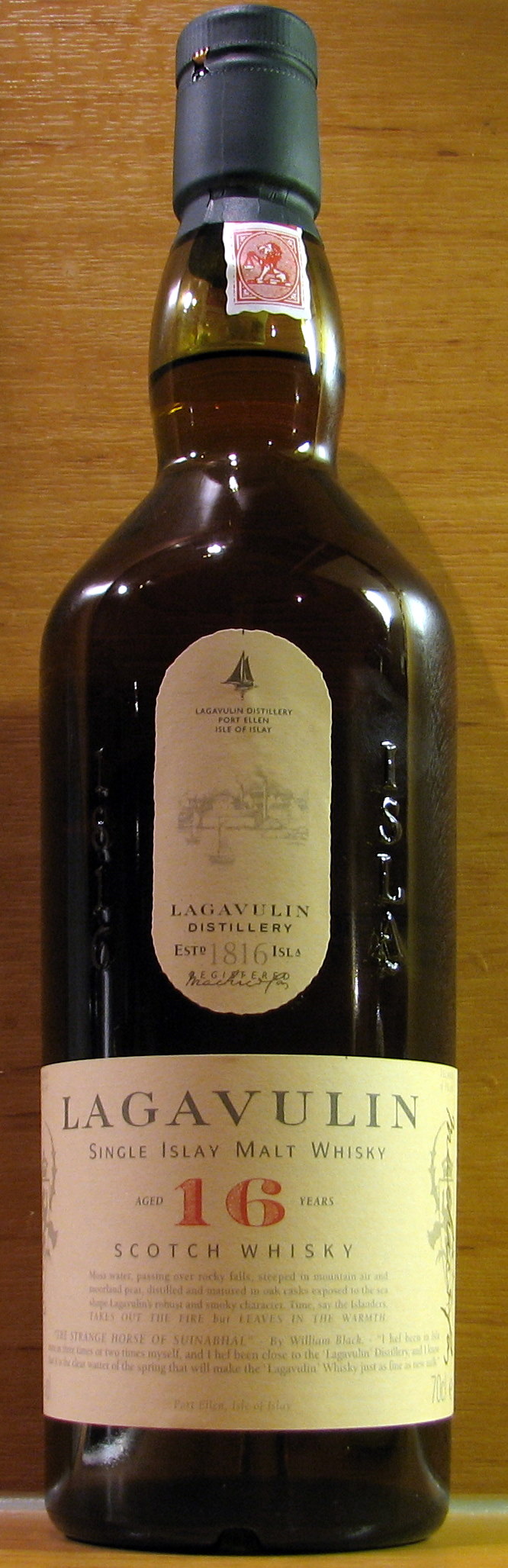
Islay's southern coast defines Lagavulin's character as surely as its copper stills do. The peat here is dense and maritime, layered with decomposed heather and seaweed, and when burned to dry the malted barley it imparts a smoke that tastes of iodine and the sea. The water runs through that same peat before reaching the distillery, carrying its mineral signature into every stage of production. The standard expression, aged sixteen years in oak casks, is bottled at 43% ABV and has collected accolades with the regularity of tides. The San Francisco World Spirits Competition awarded it four consecutive double gold medals between 2005 and 2008. Wine Enthusiast Magazine placed it in its 90-95 point range. There is also a Distiller's Edition, finished in Pedro Ximenez sherry casks, and a twelve-year-old cask strength release that strips away any softening to reveal the spirit at full intensity.
From Islay to Everywhere
Lagavulin's cultural reach extends far beyond whisky circles. Ron Swanson, the libertarian parks director played by Nick Offerman on Parks and Recreation, made it his drink of choice, and the distillery featured in the show's sixth-season premiere. In Glass Onion: A Knives Out Mystery, it is offered as the preferred scotch of a connoisseur. Lex Luthor drinks it in the finale of Titans. Chrisjen Avasarala orders it in The Expanse, set centuries in the future, suggesting that Lagavulin outlasts civilizations. Even the video game Slay the Spire borrowed the name for one of its elite enemies. All this from a hollow on the south shore of an island that many people would struggle to find on a map. But that remoteness is the point. Lagavulin's power comes from place: from the peat beneath the bog, the salt in the air, the water filtered through ancient rock. No amount of corporate ownership changes those fundamentals. The hollow of the mill keeps grinding.
From the Air
Located at 55.64N, 6.13W on the southern coast of Islay, Scotland. The distillery's white-walled buildings are visible along the bay. Nearby airports include Islay/Port Ellen (EGPI). Best viewed at 2,000-3,000 feet for context of the coastline and neighboring Laphroaig distillery to the east.