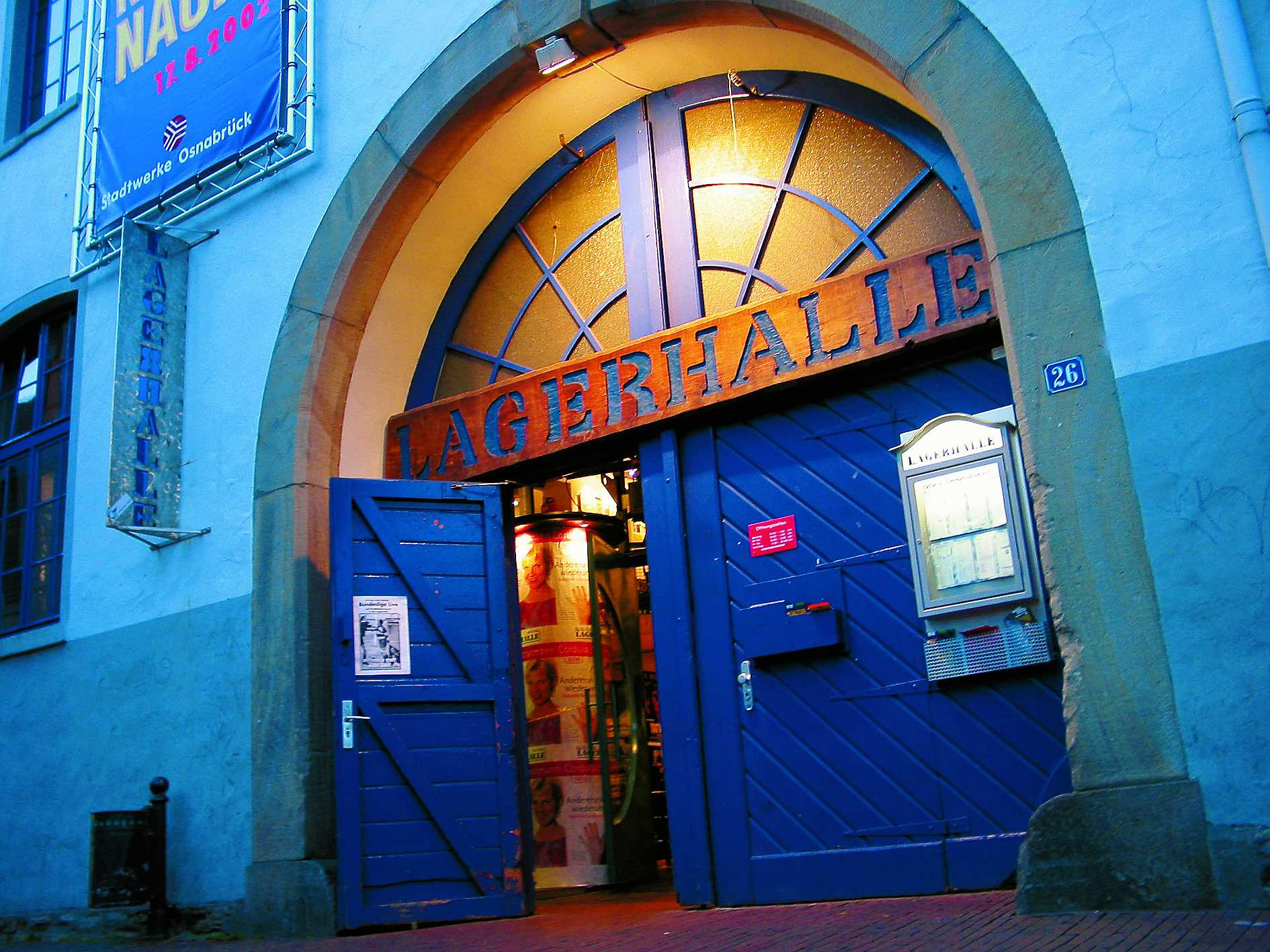
Lagerhalle
In 1972 the Richter ironware company moved out of central Osnabrück, leaving behind a brick warehouse near the Heger Tor with brick floors stained from a century of metalworking. The kind of building that, in most German cities of the early 1970s, would have been quietly demolished. Towards the end of 1973 a citizens' group of artists, arts enthusiasts and craftspeople walked through the empty halls and saw something else. They wrote up a concept and took it to the city. They wanted a cinema, a theatre, a place for readings and concerts and cabaret and lectures and children's events - a Kommunikationszentrum, a communications centre, with the warehouse left more or less as it was. Fifty years later, the Lagerhalle holds 500 events a year and has won the Lower Saxony cinema prize four times.
From Citizen Initiative to City Property
The early 1970s were the great age of West German Soziokultur - the socio-cultural centre movement that sprang up across the Federal Republic in reaction to the buttoned-down cultural establishment of the Adenauer era. Osnabrück's contribution began in February 1974, when the Lagerhalle group presented its concept to Lord Mayor Ernst Weber and asked the city to buy the building. The Richter family wanted 550,000 Deutschmarks for the warehouse, with one condition: whatever happened next must not clash with the historic character of the Heger Tor quarter just up the street. The city's culture committee approved the concept in November. On 23 December 1974 the city council bought the building for 465,000 Deutschmarks - eighty-five thousand less than the asking price - and handed it back to the citizens' group, now incorporated as the Lagerhalle-Verein, to run.
Eighteen Months and a Cultural Centre
The conversion took eighteen months. The city paid the running costs and made all the interior space freely available to the association; the association ran the programme and hired the staff. By 1976 the place was open. The main hall, 200 square metres of warehouse floor, can seat 250 or hold 450 standing. Above it sit the Spitzboden under the attic peak, the Empore mezzanine gallery, a craft room and six seminar rooms. The building is now registered as a protected cultural monument under section 4 of the Lower Saxony heritage law, which sits oddly alongside its function as a warehouse: it is one of the few protected industrial buildings in the country still being protected by being used. In 1979 the Lagerhalle was a co-founder of the Bundesvereinigung Soziokultureller Zentren, the federal association that now represents every centre of its kind in Germany.
The Cinema Inside the Warehouse
The Filmkunstkino - the art-film cinema - is what brings most outsiders to the Lagerhalle. It is the home venue of three festivals: the European Media Art Festival, one of the longest-running showcases of experimental film and video art in Europe; the Unabhängige FilmFest Osnabrück, the independent film festival; and the New Japanese Film Festival. In 2005, 2008, 2009 and 2010 the cinema won the Kinoprogrammpreis Niedersachsen/Bremen, the Lower Saxony and Bremen cinema programming prize, in the non-commercial category - an award given by the state arts ministries to cinemas whose programming pushes beyond the box-office mainstream. The Filmkunstkino sits on programming committees of three national associations: the federal association of non-commercial cinemas, the German film theatres association, and the AG Kino-Gilde of German arthouse cinemas.
Cabaret, Morgenland, and Five Hundred Other Things
Beyond the cinema, the Lagerhalle hosts Osnabrück's annual Cabaret festival and the Morgenland Festival Osnabrück - a major showcase of music from the Middle East and Central Asia that brings musicians from Iran, Syria, Afghanistan, Armenia and Turkey to a city that for most of its history saw none of them. The board's count of five hundred events per year includes everything from children's theatre to political readings to electronic music nights. Funding comes from the in-house bar and restaurant - the Lagerhalle is also a place to eat and drink - and from public subsidies. The non-profit association still runs the whole thing on behalf of the city, an arrangement that has now outlasted four mayors and the Deutschmark itself.
A Neighbourhood of Memory
The Lagerhalle stands a few hundred metres from the Felix-Nussbaum-Haus, the Daniel Libeskind-designed museum that holds the largest collection in the world of the Osnabrück-born Jewish painter who was murdered at Auschwitz in 1944. Up the street is the Waterloo-Tor, the city gate built after 1815 to commemorate the Hanoverian troops who fought alongside Wellington. The Lagerhalle's hosting of the Morgenland Festival sits in conscious contact with that geography. The warehouse the ironmonger left empty in 1972 has spent half a century being used by a city to talk to itself about who it is and who it might be.
From the Air
The Lagerhalle sits at 52.28°N, 8.04°E on Rolandsmauer, on the western edge of Osnabrück's Altstadt near the Heger Tor. EDDG (Münster/Osnabrück International) is the obvious approach, 30 km north. The Felix-Nussbaum-Haus, with its distinctive zinc-clad Libeskind geometry, lies barely 200 metres south and is the easiest visual landmark to fix the area from altitude.