Lagos Colony
Oba Dosunmu held out for eleven days. On August 6, 1861, facing the guns of HMS Prometheus and the pressure of Acting British Consul William McCoskry, the king of Lagos -- spelled 'Docemo' in British documents, as if even his name was subject to colonial editing -- signed the Lagos Treaty of Cession. The island became a British colony. The British said they came to end the slave trade, and that was partly true. Lagos had been a major slaving port since 1730, when the Oba invited Portuguese traders to the island. But the British also came for palm oil, for trade routes into the Yoruba interior, and for strategic position on the Gulf of Guinea. The colony they established would grow, absorb its neighbors, and eventually become the foundation of modern Nigeria.
Before the Flag
The earliest Lagos was an Awori Yoruba fishing settlement on the islands and peninsula that form the modern city. Its founding families claimed descent from a semi-mythical figure called Olofin, and their descendants became the Idejo or 'white cap chiefs' -- an aristocracy that predates every colonial boundary. In the 16th century, troops of the Oba of Benin sacked and colonized the island during the Benin Empire's expansionary phase, establishing a war camp that grew into a port town. The monarchs of Lagos since then have claimed descent from the warrior Ashipa, whose grandson moved the seat of government to the palace on Lagos Island. By the 18th century, Lagos was technically a vassal of Benin but increasingly independent, its power growing as Benin's waned. When Portuguese slave traders arrived in 1730, a fortified island with a protected harbor and access to the Yoruba hinterland proved ideal for their purposes.
Bombardment and Bible
The British first attacked Lagos at the end of 1851, bombarding the island into submission, deposing Oba Kosoko, and installing the more cooperative Oba Akitoye. A treaty signed on January 1, 1852 made slavery illegal in Lagos. A Yoruba emigrant named James White captured the mood: 'By the taking of Lagos, England has performed an act which the grateful children of Africa shall long remember. One of the principal roots of the slave trade is torn out of the soil.' But gratitude curdled quickly. Akitoye died suddenly in September 1853 -- perhaps by poison -- and his son Dosunmu became Oba, only to face the full annexation eight years later. The consulate evolved into a protectorate, and the protectorate into a colony. McCoskry, the acting governor, opposed missionaries and once signed a petition to prevent two of them from returning to Lagos. He communicated his views to the explorer Richard Francis Burton, who agreed that Africans were more likely to be converted by Islam than by Christianity.
The Cosmopolitan Colony
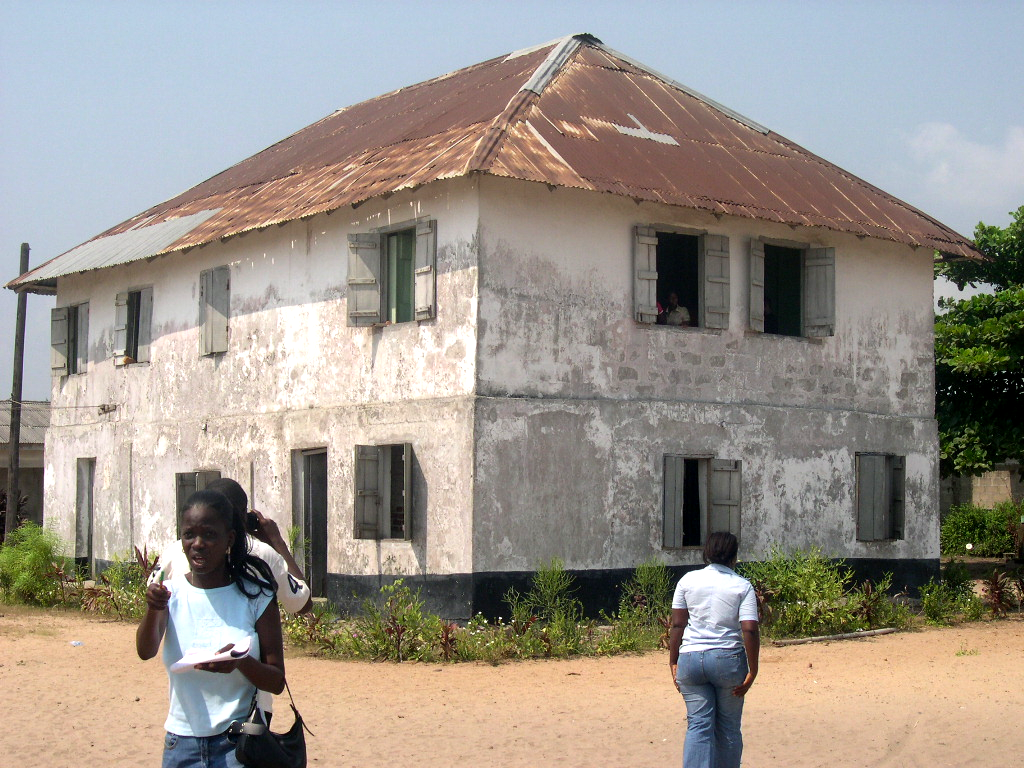
Colonial Lagos became a busy, cosmopolitan port with an architecture that blended Victorian and Brazilian styles. The Brazilian element came from skilled builders and masons who had returned from Brazil -- formerly enslaved people who brought their craftsmanship back across the Atlantic. The black elite was composed of English-speaking 'Saros' from Sierra Leone and other emancipated people repatriated from Brazil and Cuba. By 1872, the colony's population exceeded 60,000, of whom fewer than 100 were European. The CMS Grammar School had been founded in 1859, and the Methodist Boys School followed in 1877. The first newspaper, Iwe Iroyin, had appeared in 1854. Robert Campbell, a Jamaican of part-Scottish, part-African descent, launched the Anglo-African in 1863 despite the governor's objection that a newspaper would be 'a dangerous instrument in the hands of semi-civilized Negroes.' The British government overruled the governor. The press survived.
Wars, Railways, and Amalgamation
The Yoruba hinterland burned with conflict for decades. A trade war between Ibadan and both Abeokuta and Ijebu broke out in 1877, and the Ekiti and Ijesa revolted against Ibadan rule the following year. Fighting dragged on for sixteen years, fueled partly by breech-loading rifles supplied by Saro merchants in Lagos. When Governor Gilbert Thomas Carter arrived in 1891, he pursued an aggressive policy -- attacking Ijebu in 1892, touring Yorubaland to force treaty signings, and opening the way for a railway from Lagos to Ibadan. By 1895, colonial control was firmly established. Telephone links with Britain had been operating since 1886, electric street lighting since 1898, and in 1897 a major strike broke out that has been called the first significant labor protest in African history. Walter Egerton, the last Governor of Lagos Colony, pushed the railway onward to Oshogbo. On February 28, 1906, Lagos Colony merged with the Southern Nigeria Protectorate. In 1914, that combined territory merged with Northern Nigeria to form the Colony and Protectorate of Nigeria. Lagos would serve as its capital until 1991.
From the Air
Located at 6.453N, 3.396E on Lagos Island, in the Lagos Lagoon on the Atlantic coast of the Gulf of Guinea, west of the Niger River delta. The colonial-era core of Lagos is concentrated on the island, with the harbor channel visible to the south separating the island from the mainland. Long sand spits extend up to 100 km in both directions along the coast. Nearest airport: Murtala Muhammed International Airport (DNMM), approximately 14 nm to the north.