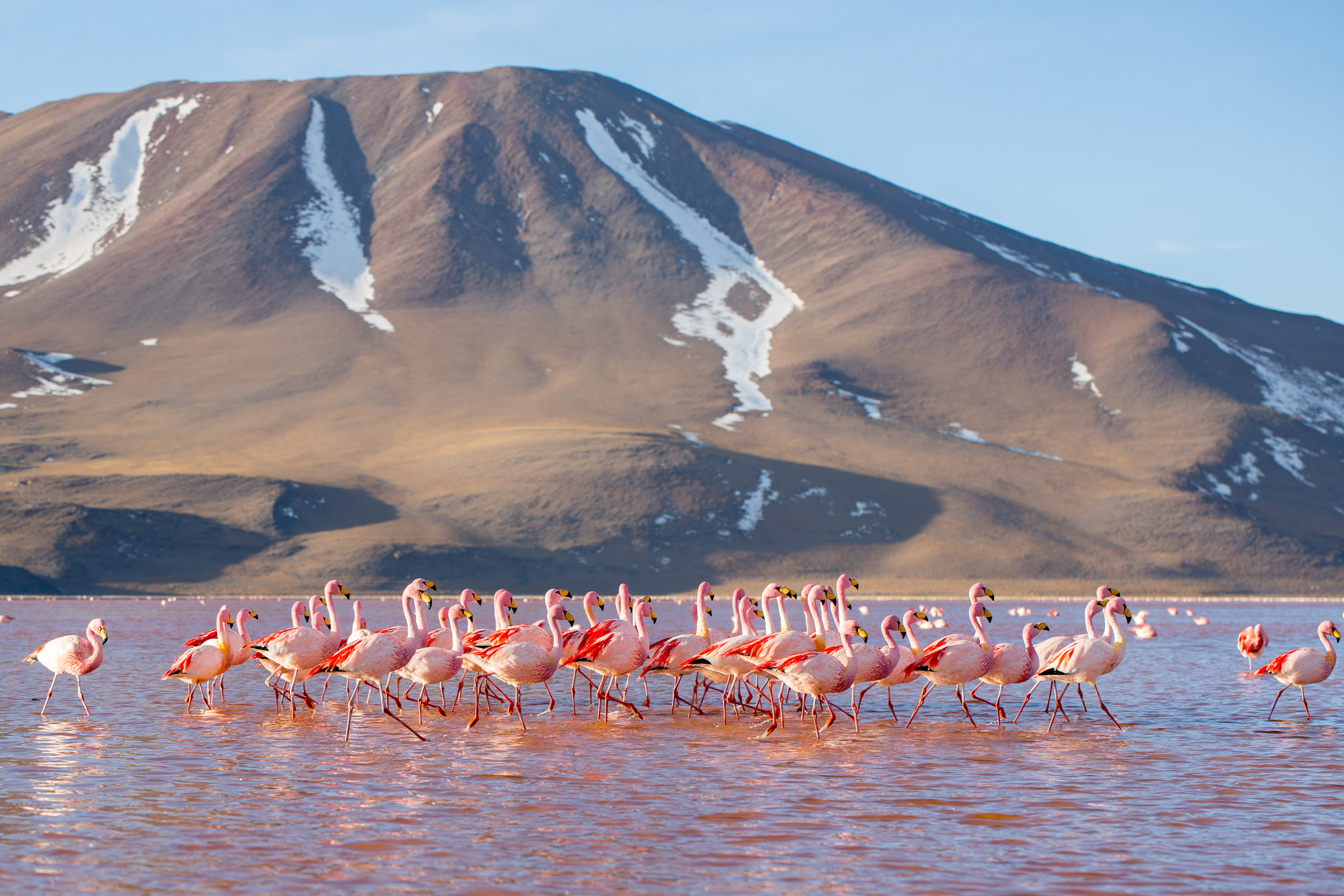
Laguna Colorada
The water is red. Not rust-tinged, not faintly pink in certain light, but a deep, vivid crimson that shifts across the spectrum depending on the hour -- soft rose at dawn, blood-dark under midday sun, fading to coral as afternoon clouds roll across the altiplano. Laguna Colorada sits at 4,278 meters above sea level in the remote southwestern corner of Bolivia, a shallow hypersaline lake whose color comes not from the sky above but from the biology and geology below: red sediments on the lakebed and vast colonies of Dunaliella salina, a pigmented alga that thrives in water too salty for almost anything else.
Painted by Algae
The mechanism behind Laguna Colorada's color is elegantly simple. Dunaliella salina, a single-celled alga adapted to extreme salinity, produces beta-carotene as a protective pigment against intense UV radiation at high altitude. When conditions favor algal growth -- warmer temperatures, stronger sunlight -- the lake deepens to its most saturated reds. In cooler or cloudier periods, the color softens to pink or even orange. Against this shifting canvas, islands of white borax deposits emerge from the water's surface, creating a contrast so stark it seems designed for the eye rather than by accident of chemistry. The lake's water, fed by the Sulor River, is rich in sodium chloride, borates, sulfates, and diatomite, with a pH that ranges from 5.3 to 9.0 -- conditions hostile to most life but ideal for the microorganisms that give the lake its name.
Flamingo Nursery
Three species of flamingo breed at Laguna Colorada: the James's flamingo, the Andean flamingo, and the Chilean flamingo. The James's is the most abundant, its population drawn to the lake's rich plankton -- the same microscopic life that tints the water also feeds the birds and contributes to the pink pigmentation of their feathers. For the James's flamingo in particular, Laguna Colorada is one of the most important breeding sites in the world. The surrounding ecosystem, despite its apparent barrenness, supports a wider community of high-altitude specialists: the Andean mountain cat, one of the rarest wild cats on Earth; the culpeo, or Andean fox; herds of wild vicunas; and domesticated llamas tended by the few human communities that persist in this landscape.
Ramsar and the Expanding Boundary
In 1990, Laguna Colorada was designated a Wetland of International Importance under the Ramsar Convention, initially covering just over 500 square kilometers. On July 13, 2009, the protected area was dramatically expanded to 14,277 square kilometers -- an area larger than the nation of Montenegro -- to encompass the surrounding high Andean endorheic, hypersaline, and brackish lakes and their associated wetlands, known locally as bofedales. These are the spongy, waterlogged meadows that develop around springs and streams on the altiplano, critical habitat in a landscape that receives minimal rainfall. The lake lies within the Eduardo Avaroa Andean Fauna National Reserve, Bolivia's most-visited protected area, where tourists on the Uyuni-to-Atacama route pause to photograph the improbable palette of red water and white mineral.
Chemistry of the Impossible
Laguna Colorada's water chemistry reads like a list of conditions that should preclude life. Hypersaline, with high concentrations of arsenic, selenium, and mercury, the lake exists in a state of chemical extremity that scientists have studied for decades. Recent research has examined how these toxic elements speciate -- that is, what chemical forms they take -- in the lake's waters, and how their presence affects the distribution of organisms across the wetland system. The results suggest that life here does not merely tolerate these conditions but has organized itself around them, with different species occupying niches defined by the precise chemistry of their microhabitat. The flamingos wading in the shallows, the algae coloring the depths, the microorganisms in the sediment -- each has found its place in a system that, by most standards, should not support a food web at all.
From the Air
Laguna Colorada is located at approximately 22.20S, 67.78W at 4,278 m elevation on the Bolivian Altiplano. The lake's vivid red color makes it one of the most visually distinctive water features in South America when seen from altitude. It lies within the Eduardo Avaroa Andean Fauna National Reserve, south of Sol de Manana geothermal field and north of Laguna Verde. Nearest airports are in Uyuni (approx. 300 km) or Calama, Chile (SCCF). White borax islands contrast sharply with the red water, visible even from high altitude in clear conditions.