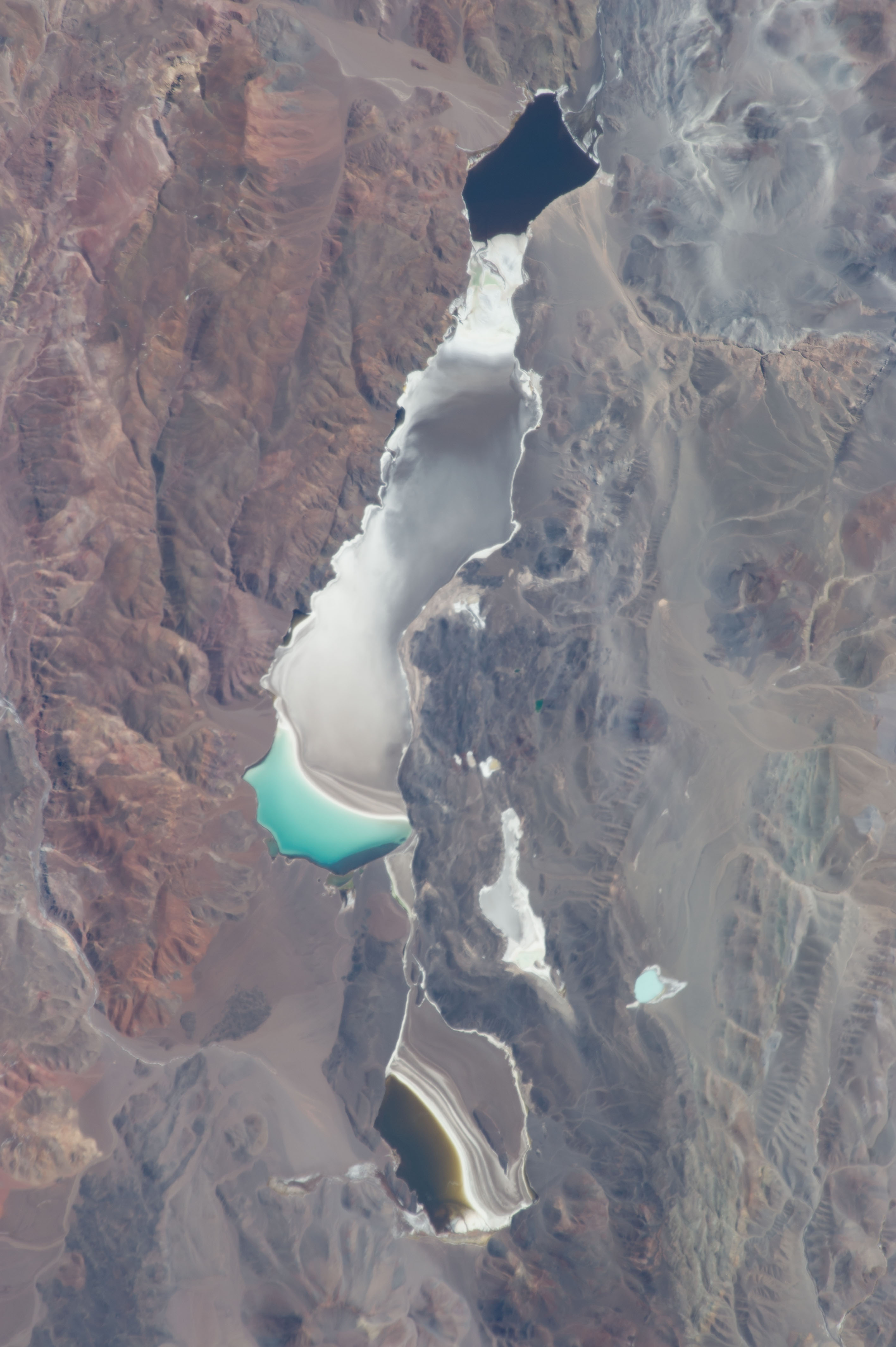
Laguna Negra, Catamarca
Scientists searching for clues about life on Mars do not always look up. Sometimes they look at a shallow, wind-scoured lake in the Argentine Andes. Laguna Negra sits at 4,131 meters elevation on the Puna plateau in Catamarca Province, near the San Francisco Pass between Chile and Argentina. Less than two meters deep and covering just 8.6 square kilometers, it would be easy to overlook. But along its southeastern shore, in water barely ten centimeters deep, grow structures that connect the present to the deep past: living stromatolites and microbialites whose layered, multicolored forms resemble fossils from the Precambrian era, when life on Earth was measured not in species but in microbial mats.
Three Lakes at the End of the World
Laguna Negra is the southernmost of three lakes aligned north to south in a high valley enclosed by volcanic rock. Laguna Verde lies in the middle, its waters tinted green, and Laguna Tres Quebradas sits to the north, separated from Verde by a white salt pan. Together they form the Laguna Verde Saline Complex, a chain of closed basins with no outlet to the sea. Lava flows from surrounding volcanoes sealed the valley's southern exit long ago, trapping water that now cycles between snowmelt and evaporation. The 6,795-meter Monte Pissis looms nearby, and the terrain consists of basalt, andesite, and evaporite deposits spread across a plateau that has been rising since the Cenozoic. From space, the complex looks like a painter's palette dropped onto brown mountains — the brownish Laguna Negra, the vivid green of Laguna Verde, and the brilliant white of the salt pans between them.
The Stromatolite Belt
Along the southeastern margin of Laguna Negra, where an alluvial fan pushes into the lake and groundwater seeps upward, a 0.3-square-kilometer zone called the Stromatolite Belt hosts an ecosystem unlike almost anything else on the modern Earth. Here, in water no deeper than a hand's width, oncoids and stromatolites grow from the interaction of carbonate minerals and living microorganisms. The oncoids — rounded structures up to ten centimeters across — have concentrically layered interiors, each ring a different color: green-yellow, orange, snow white. Some sit submerged; others emerge from the mud, crusted with halite crystals. Microbial mats blanket them in shades ranging from green near freshwater springs to black on exposed carbonates, their colors produced by carotenoid and scytonemin pigments that shield the organisms beneath from the Puna's intense ultraviolet radiation.
Life at the Extremes
The waters of Laguna Negra are hypersaline, their primary salt calcium chloride, with arsenic present at concentrations that would be toxic to most complex life. Temperature swings from 30 degrees Celsius in summer days to well below freezing in winter nights. High salinity prevents the lake from icing over in its center, though its margins freeze where fresher inflows dilute the brine. In this punishing environment, the lake's biology is almost entirely microbial. Cyanobacteria conduct photosynthesis at the surface. Below them, green and purple sulfur bacteria carry out anoxygenic photosynthesis, generating sulfur deposits as a byproduct. Deeper still, sulfate-reducing bacteria complete the metabolic stack. These organisms are extremophiles, evolved to tolerate conditions that would eliminate most life on Earth. The bacterial species Rivularia halophila was first described from Laguna Negra — the first member of its genus identified in hypersaline inland waters.
A Mirror for Mars
What makes Laguna Negra remarkable beyond its biology is what it implies. The stromatolites here resemble ancient Precambrian forms more closely than they resemble the more recent Proterozoic examples found elsewhere. The conditions at the lake — extreme aridity, intense UV radiation, hypersalinity, thin atmosphere — approximate what scientists believe existed on early Earth and early Mars. Researchers have used Laguna Negra as an analog site for interpreting geological deposits detected on the Martian surface. Studies of isotope fractionation in the lake's carbonates have also demonstrated that variations in oxygen and carbon isotopes are not necessarily proof of biological activity, a finding with direct implications for how we interpret chemical signatures in Martian rocks. In 2009, the lakes were designated a Ramsar Site for their importance as a bird conservation area, adding ecological recognition to the scientific interest that had already put this remote plateau on the map.
From the Air
Laguna Negra is located at 27.65°S, 68.55°W on the Puna plateau in Catamarca Province, Argentina, at 4,131 meters elevation. The lake is visible as a brownish rectangle adjacent to white salt flats and the green-tinted Laguna Verde to its north. Monte Pissis (6,795 m) dominates the skyline to the south-southwest. The nearest significant airport is Catamarca Airport (SANC), roughly 300 km to the east. This is extremely high-altitude terrain with no infrastructure; pilots should expect turbulence, thin air performance degradation, and limited emergency landing options. The San Francisco Pass border crossing with Chile lies nearby.