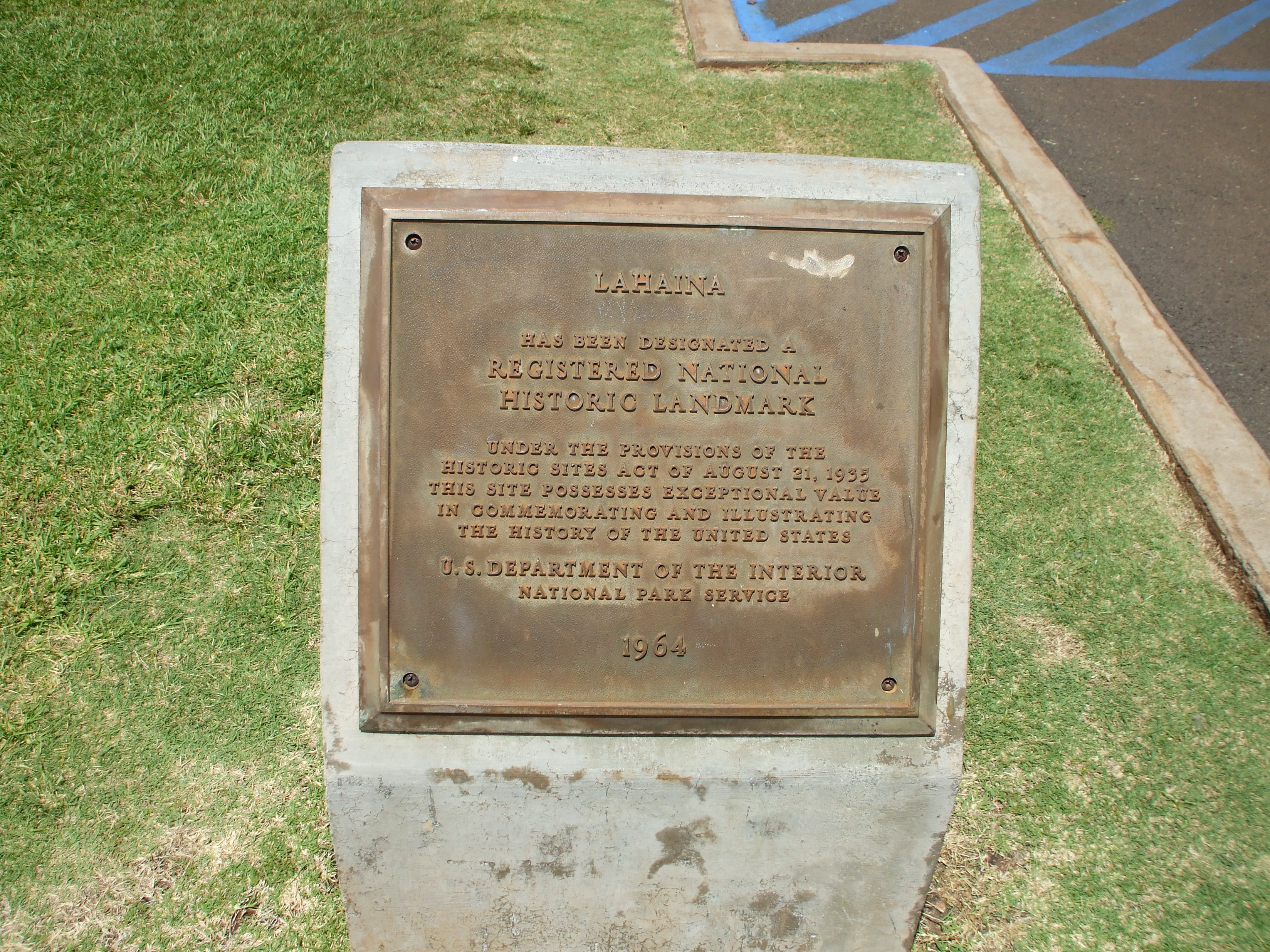
Lahaina Historic District
Nine buildings. That was the number the National Park Service called out in 1962 when it designated the Lahaina Historic District as a National Historic Landmark -- nine structures that together told the story of a Pacific whaling capital, a Hawaiian royal seat, and a missionary outpost colliding on the same stretch of Maui coastline. By August 2023, several of those buildings existed only as charred coral walls and ash. The district that once stretched from Puuona Point to Makila Point, and all the way out across the water to the island of Lanaʻi, became a monument to what fire can erase in hours and what history cannot.
Boundaries Written in Water
The Lahaina Historic District is unusual among landmark designations: its western boundary extends across open ocean to include the island of Lanaʻi. This is because the district encompasses the Lahaina Roads, the sheltered roadstead between Maui and Lanaʻi that made the town viable as a port. Without that anchorage -- where hundreds of whaling ships once clustered during the Pacific hunting season -- Lahaina would have remained a quiet coastal village. The roadstead created the economic engine; the town grew up around it. On land, the district runs from the ridge of hills above town down to the waterfront, bounded by Puuona Point to the north and Makila Point to the south. Within that frame, layers of Hawaiian, missionary, and commercial history accumulated over two centuries.
The Landmarks That Defined It
The Old Spring House, dating to 1823, was among the earliest structures in the district. The Old Prison from the 1830s confined sailors who violated Lahaina's sunset curfew -- coral-block walls thick enough to hold men who had been drinking for weeks at sea. The Baldwin House, built between 1834 and 1849, served as home to the missionary-physician Dwight Baldwin, who is credited with protecting Maui's population during the 1853 smallpox epidemic. The U.S. Seamen's Hospital opened in 1843 to treat the whaling fleet's sick and injured. Maria Lanakila Catholic Church and Hale Aloha, both completed in 1858, represented the competing religious influences that shaped the town. The Old Courthouse, built in 1859 from coral blocks recycled from the demolished Lahaina Fort, became the seat of local government. And the Pioneer Inn, opened in 1901, served travelers for over a century.
A Living District, Not a Museum
What made the Lahaina Historic District remarkable was that it never stopped being a working town. The courthouse housed a post office, a tax collector, and a courtroom with a jail in the basement. Waiola Church held Sunday services in Hawaiian and English. The Pioneer Inn rented rooms. Front Street's shops and restaurants drew visitors, but local families lived among the historic structures. The district was designated a National Historic Landmark in 1962 -- one of the earliest such designations in Hawaii -- and was subsequently listed on the Hawaii Register of Historic Places. The Lahaina Restoration Foundation managed 60 historic sites within the district. Don the Beachcomber, the creator of tiki bar culture, had ties to the area. It was a place where history was inhabited rather than merely displayed.
What the Fire Took
The 2023 Hawaii wildfires tore through the district on August 8 and 9. The destruction was catalogued in the language of loss: the Pioneer Inn, 122 years old, gone. The Old Courthouse, gutted to its coral walls. Waiola Church, which had burned and been rebuilt multiple times since its founding in 1823, burned once more. The Baldwin House, one of the oldest surviving homes on Maui, was consumed. The banyan tree in Banyan Court Park -- planted in 1873, grown to cover two-thirds of an acre -- was scorched but survived, its root system deep enough to endure what its canopy could not. Maria Lanakila Catholic Church was damaged. The Hale Aloha bell tower, painstakingly restored in the 1980s and 1990s, was destroyed. The landmarks that had survived whaling-era riots, storms, and a century of tropical weather could not survive the wind-driven fire.
Rebuilding What Cannot Be Replaced
The question facing Lahaina is whether a historic district can be rebuilt or only mourned. The University of Hawaii has committed to preservation research. The Lahaina Restoration Foundation continues its work. Coral walls still stand -- the same material that once formed the fort, then the prison, then the courthouse, proving that coral outlasts nearly everything else. But the wooden structures, the interiors, the collections, the accumulated texture of a place that people actually lived in -- those are gone. The 2023 fires did not just destroy buildings. They severed the physical thread connecting a 21st-century town to its 19th-century self. What gets rebuilt will be new, however faithfully it echoes the old. The district's National Historic Landmark status, bestowed when those nine buildings still stood, now designates a place defined as much by absence as by presence.
From the Air
The Lahaina Historic District sits at 20.873N, 156.678W on west Maui's coast. From the air, the district occupies the waterfront zone between the small-boat harbor and the residential hillside. Post-fire damage is visible as cleared or rebuilt zones contrasting with surviving structures. Kapalua Airport (PHJH) is approximately 7 nm northwest; Kahului Airport (PHOG) is 23 nm east. The Lahaina Roads anchorage between Maui and Lanaʻi is clearly visible. Best viewed at 1,500-3,000 feet.