Lahainaluna High School
Twice a year, students at Lahainaluna High School shoulder 50-pound sacks of lime and hike to the 2,000-foot elevation mark on the mountain above Lahaina. There, they clear weeds, scrub rock, and lay a fresh coat of white on a 30-foot letter "L" that has overlooked the town since 1929. On a clear day, the freshly limed letter is visible from the island of Molokai, 26 miles across the channel. When they finish, they walk to the gravesite of David Malo, the school's most famous student, lay leis, chant, and pray. It is a ritual that connects a 21st-century public school to its origins as the first formal Western-style educational institution in all of Hawaii.
A Seminary in Thatched Huts
American missionary William Richards founded a mission station in Lahaina in 1823, and by 1831, the need for a more formal school had become clear. Lorrin Andrews was chosen as the first principal of a seminary for boys and young men, sited on the hillside above town at a place called Lahainaluna, meaning "upper Lahaina." On September 5, 1831, classes began in thatched huts with 25 Hawaiian young men as students. Among them was David Malo, a former royal historian who would become one of Hawaii's most important Native Hawaiian scholars and an adviser to the royal family. The school predates every high school and university west of the Rocky Mountains. Its post-secondary program eventually evolved into the foundation of the University of Hawaii.
The House of Printing
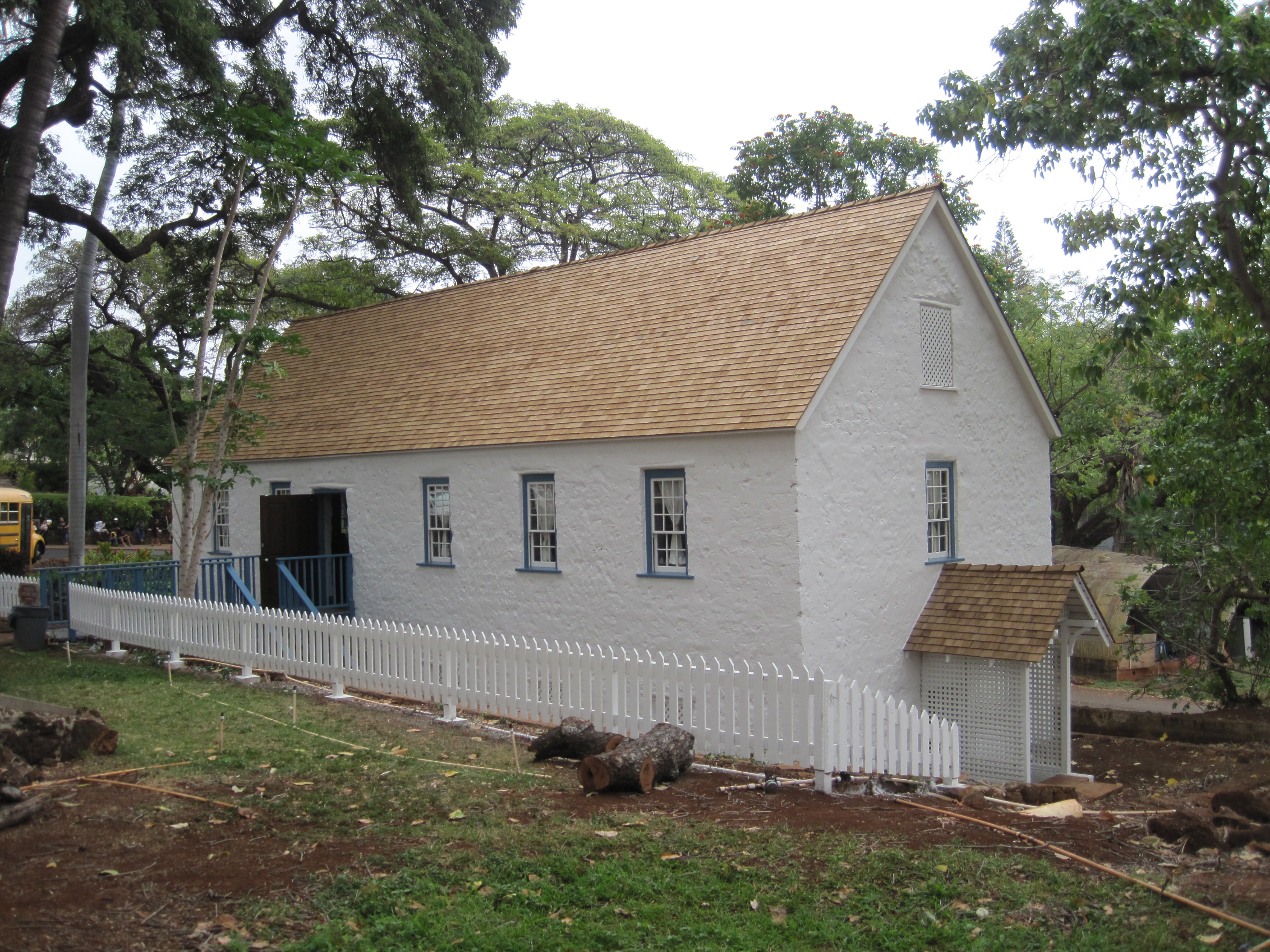
On the Lahainaluna campus sits Hale Pai -- the "house of printing" -- a small coral and timber building that, starting in 1834, housed Hawaii's first printing press. English and Hawaiian language Bibles, books, and newspapers rolled off that press, including the first newspaper printed west of the Rocky Mountains. In 1843, Hawaii's first paper currency was printed here, bearing a hand-drawn map of the islands and denominated in "dala." The following year, a student was expelled for counterfeiting, prompting the government to re-issue all paper money with secret marks. It is the kind of detail that makes Lahainaluna's history feel less like a textbook and more like a novel. Hale Pai was listed on the National Register of Historic Places in 1976 and now serves as a museum maintained by the Lahaina Restoration Foundation.
Boarding Life on the Hill
Lahainaluna remains one of the very few public boarding schools in the United States. Students from Maui's outer islands and remote communities live in two dormitories -- David Malo Dormitory for boys and Hoapili Dormitory for girls -- and work 18 hours per week in exchange for room and board. They maintain the grounds, tend farm animals, and prepare meals in the cafeteria. The boarding program, initially open only to males, went coed in 1980. It is a model that blends education with labor in a way that echoes the school's missionary origins, though the context has shifted. Today, the program serves students who might otherwise lack access to the educational opportunities available on Maui's west side.
Fire, Torches, and the Super Bowl
On graduation day, Lahainaluna alumni traditionally hike to the hillside "L" after dark and light torches along its outline, a constellation of fire that marks each class's passage from the school. The 2023 Maui wildfires brought a different kind of fire to Lahaina, destroying much of the town below the school. In February 2024, members and coaches of the Lahainaluna High School football team were honored at Super Bowl LVIII, participating in the pre-game coin toss in a moment that acknowledged both their community's devastation and its resilience. The school's alumni roster spans nearly two centuries: from David Malo and Timothy Ha'alilio, Class of 1835, to NFL defensive tackle Hercules Mata'afa, Class of 2014. What connects them is not just a diploma but a hillside, a letter carved into it, and the understanding that some traditions survive because people carry them uphill.
From the Air
Located at 20.889N, 156.659W on the hillside above Lahaina, west Maui. The whitewashed 'L' at the 2,000-foot mark on Pu'u Pa'u Pa'u is a distinctive visual landmark visible from the air and even from neighboring Molokai. The school campus sits above the Lahaina wildfire zone. Nearest major airport is Kahului Airport (PHOG), approximately 22 nm east. Kapalua Airport (PHJH) is about 8 nm northwest. The West Maui Mountains provide dramatic terrain behind the school.