Lake Ashi
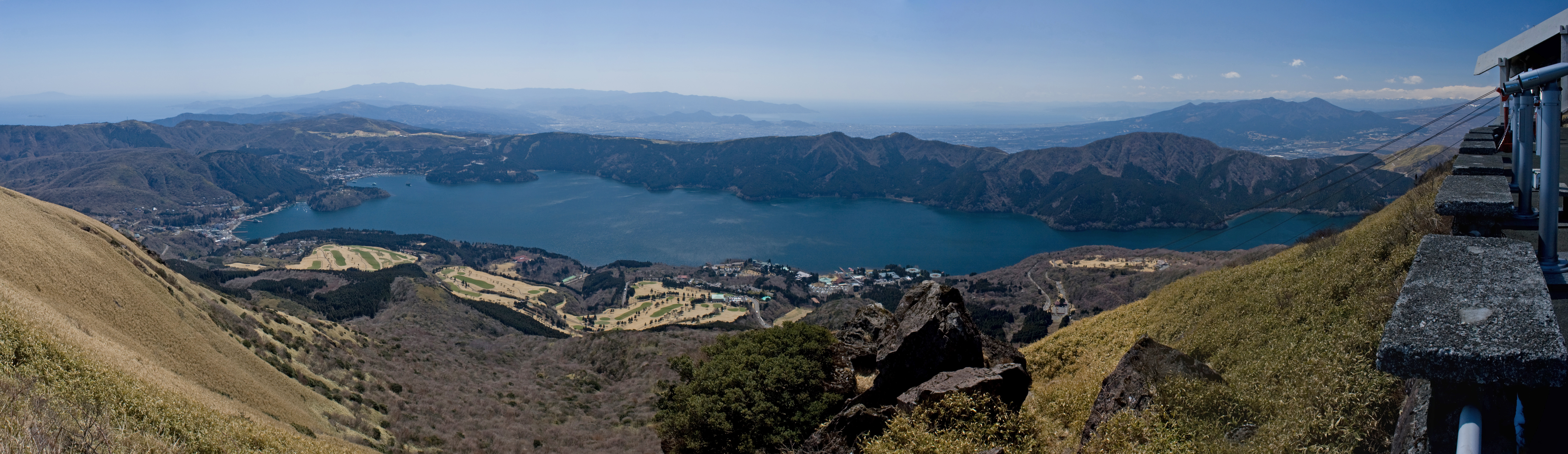
The name means 'lake of reeds,' from the Japanese ashi and ko, but the first thing you notice is not the reeds. It is the volcano. Lake Ashi fills part of the caldera of Mount Hakone, a complex volcano whose overlapping craters span roughly 10 by 11 kilometers. About 3,000 years ago, a phreatic explosion triggered the collapse of the northwest face of Mount Kamiyama. The resulting avalanche of rock debris dammed the Hayakawa River valley, and the water pooled behind the natural dam, slowly filling what is now one of Japan's most photographed landscapes. On still mornings, Mount Fuji floats perfectly reflected on the lake's surface, and a vermillion torii gate rises from the shallows as if marking the entrance to another world.
Born from Catastrophe
Mount Hakone is a complex volcano truncated by two overlapping calderas formed during major explosive eruptions roughly 180,000 and 49,000 to 60,000 years ago. The lake itself is much younger. When Kamiyama's flank collapsed around 3,000 years ago, the debris avalanche flowed down into the Sengokuhara area and created a natural dam near present-day Kojiri, blocking the Hayakawa River's path. Water accumulated behind this barrier, gradually forming the lake that now stretches along the southwestern wall of the caldera. The volcano's most recent phreatic eruptions occurred in the 12th to 13th centuries CE, and Owakudani, the steaming valley on the caldera's northern rim, is a constant reminder that this landscape is anything but finished. Sulfurous vents hiss through barren, yellow-stained ground, evidence that the geological forces that created Lake Ashi remain very much alive.
The Tokaido's Watery Mirror
Lake Ashi lies along the historic Tokaido road, the main route linking Kyoto and Tokyo during the centuries of Tokugawa rule. Travelers on this highway would have passed along the lake's shore, the same views of water and mountain that today draw millions of visitors annually. Hakone Shrine, founded in 757 CE, has watched over these shores for more than twelve centuries. Shoguns, samurai, and ordinary pilgrims have all made their way to its forested precincts, where Japanese cedar trees, some over 800 years old, shade the stone paths. The shrine's lakeside torii gate, erected in 1952, has become one of the most iconic images in Japanese tourism, its red columns reflected in the dark water with Fuji hovering in the background. Onshi Park, established in 1886 as a summer retreat for the imperial family, now welcomes the public to its lakeside grounds.
Pirates on the Caldera
Since 1950, the Hakone Sightseeing Cruise has operated on Lake Ashi, and its vessels are anything but subtle. Three ships, the Lake Ashi Queen, Royale II, and Victory, are elaborately decorated to resemble pirate galleons, each carrying at least 500 passengers on a counterclockwise loop between Togendai on the north shore and Moto-Hakone and Hakone-Machi ports on the south. The full loop takes about 90 minutes, with a single crossing running roughly 30 minutes. These pirate ships are part of an interconnected transportation network operated by the Odakyu Hakone Company. At Togendai, passengers transfer to the Hakone Ropeway, an aerial gondola that climbs over the volcanic landscape of Owakudani before descending to Sounzan. From there, the Hakone Tozan Cable Car funicular connects to Japan's oldest mountain railway, the Hakone Tozan Line, which switchbacks down to Odawara and onward rail connections to Tokyo.
Water Flowing the Wrong Way
Lake Ashi holds a quiet engineering curiosity. Geographically, its water should drain eastward via the Haya River toward Odawara and the Pacific coast. Instead, since 1670, the lake has been diverted westward through the Fukara Aqueduct toward Susono in Shizuoka Prefecture. This 17th-century intervention redirected the lake's natural outflow, and the system has been operating for more than 350 years. The surrounding mountains offer hikers dozens of trails of varying difficulty, and the northern end of the lake hosts a campsite for those who want to linger. When the summer mists clear and the autumn colors ignite the forested caldera walls, or when the January chill sharpens Fuji's outline against a blue sky, the view across this volcanic lake achieves the quality that Hokusai and Hiroshige captured in their woodblock prints centuries ago. The reeds that gave the lake its name still line stretches of the shore, whispering in the wind off the water.
From the Air
Lake Ashi is located at 35.21N, 139.00E within the caldera of Mount Hakone in Kanagawa Prefecture. The lake is a prominent dark-water feature surrounded by the forested ridges of the volcanic caldera, clearly visible from altitude. Mount Fuji rises prominently to the northwest. The Owakudani volcanic area with its steam vents is visible on the northern caldera rim. Recommended viewing altitude: 3,000-5,000 feet for full caldera and lake context. Nearest airports: RJTT (Tokyo Haneda, 80 km NE), RJTO (Oshima, 65 km SE). The Odawara coastal plain to the east and Sagami Bay provide clear approach references.