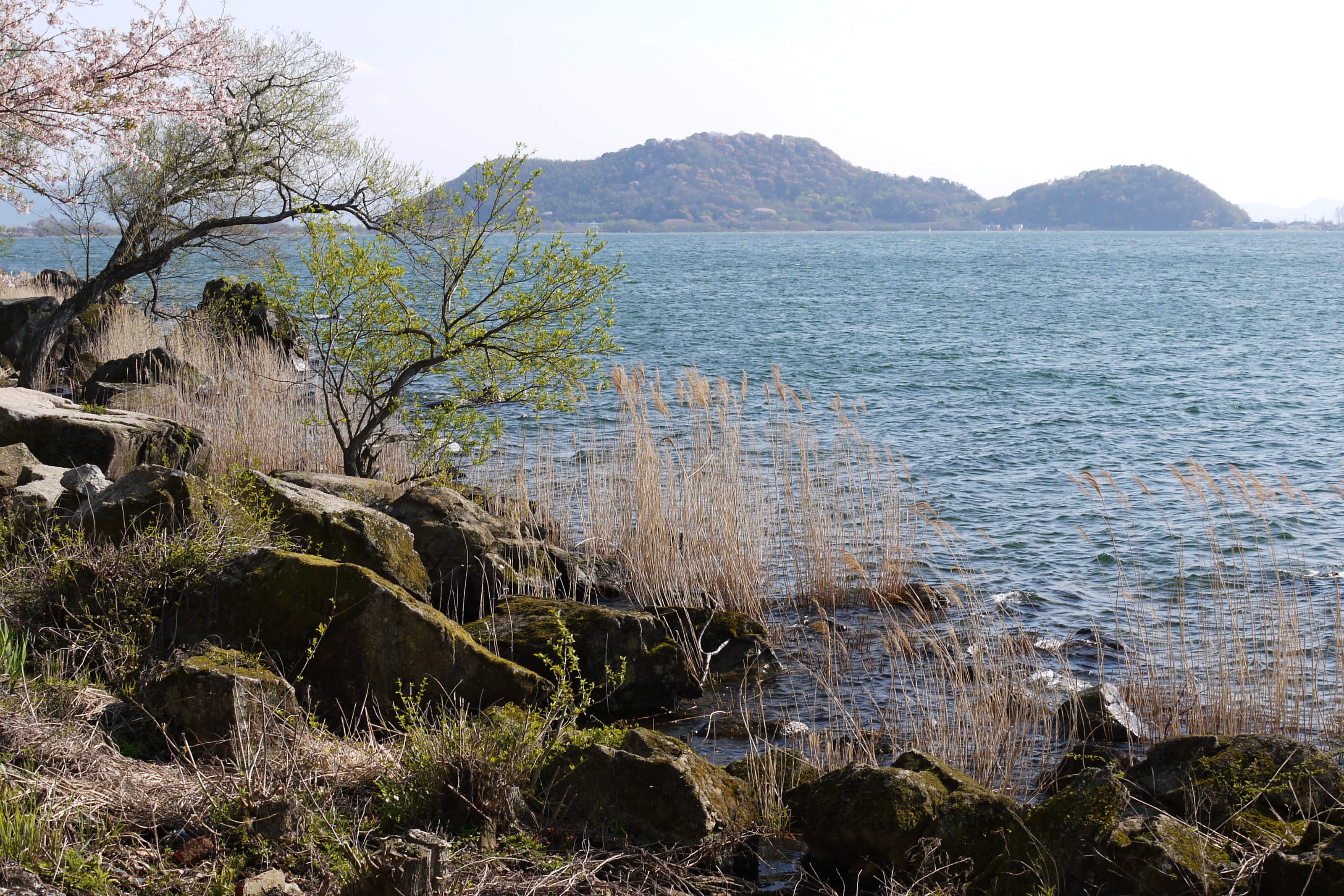
Lake Biwa: Japan's Ancient Inland Sea
In 1960, Chicago Mayor Richard J. Daley presented a gift of live bluegill sunfish to Crown Prince Akihito during a visit to the United States. The prince, a devoted ichthyologist, brought them home to Japan, where they were eventually released into lakes as game fish. The bluegills thrived. They devoured everything. Decades later, Lake Biwa -- a body of water older than most mountain ranges, four million years in the making, home to over a thousand documented species including sixty found nowhere else on Earth -- counts the bluegill and the black bass among the most serious threats to its ancient ecosystem. It is a peculiar modern footnote to a lake that has shaped Japanese civilization since before recorded history, a body of water so central to the culture that a fourteenth-century monk explained its very name as a gift from the gods.
The Goddess and Her Instrument
The lake earned its name during the Edo period, and the most enduring explanation is poetic: its elongated shape resembles the biwa, a four-stringed Japanese lute. The two even share the same kanji characters. A fourteenth-century monk named Koso, a scholar at the great Tendai monastery of Enryaku-ji on nearby Mount Hiei, offered a deeper reading. He wrote that the lake was the Pure Land of the goddess Benzaiten, who dwells on Chikubu Island in the lake's northern waters. The shape of the lake mirrors her favorite instrument, he said, because the lake itself is an offering. Before the Edo period, the lake was called by older names tied to the ancient province of Omi -- the 'near waters' as seen from the capital at Kyoto, in contrast to the 'far waters' of Lake Hamana to the east.
Four Million Years of Deep Time
Lake Biwa is one of the oldest lakes on Earth. Formed by tectonic activity at least four million years ago, during the mid-Pliocene epoch, it belongs to a small club of ancient lakes -- alongside Baikal, Tanganyika, and a handful of others -- where uninterrupted existence has allowed ecosystems to evolve in near-isolation over geological timescales. Naturalists have catalogued more than a thousand species and subspecies within its waters, including eleven species and five subspecies that are endemic or near-endemic -- creatures found in Lake Biwa and nowhere else. The largest predatory fish in the lake, the Biwa catfish, is itself an endemic species. This extraordinary biodiversity is the product of four million years of patient evolution in a stable, deep freshwater environment, sheltered by the mountains of Shiga Prefecture from the upheavals that drained and reshaped lesser lakes.
The Canal That Saved Kyoto
When Japan's capital moved from Kyoto to Tokyo in 1868, Kyoto's economy collapsed. The ancient city needed reinvention. The answer came from Lake Biwa. The Lake Biwa Canal, constructed in the late 1890s and expanded during the Taisho era, channeled the lake's waters westward through a tunnel beneath the mountains, delivering hydroelectric power and transportation to the old capital. The canal revived Kyoto's textile industries and powered its modernization. Today, the lake serves as a reservoir for both Kyoto and the city of Otsu, and its waters supply drinking water to approximately fifteen million people across the Kansai region. Small rivers drain from the surrounding mountains into the lake, and its single outlet -- the Seta River -- flows south to become the Uji, then joins the Katsura and Kizu to form the Yodo River, which empties into the Seto Inland Sea at Osaka Bay. Lake Biwa feeds an entire civilization's plumbing.
Invaders in the Water
The ancient ecosystem is under modern assault. Black bass were introduced to Lake Biwa in 1925 as a sport fishing attraction, and the bluegills that arrived via Prince Akihito's Chicago gift joined them decades later. Both species are voracious predators that have devastated native fish populations. In July 2009, the scale of the bass population was illustrated dramatically when angler Manabu Kurita pulled a largemouth bass weighing 10.12 kilograms from Lake Biwa's waters -- tying a world record that had stood for seventy-seven years, held by George Perry. The International Game Fish Association certified the catch. That a world-record largemouth bass could grow to such size in a Japanese lake underscored just how thoroughly the invasive species had colonized Biwa's productive waters, feeding on the endemic species that had evolved in isolation for millions of years.
Beaches, Marathons, and the View from Above
The lake stretches across the heart of Shiga Prefecture, its surface area making it the dominant geographic feature of the region. Popular beaches line the northwestern shore, particularly at Shiga and Omi-Maiko. The Mizunomori Water Botanical Garden and the Lake Biwa Museum in Kusatsu draw visitors to the southern end. For sixty years, the Lake Biwa Marathon followed the shore at Otsu, running annually from 1962 until its final edition in 2021. From altitude, the lake is unmistakable -- a vast blue expanse shaped unmistakably like the lute that gives it its name, cradled by mountains on three sides, with the urban sprawl of Otsu and the distant rooflines of Kyoto visible beyond the western shore. Hikone Castle stands on a hill along the eastern edge, and the sacred island of Chikubu sits in the northern waters, still the home of Benzaiten in local belief, still shaped by the goddess's favorite song.
From the Air
Located at 35.255°N, 136.08°E, Lake Biwa is the largest freshwater lake in Japan and dominates Shiga Prefecture. The lake is roughly 64 km long north-to-south and up to 22 km wide, making it unmistakable from any altitude. Its elongated lute shape is clearly visible from above. The western shore borders the mountains separating it from Kyoto. Hikone Castle is visible on the eastern shore. Chikubu Island sits in the northern section. Major airports include Chubu Centrair International (RJGG) approximately 60 nm southeast and Osaka Itami (RJOO) approximately 40 nm southwest. The lake itself serves as an excellent visual navigation reference for the entire Kansai region.