Lake Biwa Museum: Four Million Years Under One Roof
The giant catfish drifts through green water behind glass thick enough to hold back a small sea. Silurus biwaensis -- the Lake Biwa catfish, found nowhere else on Earth -- can grow over a meter long and weigh more than thirty kilograms. It is the largest native species in the lake that sprawls outside the museum windows, and it has been swimming these waters for longer than most civilizations have existed. Lake Biwa is over four million years old, one of roughly twenty ancient lakes on the planet, and the Lake Biwa Museum sits on its southeastern shore in Kusatsu, Shiga Prefecture, dedicated to one deceptively simple question: what happens when a lake and the people around it share the same home for millennia?
An Ancient Lake's Living Archive
Founded in 1996, the Lake Biwa Museum approaches its subject from every angle at once. Gallery A walks visitors through geological time -- the tectonic forces that created the lake basin in the mid-Pliocene, the shifting shorelines, the volcanic ash layers that mark epochs. Gallery B shifts to human history and folklore, tracing the communities that fished, farmed, and traded along these shores for centuries. Gallery C confronts the present: ecology, pollution, invasive species, the tension between a modern prefecture of over a million people and a body of water that sustains them. A discovery room invites children to touch and explore. Outside, the museum grounds extend to the lakeshore itself, turning the landscape into a final exhibit. The institution holds accreditation as a Registered Museum from Japan's Ministry of Education, Culture, Sports, Science and Technology, and its aquarium is a member of the Japanese Association of Zoos and Aquariums.
A Thousand Species in One Basin
Lake Biwa's age has made it a laboratory of evolution. Over four million uninterrupted years, the lake has accumulated more than a thousand documented species and subspecies, roughly sixty of which are endemic -- found here and nowhere else. The freshwater aquarium inside the museum, one of the largest in Japan, puts this biodiversity on display. Visitors walk through a tunnel tank built in 2016, surrounded by the same water that harbors endemic fish, snails, and clams. The mollusk diversity alone is remarkable: thirty-eight species of freshwater snails and sixteen bivalves, with more than half found only in Biwa. But the lake's ecosystem is under pressure. Largemouth bass and bluegill, introduced from the United States, now threaten native populations, and sixty percent of the lake's endemic taxa are classified as endangered or vulnerable. The museum does not shy away from this reality. Its exhibits frame conservation not as an abstract cause but as a local responsibility.
The Boat That Sailed a Freshwater Sea
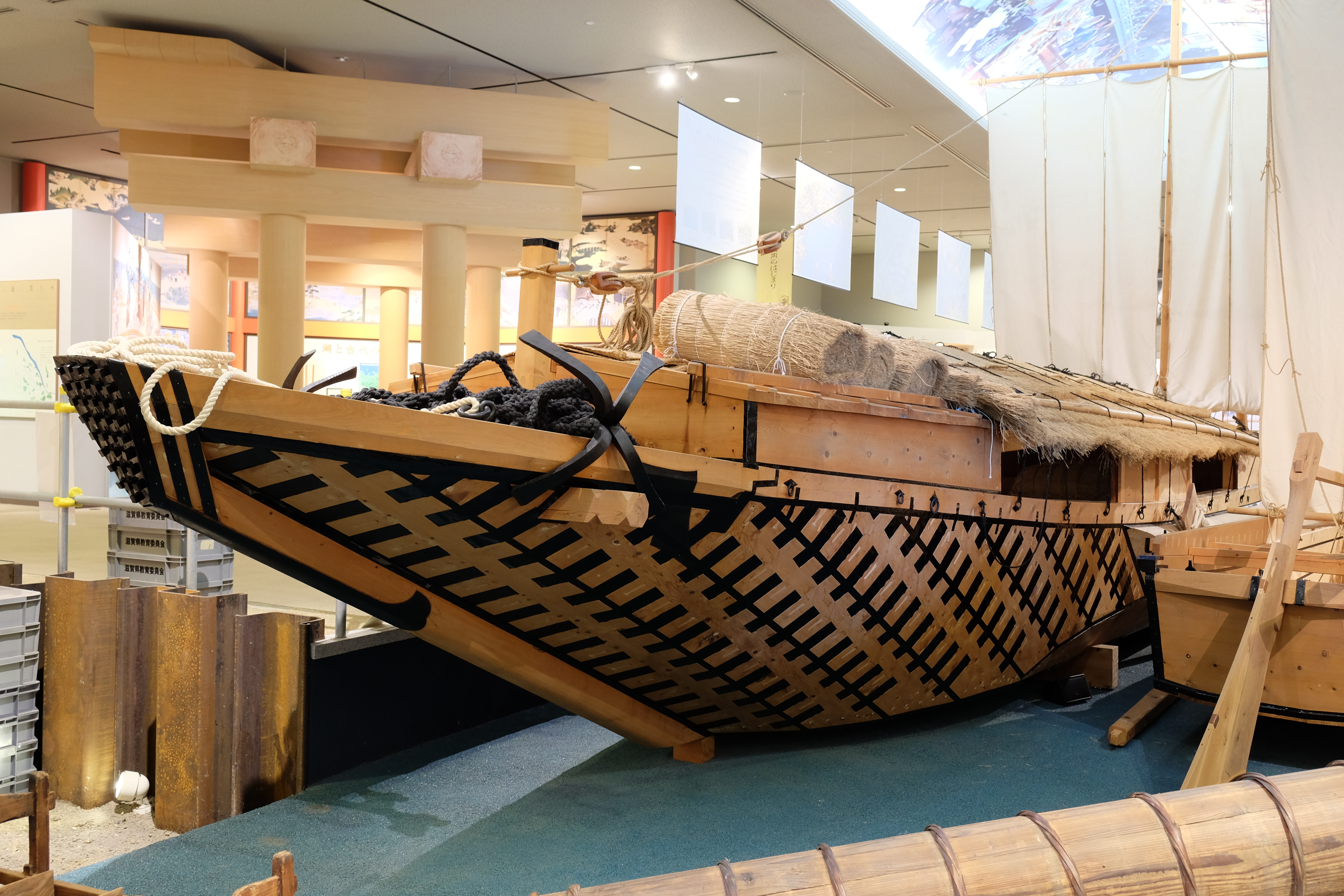
In the museum's main hall, a full-scale replica of a Maruko-bune commands attention. These broad-hulled wooden sailing vessels once carried rice, charcoal, and goods across Lake Biwa when it functioned as the region's primary highway. During the seventeenth and eighteenth centuries, over a thousand Maruko-bune traversed the lake at any given time, connecting the towns along its roughly 235-kilometer shoreline. The boats were vital to commerce in Omi Province, linking communities that would otherwise have faced arduous overland journeys through mountainous terrain. Standing beside the replica, visitors can appreciate the scale of the craft and the ingenuity of its construction -- a flat-bottomed design built for shallow harbors and open-water crossings alike. The boat is a reminder that Lake Biwa was never just scenery. It was infrastructure, economy, and the organizing principle around which an entire region built its life.
A Museum That Points You Back Outside
The Lake Biwa Museum was built on a philosophy its founders made explicit: it should be an invitation to the field, not a replacement for it. The museum's stated purpose -- to deepen understanding of the relationship between the lake and people -- reflects a Japanese concept of coexistence that runs deeper than environmental messaging. An actual private house from Hikone City, the Tomie family home, has been relocated inside Gallery C, faithfully reproducing daily life as it looked around 1964, down to the electrical appliances and household goods. It is an exhibit about how ordinary people lived alongside the lake, not about the lake in isolation. The museum sits where the urban edge of Kusatsu meets the water, accessible from JR Kusatsu Station. From the museum windows, visitors look out across the surface of a lake that has persisted through ice ages, volcanic upheaval, and the rise and fall of empires. The catfish still swim. The water still holds.
From the Air
Located at 35.07°N, 135.93°E on the southeastern shore of Lake Biwa in Kusatsu, Shiga Prefecture. From altitude, Lake Biwa dominates the landscape as Japan's largest freshwater lake, roughly 64 km long and up to 22 km wide, shaped like a narrow hourglass. The museum sits along the southern shore near the lake's narrowest point. Best viewed at 3,000-5,000 feet AGL to appreciate the lake's scale and the museum's waterfront position. Nearest major airports: Kansai International Airport (RJBB) approximately 70 nm southwest, Osaka Itami Airport (RJOO) approximately 40 nm southwest. The lake's distinctive shape and surrounding mountains make it easily identifiable from cruising altitude.