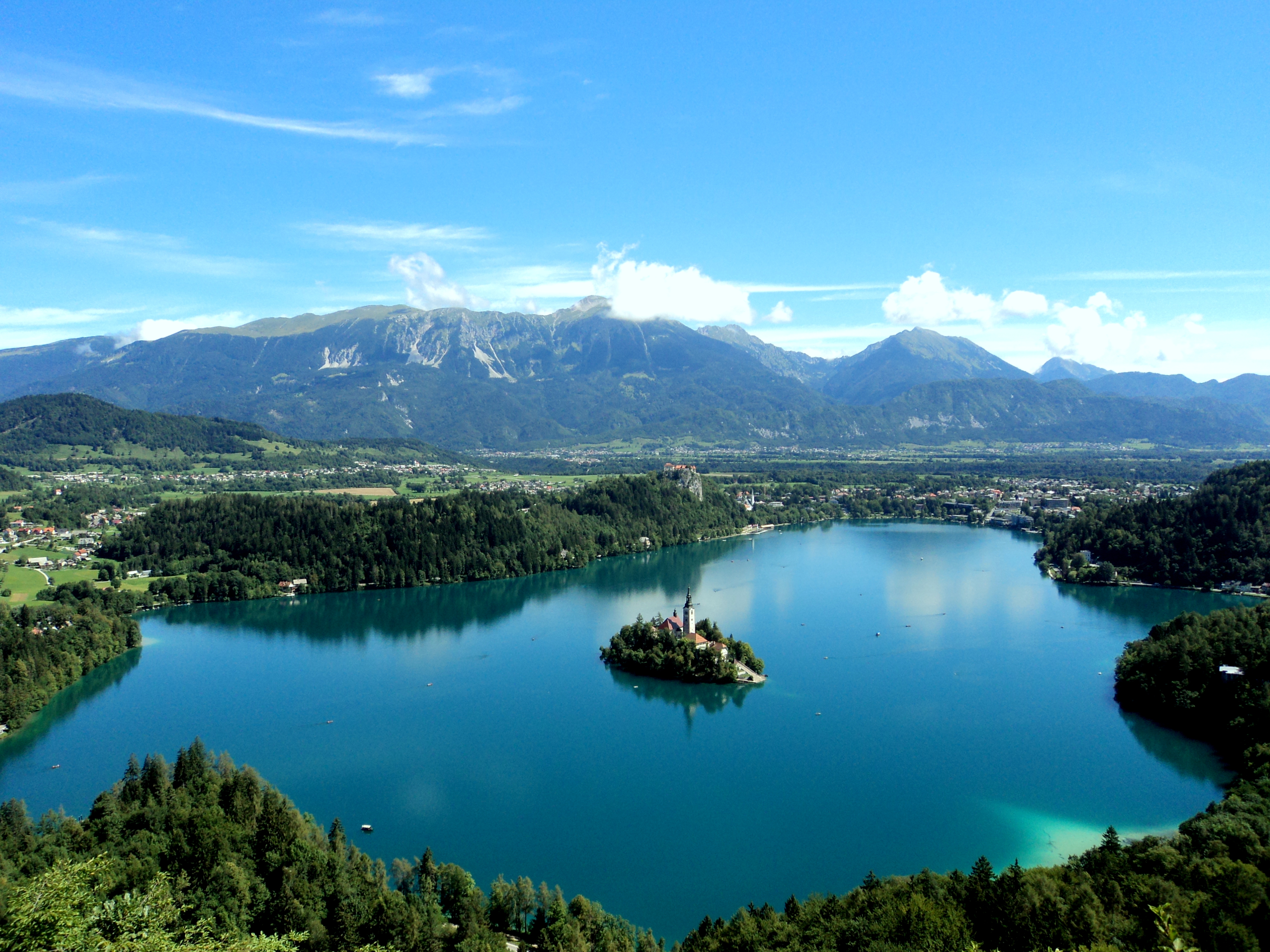
Lake Bled
In 1740, Empress Maria Theresa of Austria granted 22 local families the exclusive right to ferry religious pilgrims across a small alpine lake to a church on its island. Nearly three centuries later, the profession is still restricted. Many of the oarsmen who stand at the sterns of the brightly canopied pletna boats, propelling them with a technique called stehruder -- standing rowing, using two oars -- descend directly from those original families. The lake is Bled, and its traditions have a way of outlasting the empires that created them.
Ice, Stone, and Bronze
Lake Bled sits at the foot of the Julian Alps in northwestern Slovenia, 2,120 meters long, 1,380 meters wide, and 29.5 meters at its deepest point. Glaciers and tectonic forces created it, leaving behind a basin of startling clarity surrounded by forested mountains. But the lake was significant to humans long before anyone understood its geology. During the Bronze Age, it served as an important cult center. Gold appliques dating to the 13th or 12th century BC have been found along its shores, their embossed decorations thought to represent solar and lunar cycles. Similar artifacts have turned up in Switzerland, Bavaria, and Hungary, typically in fortified settlements or the graves of wealthy women -- evidence of a trade and belief network that stretched across prehistoric Europe, with Bled as one of its nodes.
The Island and Its Ninety-Nine Steps
Bled Island -- Blejski otok -- is the lake's centerpiece and Slovenia's only natural island. The main structure is the pilgrimage Church of the Assumption of Mary, built in its current form near the end of the 17th century. Gothic frescoes from around 1470 survive in the chancel, layered beneath rich Baroque furnishings added later. A Baroque staircase from 1655 leads up 99 stone steps to the entrance. Tradition holds that a groom must carry his bride up every one of those steps on their wedding day, then ring the church bell and make a wish inside. The tradition draws couples from across Europe. What the tradition does not mention is the climb back down.
Boats Built by Hand, Rowed While Standing
The pletna -- the word borrowed from Bavarian German Platten, meaning flat-bottomed boat -- may have plied these waters as early as 1150, though most historians place the first boats around 1590. Each pletna seats 20 passengers and is still constructed by hand, recognizable by its colorful awning and distinctive silhouette. The standing-rowing technique that pletna oarsmen use resembles Venetian gondola practice, though the boats themselves are broader and sturdier, built for alpine water rather than canal traffic. Since Maria Theresa's 1740 decree, the right to operate these boats has remained within a restricted group of families, a hereditary profession that functions as both living tradition and tourist attraction. The oarsmen know the lake's moods -- its sudden squalls off the Julian Alps, the way morning fog pools in the basin before the sun burns it away.
A Castle, a Cream Cake, and a Rowing Course
Bled Castle perches on a cliff above the lake's north shore, one of Slovenia's oldest fortifications. Emperor Henry II of the Holy Roman Empire established it as an estate in 1004 -- a gesture that suggests even a thousand years ago, Bled's beauty was worth claiming. The castle is now a museum with views that justify the entrance fee on their own. Below, the lake has hosted the World Rowing Championships four times: in 1966, 1979, 1989, and 2011, its calm surface and consistent conditions making it one of Europe's premier rowing venues. And then there is the kremna rezina -- the Bled cream cake, a pastry of puff dough, vanilla custard, and whipped cream that the Slovenian government designated a protected dish of origin in 2016. The current recipe dates to 1953, created by Istvan Lukacevic at the Hotel Park's patisserie, which has produced an estimated 12 million of them in the decades since. Lake Bled is 35 kilometers from Ljubljana Joze Pucnik Airport and 55 kilometers from the capital. It is easy to reach and, by local consensus, almost impossible to leave without ordering at least one slice.
From the Air
Located at 46.364N, 14.095E in the Julian Alps of northwestern Slovenia. The lake is a vivid blue-green oval visible from cruising altitude, with Bled Island and its church clearly distinguishable from lower approaches. Bled Castle is on the cliff on the north shore. Best viewed from 3,000-5,000 feet AGL, approaching from the south or east for the classic island-and-castle composition. Nearest airport: Ljubljana Joze Pucnik Airport (LJLJ), approximately 20 nm southeast. The Karavanke mountain range rises to the north along the Austrian border.