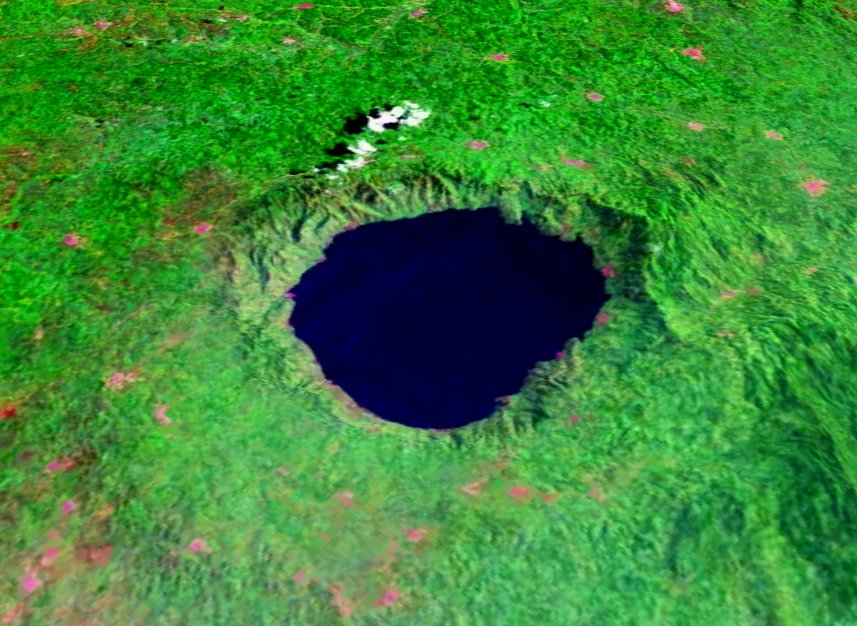
Lake Bosumtwi
A million years ago, an asteroid slammed into the rainforest of what is now southern Ghana, and the wound never healed. It filled with water instead. Lake Bosumtwi -- also spelled Bosomtwe -- sits inside a near-perfect impact crater 10.5 kilometers across, a circle of forested hills surrounding a disc of still, dark water that the Ashanti people have considered sacred for as long as memory reaches. It is Ghana's only natural lake, one of only six meteorite-formed lakes on Earth, and a place where deep time and living culture share the same shoreline.
Written in Stone and Glass
The impactor arrived from the middle main asteroid belt at a steep angle, striking with enough force to excavate a crater 380 meters deep -- or 750 meters if you include the sediment that has slowly filled the basin over a million years. The collision scattered tektites, glassy beads of melted rock, as far as neighboring Ivory Coast, and microtektites have been recovered from deep-sea sediments in the Atlantic west of the African continent. Shatter cones -- cone-shaped fracture patterns that form only under the extreme pressures of hypervelocity impact -- lie embedded in the crater walls, though dense tropical vegetation makes them difficult to study. In 2004, an international drilling project bored into the central uplift beneath the lake floor, recovering an abundance of shocked quartz and other materials that confirmed the crater's violent origins beyond any remaining doubt.
Where Spirits Say Goodbye
For the Ashanti, Bosumtwi is far more than a geological curiosity. Traditional belief holds that the souls of the dead travel here to bid farewell to Asase Ya, the Earth goddess, before passing on. This spiritual significance shapes how people interact with the lake. Fishing is permitted, but only from wooden planks -- not boats -- a restriction rooted in reverence rather than regulation. The lake harbors its own endemic species, including the cichlid Hemichromis frempongi, found nowhere else on Earth, and the near-endemic Tilapia busumana and Tilapia discolor. For generations, the crater has served as a site for rituals and ceremonies, its forested rim forming a natural amphitheater that separates the sacred interior from the surrounding landscape.
A Climate Archive in the Mud
Because the lake has no outflow -- all water leaves only through evaporation and seepage -- its sediments preserve an unusually detailed record of West African climate over the past million years. During wet periods, the lake rose until it spilled over the crater's lowest rim, and fossils of fish found on the surrounding hilltops testify to these ancient high-water marks. During dry spells, the water shrank until the rainforest reclaimed the basin floor and the lake became little more than a pond. Paleoclimate records and Ashanti oral tradition converge on one such dry period that ended roughly 300 years ago. The lake's sediment cores, recovered during the 2004 International Continental Scientific Drilling Program expedition, have become a key resource for understanding how Atlantic Ocean temperatures drive rainfall patterns across the Sahel and the Guinea coast.
A Rare Treasure Under Pressure
Lake Bosumtwi is one of only 190 confirmed impact craters worldwide, and among the best-preserved young complex impact structures on the planet. It lies about 30 kilometers southeast of Kumasi, the Ashanti capital, close enough for day trips but remote enough that dense forest still blankets much of the crater rim. Tourism is growing -- the lake is increasingly popular for swimming, canoeing, and hiking -- but so are pressures from agriculture and settlement encroaching on the forested slopes. Scientists and conservation advocates have argued that the crater deserves formal protection as a geoheritage site, a place where a catastrophic moment from deep time produced something beautiful, ecologically unique, and spiritually irreplaceable.
From the Air
Located at 6.51 degrees N, 1.41 degrees W in the Ashanti Region of Ghana, approximately 30 km southeast of Kumasi. The nearly circular crater is dramatically visible from the air -- a dark disc of water ringed by forested hills rising 200-300 meters above the lake surface. Best viewed from 5,000-8,000 feet for full crater perspective. Nearest airport is Kumasi (DGSI), about 30 km to the northwest.