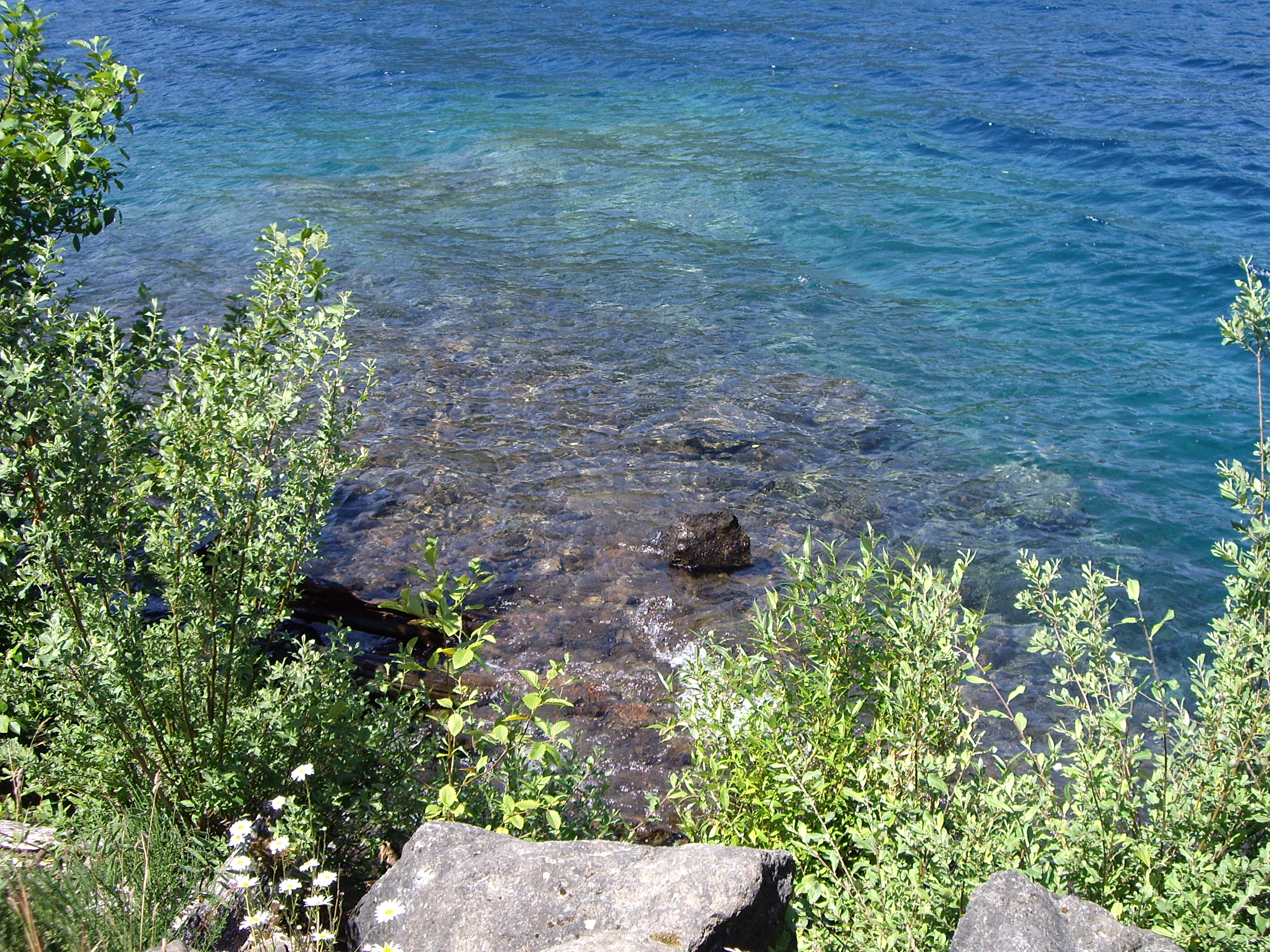
Lake Crescent
In 1937, fishermen on Lake Crescent hauled in something that was not a fish. The body of Hallie Illingworth, a waitress who had disappeared three years earlier, floated to the surface after the ropes weighting her down finally decayed. The near-freezing water had preserved her so completely that her skin had transformed into a waxy substance resembling ivory soap, a chemical process called saponification caused by lake minerals interacting with body fat. Her husband Monty was convicted of her murder. The lake that held his secret for three years would eventually yield another: in 2002, a 1927 Chevrolet belonging to Russell and Blanch Warren, who vanished while driving near the lake in 1929, was found more than 160 feet beneath the surface.
Born from a Landslide
Lake Crescent owes its existence to catastrophe. Glaciers carved the valley during the last Ice Age, and the lake originally drained through Indian Creek into the Elwha River. Approximately 8,000 years ago, a massive landslide from the Olympic Mountains dammed Indian Creek, and the deep valley filled with water. Many geologists believe that Lake Crescent and nearby Lake Sutherland were once a single body of water, separated by the same landslide. The Klallam people have their own explanation: Mount Storm King, angered by warring tribes, threw a boulder that split the lake in two. From the summit of Pyramid Mountain, the evidence of the landslide is plainly visible. Eventually, the trapped water found an alternative outlet, spilling into the Lyre River and over Lyre River Falls into the Strait of Juan de Fuca.
Water the Color of Sapphires
Lake Crescent's brilliant blue water and exceptional clarity are not the result of depth alone, though at an official maximum of 624 feet it is the second deepest lake in Washington state after Lake Chelan. The clarity comes from low nitrogen levels that inhibit algae growth, leaving the water so transparent it seems illuminated from within. The 624-foot figure became official almost by accident: during a 1970 survey by Peninsula College fisheries students, their instruments simply could not measure deeper. When power cables were laid in the 1980s, readings exceeded 1,000 feet, but a comprehensive bathymetric survey in 2013-2014 by scientists Eian Ray and Jeff Enge, using over 5,000 depth soundings, found the deepest point at 596 feet and estimated the lake holds approximately half a cubic mile of freshwater. The earlier 1,000-foot readings were likely sonar echoes bouncing off the steep underwater cliff faces that line much of the shoreline.
Trapped Fish, New Species
When the landslide sealed Lake Crescent from the Elwha River system, the anadromous fish already living in the valley became landlocked. They could not ascend Lyre River Falls to reach the sea, and the sea could not reach them. Over thousands of years of isolation, two distinct subspecies evolved within the lake: the Beardslee trout, a relative of rainbow trout that spawns in the Lyre River above the falls, and the Crescenti cutthroat trout, which spawns in Barnes Creek. Both are endemic to Lake Crescent, found nowhere else on Earth. Their existence is a textbook case of speciation driven by geographic isolation, the same process that produced Darwin's finches, happening here in a single lake on the Olympic Peninsula.
Megatsunamis and Naming Rights
The lake's violent geological history did not end with its creation. Scientists have found evidence of four massive landslides entering the lake between roughly 5,200 BCE and 1,100 BCE. The most dramatic, around 1,100 BCE, was triggered by an earthquake that sent 7.2 million cubic meters of rock cascading from Mount Storm King into waters at least 460 feet deep. The resulting megatsunami reached an estimated maximum run-up height of 82 metres (about 270 feet). Whether the lake was named for its crescent shape or for nearby Crescent Bay, named by Captain Henry Kellett in 1846, remains uncertain. British-Canadian fur trappers John Sutherland and John Everett discovered the lake in 1849, and it was known variously as Big Lake, Elk Lake, and Everett Lake before a newspaper editor named M.J. Carrigan promoted the name Lake Crescent in 1890. The lake was folded into the Olympic Forest Reserve in 1897 and became part of Olympic National Park in 1938.
From the Air
Located at 48.06N, 123.83W, approximately 17 miles west of Port Angeles on US-101. Lake Crescent is a prominent crescent-shaped blue water body clearly visible from altitude, surrounded by Olympic Mountains including Mount Storm King. Nearest airport is William R. Fairchild International Airport (KCLM) in Port Angeles. US-101 runs along the lake's south shore. Best viewed at 4,000-6,000 ft AGL to appreciate the lake's full crescent shape and the surrounding mountain terrain.