Lake Edward Sanatorium
In 1904, there was no road to Lake Edward. No electricity. No telephone. The nearest city lay 179 kilometers away by rail. Into this isolation, Sir Richard Turner -- sawmill owner, steamboat operator, and fishing camp proprietor -- invited three tuberculosis patients to convalesce in his house on a peninsula jutting into the 28-kilometer-long lake. The theory was simple: at 400 meters of altitude, surrounded by boreal forest, the air itself would heal. It was an era when fresh air and remoteness were the only prescriptions medicine could offer against the white plague. From those three patients and that lonely house grew a hospital complex that would employ over a hundred people, treat more than 225 patients at a time, and anchor the entire village of Lac-Edouard for the better part of a century.
Rails into the Wilderness
The Quebec and Lake St-John Railway reached Lake Edward in autumn 1886, building a station with a telegraph office, dormitory, shunting yard, water tower, coal shed, and a semicircular repair shop called the Rotonde, whose six service doors opened onto a large turntable for steam locomotives. The railway workers who built and serviced these facilities became the founding population of the village. The rail line also brought wealthy Americans, who rented vast tracts of forest from the Quebec government for hunting and fishing. By 1894, fourteen private sporting clubs operated along the railway corridor. The Triton Fish and Game Club opened in 1886. The Paradise Fin and Feather Club set up camps on Paradise Island in 1888 -- an island later purchased by the Ziegfeld family. A forest fire in 1903 ended the lumber operations that had kept the region commercially active, leaving Turner's fishing camp and sawmill as the area's primary enterprises.
A Hospital at the End of the Line
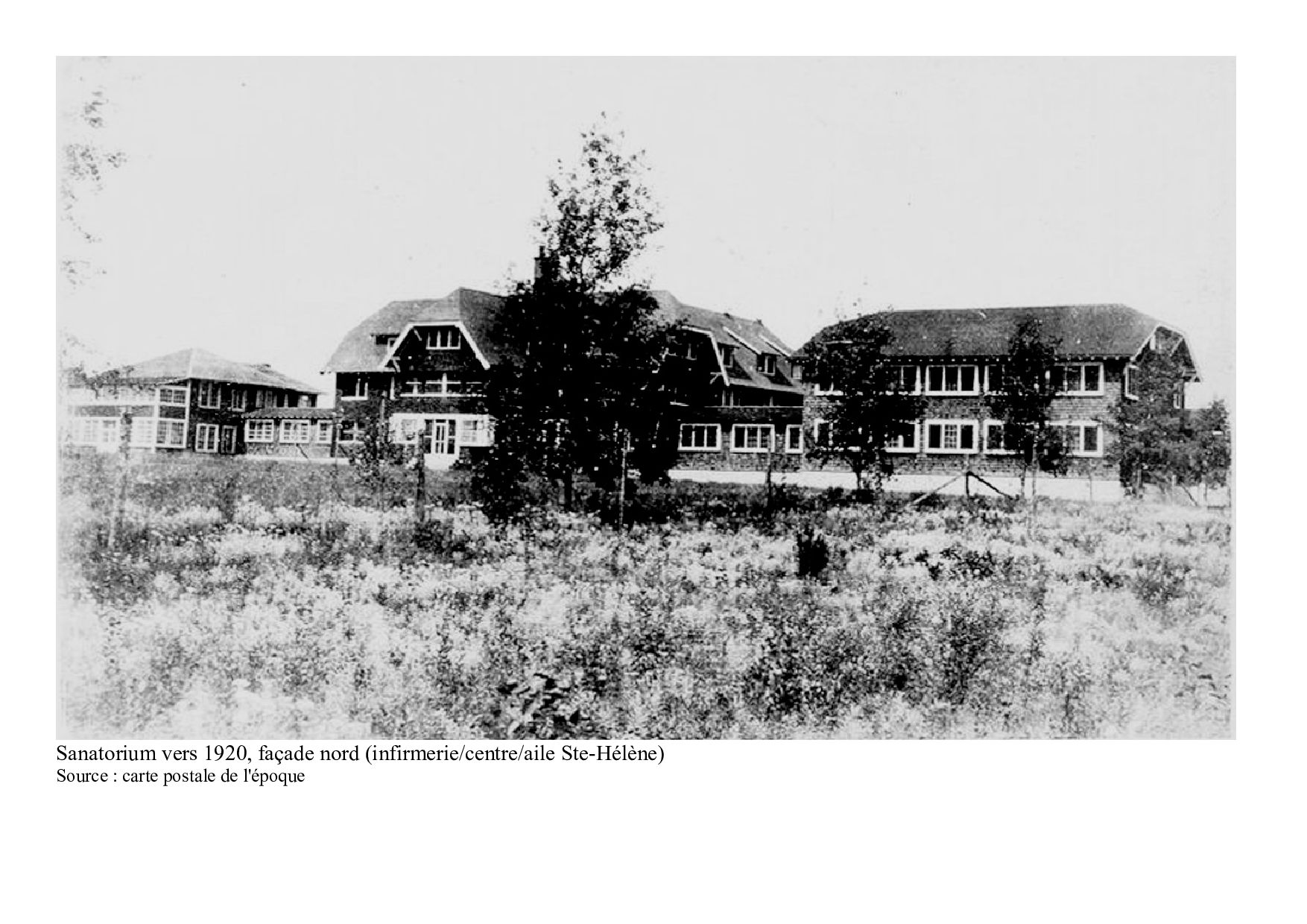
When Turner's house proved too small for the growing demand, he founded the Lake Edward Sanatorium Association in 1905 with wealthy friends. The Quebec government granted 137 acres of land, and construction began in 1908 at a cost of 26,000 Canadian dollars. The sanatorium opened in 1909 with capacity for 26 Anglo-Protestant patients, its main building measuring 87 by 25 feet with east and west wings. That same year, the directors agreed to accept French-Catholic patients, provided Protestants retained priority. During World War I, the Military Hospitals Commission took over the facility to treat soldiers suffering from tuberculosis or toxic gas exposure. An east annex for 75 male patients went up in 1916, a west annex in 1918. After the war, the Quebec provincial government purchased the entire complex for 60,000 dollars in 1921 and placed it under the administration of Laval Hospital.
Self-Sufficient and Snowbound
Running a hospital 179 kilometers from the nearest city demanded extraordinary self-reliance. A steam turbine drove a direct current generator that powered the complex until 1950, when diesel engines took over -- engines that also supplied electricity to the entire village until Hydro-Quebec extended its power lines in 1967. Water was pumped from the lake through a six-inch copper pipe. Concrete tunnels delivered steam heat to every building; between the nuns' villa and the main sanatorium, the tunnel was wide enough for staff to walk through during winters when temperatures dropped below minus forty. The bodies of deceased patients were returned to their families by train, sealed in watertight wooden boxes per railway regulations. The sanatorium published its own magazine, L'etoile du San -- San's Star -- which ran for 275 issues from 1936 until autumn 1963. A gravel road did not reach the village until 1961, and only in winter when the Bostonnais River froze solid enough to serve as a crossing.
The Cure Arrives, the Purpose Departs
In 1946, streptomycin became the first effective antibiotic against tuberculosis. The discovery should have emptied the sanatorium, but Lake Edward's hospital was the village's primary employer, and the institution continued treating TB patients until 1967. It then converted to a veterans' hospital and later a rehabilitation center for the physically handicapped. The center closed on January 23, 1980. Shortly after, a storm destroyed the roof of the Couillard wing -- the only brick building that had survived a devastating 1943 fire -- and the structure was abandoned. The provincial government created a vacation center on the grounds in 1981, reusing the wooden service buildings. It operated until 2004. In 2013, vandals burned down the nuns' villa. Most of the other buildings still stand on the peninsula, their windows dark, looking out over the same lake whose air was once believed to cure anything.
From the Air
Located at 47.65N, 72.29W in the Haute-Mauricie region of Quebec. The sanatorium complex sits on a peninsula on the northeast shore of Lake Edward, a 28-km-long lake at approximately 400 meters elevation. From altitude, the lake is the dominant feature, elongated north-south with dense boreal forest on all sides. The village of Lac-Edouard is at the southern tip of the lake. The former railway line (Quebec and Lake St-John Railway, later Canadian National) runs through the area. Route 155 connects to La Tuque, 58 km to the southwest. Nearest airport: La Tuque (CYLQ) approximately 58 km southwest. Quebec City Jean Lesage International (CYQB) approximately 295 km south. The area is remote with limited services. Expect boreal conditions: cold winters, short summers, with possible fog over the lake.