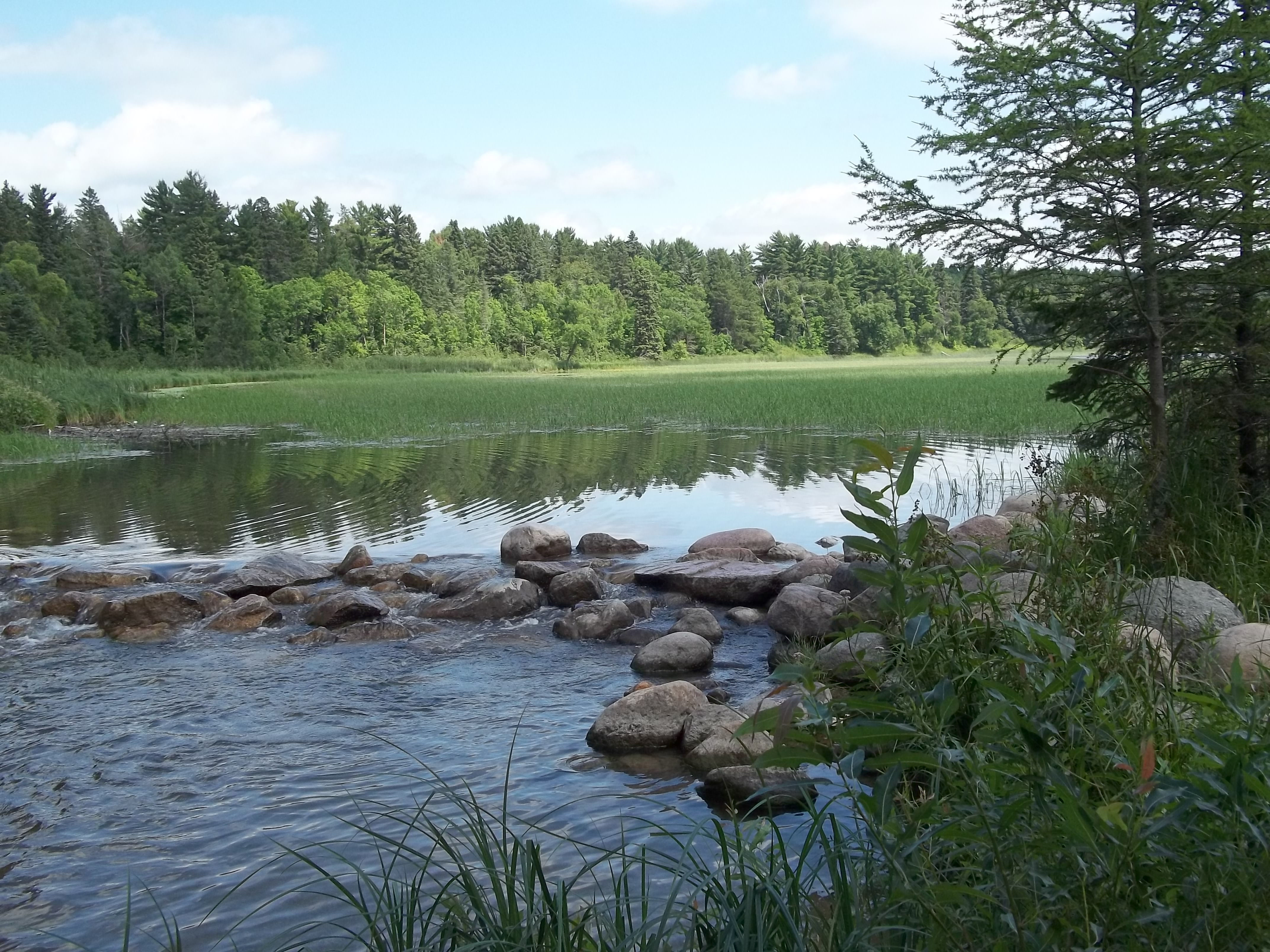
Lake Itasca
The name is a fraud -- a beautiful, enduring fraud. In 1832, explorer Henry Schoolcraft reached this small glacial lake in north-central Minnesota, guided by Ozawindib, an Ojibwe man who knew the waterways intimately. Schoolcraft wanted a name worthy of the moment: the discovery of the Mississippi River's source. He asked his missionary companion, William Boutwell, for a Latin phrase meaning 'true head.' Boutwell offered veritas caput. Schoolcraft then performed a bit of linguistic surgery, slicing out the middle letters to produce 'Itasca' -- a word that sounds vaguely indigenous but is entirely manufactured. The Ojibwe already had a perfectly good name: Omashkoozo-zaaga'igan, meaning Elk Lake. The French Canadians who explored before Schoolcraft called it Lac Labiche, Doe Lake. But Schoolcraft's invented name stuck, and Lake Itasca became the official birthplace of America's greatest river.
A Contested Birthplace
Lake Itasca is the primary source of the Mississippi River, which flows 2,340 miles from here to the Gulf of Mexico. But 'primary source' is not quite the same as 'true source,' and the distinction has fueled nearly two centuries of argument. Several tributaries feed the lake year-round. Nicollet Creek enters from a nearby spring. Another stream connects Itasca to Elk Lake, which itself is fed by two additional streams. By the standards modern geographers apply to rivers like the Nile and the Amazon -- tracing the longest continuous channel to its most distant trickle -- the actual source of the Mississippi lies somewhere upstream of the lake. Jacob V. Brower, the land surveyor who campaigned to protect the area in the 1880s, dismissed these feeder streams as 'too small' to count. Modern cartographers disagree. But the lake remains the ceremonial and symbolic headwaters, the place where tourists wade across the Mississippi and declare they have stood at the beginning of something vast.
The Channel They Manufactured
The iconic scene at the lake's north end -- shallow water flowing over stepping stones where visitors cross the infant Mississippi -- is not entirely natural. In the 1930s, the Civilian Conservation Corps bulldozed the outlet channel to create what they described as a 'more pleasant experience' for visitors. The project drained the surrounding swamp, dug a new channel, and installed man-made rock rapids. The rocks that tourists step across were placed there by design. In October 2020, the Minnesota DNR undertook restoration work on the channel, reshaping it to direct water away from an eroding shoreline. They stabilized the banks with boulders and native vegetation. The path of the stepping stones shifted, but the underlying dam -- the structure that defines the Mississippi's emergence from the lake -- remained unchanged. The headwaters are simultaneously one of America's most natural landmarks and one of its most carefully engineered.
Three Forests in One Place
Lake Itasca sits at an ecological triple point: the juncture of the Great Plains to the west, the Deciduous Forest to the south, and the Coniferous Forest to the north. This convergence makes the surrounding landscape unusually diverse for a single location, and it is one reason the University of Minnesota established its Itasca Biological Station and Laboratories on the lake's shore in 1909. The campus offers spring and summer field courses and supports year-round research. The region also holds roughly a quarter of Minnesota's remaining old-growth forest. Composer Ferde Grofe found the geography so striking that he opened his Mississippi Suite -- a popular orchestral work from 1926 -- with a movement depicting the river's birth at Lake Itasca and the Native peoples who lived along its shores. The music translates into sound what the landscape communicates through sight: something immense beginning in a place of extraordinary quiet.
Saved by a Single Vote
Jacob V. Brower arrived at Lake Itasca in the late 1880s to settle the long-running debate over the Mississippi's true source. What he found instead was an emergency. Loggers were stripping the tall pine forests around the lake, and the landscape that framed the headwaters was vanishing. Brower shifted from scientific inquiry to political advocacy, lobbying the Minnesota Legislature to protect the area. On April 20, 1891, the legislature voted to establish Itasca State Park by a margin of one vote. The park -- Minnesota's first and the second oldest in the nation -- preserved the lake and its surrounding forests. Brower earned the title 'Father of Lake Itasca,' and the park's main visitor center carries his name. The lake itself covers a modest area, with an average depth measured in single digits of feet, perched at an elevation above sea level. From this unassuming body of water, one of the continent's defining geographical features begins its long run south.
From the Air
Located at 47.158°N, 95.224°W within Itasca State Park in Clearwater County, north-central Minnesota. The lake is a small glacial body easily identified from the air by the narrow channel of the Mississippi River emerging from its north end. Elk Lake lies immediately to the south, connected by a visible stream. The surrounding old-growth pine forest appears darker and taller than neighboring second-growth timber. Park Rapids Municipal Airport (KPKD) is approximately 21 miles to the south. Bemidji Regional Airport (KBJI) lies about 49 miles northeast. Best viewed at 2,000-4,000 feet AGL where the lake's shape and the Mississippi's outlet channel are clearly distinguishable. The University of Minnesota's Itasca Biological Station buildings are visible on the eastern shore.