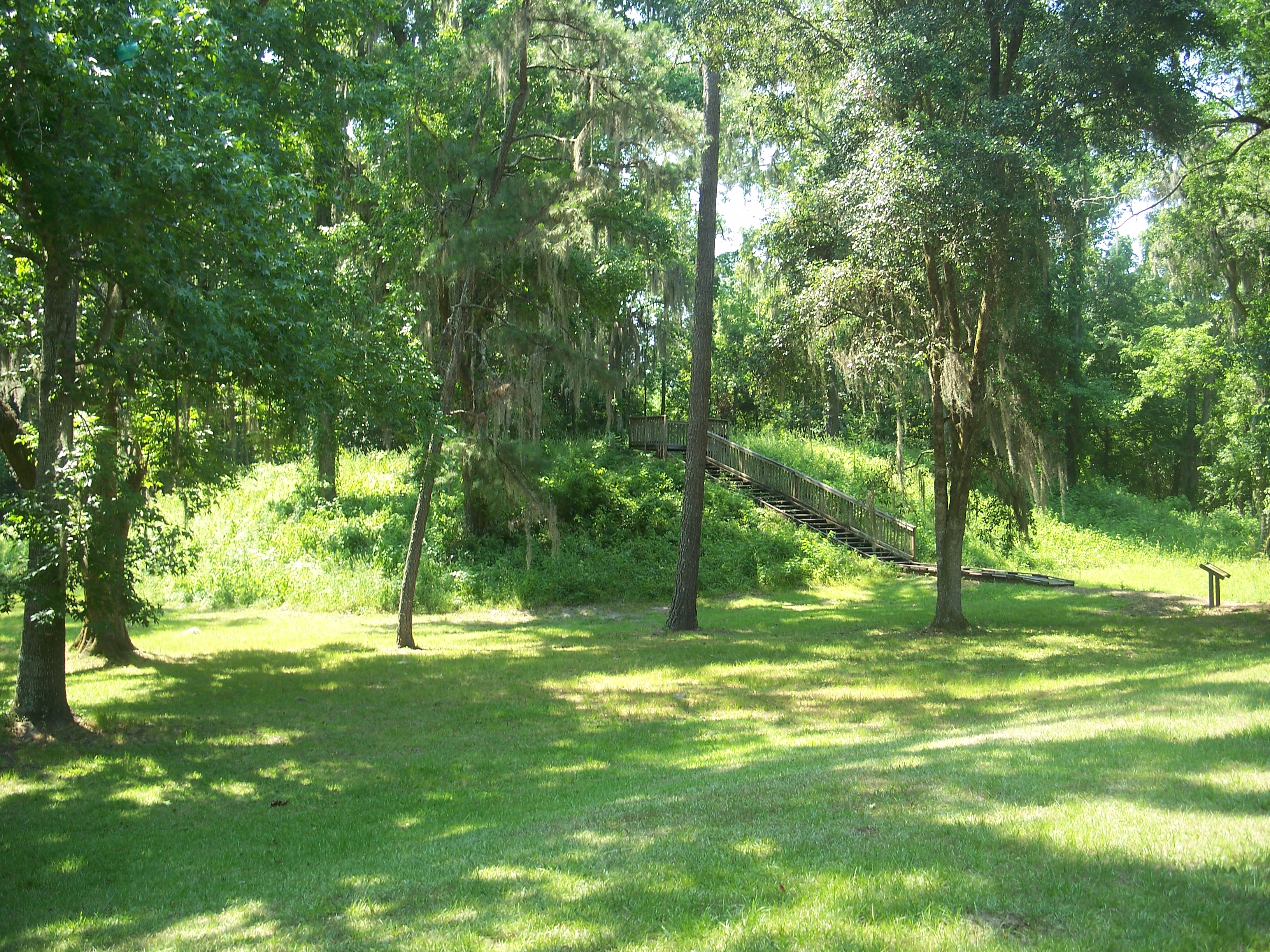
Lake Jackson Mounds Archaeological State Park
One of the copper plates pulled from Mound 3 depicts a winged figure mid-dance, a ceremonial mace in one hand and a severed head in the other, its headdress crowned with an ogee symbol found on artifacts from Oklahoma to Georgia. The plate was recovered in a frantic salvage dig in the winter of 1975, just ahead of bulldozers that would level the mound for fill dirt. That a single object could connect a hilltop on the south shore of Lake Jackson to the vast Mississippian trade network stretching across half a continent tells you everything about what this place once was -- not a backwater village on the Florida frontier, but the political and religious capital of the Fort Walton Culture, the southernmost reach of a civilization that reshaped North America.
A Chiefdom on the Lake
Between 1000 and 1500 CE, the people of the Fort Walton Culture built seven earthwork mounds on the south shore of Lake Jackson in what is now northern Tallahassee. The scale of the complex -- mounds, a leveled ceremonial plaza for ritual games and gatherings, residential quarters for artisans and workers, and communal agricultural fields radiating into the surrounding countryside -- marks this as the seat of a regional chiefdom. The site is oriented on an east-west axis, perpendicular to the Meginnis Arm of Lake Jackson, and every mound follows this alignment. Radiocarbon dating places construction of the largest mounds between approximately 1190 and 1475 CE. The time between mound renewals suggests each building phase corresponded to a ruler's lifespan -- when a chief died, a new layer of basket-loaded earth and red clay was added, literally burying one era and building the platform for the next.
Copper, Pearl, and the Falcon Dancer
Excavations of Mound 3 and Mound 4 revealed burial goods that connect Lake Jackson to the Southeastern Ceremonial Complex, a shared set of religious symbols and trade objects linking Mississippian centers from Spiro in Oklahoma to Moundville in Alabama and Etowah in northwestern Georgia. Among the finds: pearl beads, copper axes, stone and ceramic pipes, and the engraved copper plates that are Lake Jackson's most famous artifacts. Stylistic analysis shows the closest artistic ties were with Etowah, some 350 miles to the north. The copper plates depict falcon dancers -- winged warrior figures associated with the chunkey-player motif found across Mississippian art -- wearing elaborate regalia including columnella pendants, large shell beads, bellows aprons bearing scalp motifs, and long-waist sashes. These were not local inventions but part of a symbolic language shared across thousands of miles, evidence that Lake Jackson's chiefs participated in a continental network of power, religion, and exchange.
The Apalachee Inheritance
Sometime around 1500, the chiefdom seat shifted from Lake Jackson to Anhaica, a settlement rediscovered in 1987 by Florida state archaeologist B. Calvin Jones within what is now DeSoto Site Historic State Park. By the time Hernando de Soto's expedition arrived in 1539, the residents were the Muskogean-speaking Apalachee people, heirs to the Fort Walton tradition. De Soto's chroniclers described a powerful, well-organized society -- exactly what the mound complex at Lake Jackson would have predicted. The connection between the archaeological record at Lake Jackson and the living Apalachee encountered by Spanish explorers is one of the clearest examples in the Southeast of tracing a pre-contact civilization forward into the historical period. Related Fort Walton sites at Velda Mound, Cayson Mound and Village, and Yon Mound and Village reinforce the picture of a region dense with organized settlement.
Salvage and Survival
The park owes much of its archaeological record to a race against destruction. When the mound on private property outside the park boundaries was slated for demolition in the winter of 1975-1976, B. Calvin Jones led a salvage excavation that recovered the copper plates, burial goods, and structural evidence before the earthwork was leveled for fill. Inside the park, six of the original seven mounds survive. Two of the largest are visible from the picnic area, quiet grass-covered rises that give little hint of the burials and ceremonial layers beneath. The site was listed on the National Register of Historic Places on May 6, 1971, and is recognized as part of Florida's Native American Heritage Trail. A 0.75-mile interpretive trail passes through landscapes from the Florida Territorial Period of the 1820s-1860s, when Colonel Robert Butler owned the estate, while a 2.2-mile nature trail winds through native growth past the remnants of a 19th-century grist mill.
A Rare Bloom Among the Mounds
In February 2010, hikers in the park discovered Trillium reliquum, a federally endangered plant species previously thought to exist only in parts of Alabama, Georgia, and South Carolina. The U.S. Fish and Wildlife Service is now working to catalog the population. It is a fitting detail for a place defined by unexpected connections -- a pre-Columbian capital linked to Mississippian centers hundreds of miles away, an archaeological treasure nearly lost to bulldozers, and now a rare flower growing quietly among the mounds, extending its known range into Florida for the first time.
From the Air
Located at 30.50°N, 84.31°W on the south shore of Lake Jackson in northern Tallahassee, Leon County, Florida. The mounds are grass-covered earthworks visible as subtle rises along the lakeshore in clear conditions; the park's wooded trails and open picnic areas help distinguish it from surrounding residential development. Tallahassee Regional Airport (KTLH) lies approximately 5nm to the south-southeast. Lake Jackson itself is a prominent visual landmark -- a large sinkhole lake easily spotted from above. Best viewed at 2,000-3,000 feet AGL for mound detail.