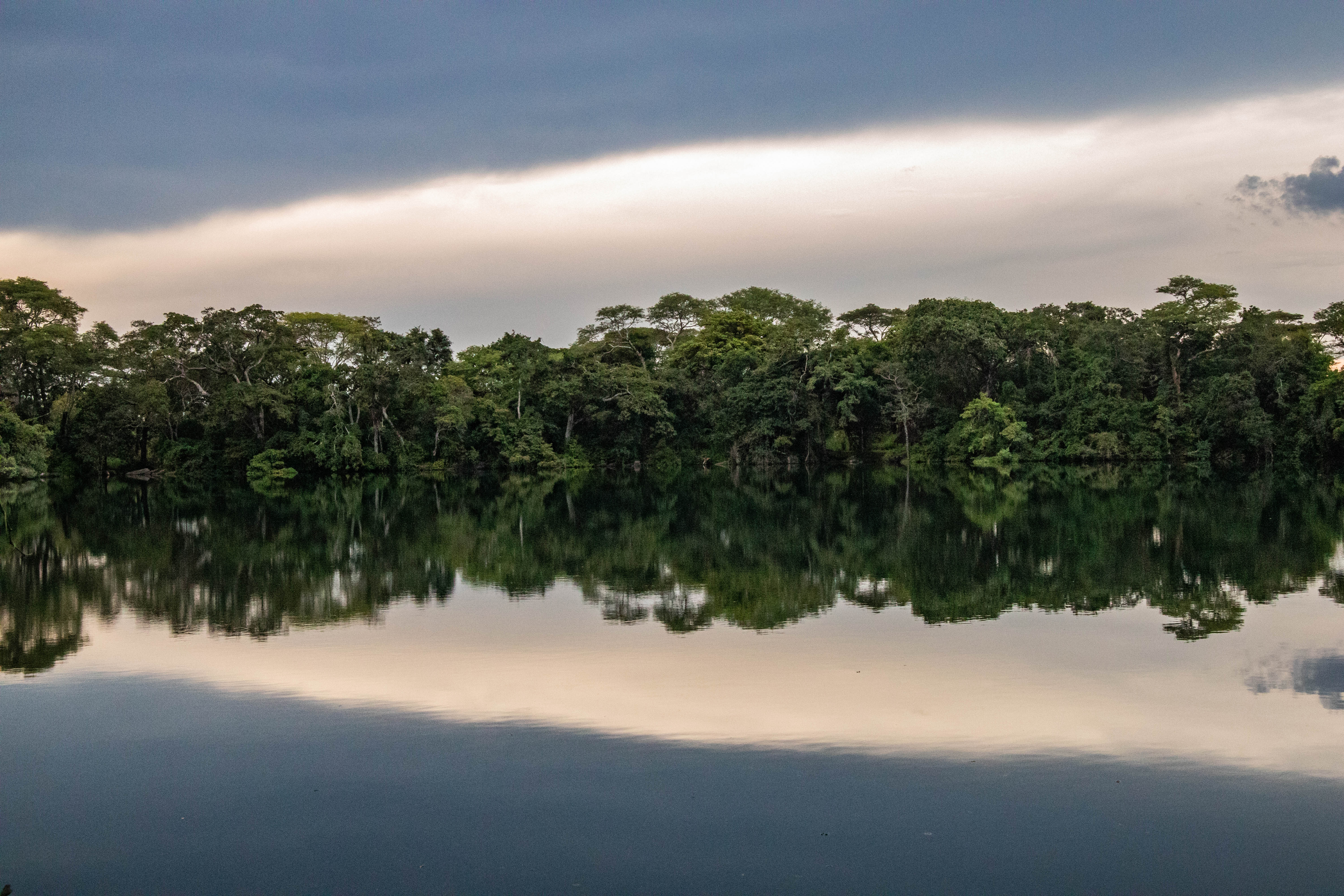
Lake Kashiba
Stand at the edge and look down. The water is ten meters below, impossibly blue, so clear that bream glide visibly through the depths like slow thoughts. The forest closes in around the rim, as if the earth simply fell away one day and the trees kept growing at the old level, indifferent to the void below. Lake Kashiba, southwest of Luanshya in Zambia's Copperbelt, is not really a lake in the conventional sense. It is a sinkhole -- a place where acidic water dissolved the limestone bedrock over millennia, hollowed out a cavern, and then the roof collapsed, leaving a hole 3.5 hectares in area and as much as 150 meters deep on its north side.
The Sunken Lakes
Kashiba is the most impressive of several small, deep pools in the Ndola district collectively known as the Sunken Lakes. The name itself means "small lake" in the local language -- a modest label for a feature that plunges to depths most Zambian lakes never approach. The south side reaches about 70 meters; the north side drops to approximately 150 meters, making it remarkably deep relative to its surface area. All of the sunken lakes share the same origin: water working on limestone, dissolving it grain by grain, carving out subterranean chambers that eventually lost their structural integrity and caved in. The result is a landscape of sudden voids in the forest -- places where the ground gives way to vertical walls and dark water. Kashiba sits close to Mpongwe and St. Anthony's Mission, an area where the geological instability is matched by the richness of the oral tradition that has grown up around these strange, deep places.
The Shadow Catcher
Local legends warn against fishing in Kashiba. The fish, people say, cannot be cooked no matter how long you try. A deeper fear lives in the water: a creature called Ichitapa, or Isoka Ikulu, said to dwell in the depths. When a person stands on the rocks at the lake's edge and their shadow falls across the water, the monster rises from below and seizes the shadow. The victim becomes paralyzed and falls in. Whether these stories encode a practical warning about the dangers of the lake's steep, undercut banks and cold depths, or whether they carry older meanings, they have kept generations of people cautious around water that invites fascination but punishes carelessness.
Kabunda and the Goat Clan
The most powerful legend of Kashiba reaches back to the origin story of the Lamba people. Chipimpi, a chief who came from the west carrying seeds to plant the first gardens, had a son named Kabunda. After the people finished plastering a grain store, Chipimpi gave them porridge to eat, but to Kabunda and his nephew he gave a goat so they could wash the mud from their bodies with its blood. Kabunda refused the goat. He demanded the blood of a man. Chipimpi gave him a slave, and Kabunda killed him with a hoe, declaring: "Now we are the people of the Hair Clan, for we have killed a man with hair on his head. But you, my father and cousin, are people of the Goat Clan." Then Kabunda killed Chipimpi and seized power. When Kabunda began mistreating the younger relatives of Chipimpi -- members of the Goat Clan -- they chose death over subjugation. They gathered their goods, their goats, chickens, and dogs, tied themselves together with a long rope, and threw themselves into Lake Kashiba.
The One Who Cut the Rope
The story does not end in the water. A member of the Leopard Clan, tied at the very end of the rope, cut it at the last moment. He pulled his wife back from the edge and carried her to the village, where she became the mother of all the surviving Goat Clan. It is a story about tyranny, collective resistance, and the thin thread by which a lineage survives extinction. The lake, in Lamba tradition, is not merely a geological curiosity. It is a grave, a monument, and a warning. The blue water holds the memory of people who chose to die together rather than live under a ruler who had forgotten that power comes with obligation. That the Goat Clan endured -- through one woman, one cut rope, one act of last-second refusal -- makes Kashiba a place of both tragedy and survival.
Blue Water in the Green Forest
Today, Kashiba sits quietly in the forest near the Copperbelt's mining towns, a place that tourists occasionally visit but that remains more legend than attraction. The fish still circle in the clear blue water. The limestone walls still drop away beneath the surface into darkness. The area around Luanshya and Ndola is better known for copper extraction than for natural wonders, but the sunken lakes offer something the mines cannot: a glimpse of geological time, where the patient dissolution of rock over hundreds of thousands of years created voids that human stories rushed in to fill. Kashiba is small -- its name says so -- but depth is not the same as size, and the stories it holds go deeper than any sounding line.
From the Air
Lake Kashiba lies at approximately 13.45S, 27.93E, southwest of Luanshya in Zambia's Copperbelt Province, near Mpongwe. From the air at 2,000-3,000 feet AGL, the lake appears as a dark blue oval set into dense green forest -- its steep sides and the elevation difference between the water surface and the surrounding terrain are distinctive. The nearest major airfield is Ndola (FLDN), approximately 60 km to the northeast. Luanshya has a small airstrip. The Copperbelt is generally flat to gently undulating, and the sunken lakes are among the few dramatic topographic features in the area. Dry season (May-October) offers the best visibility.