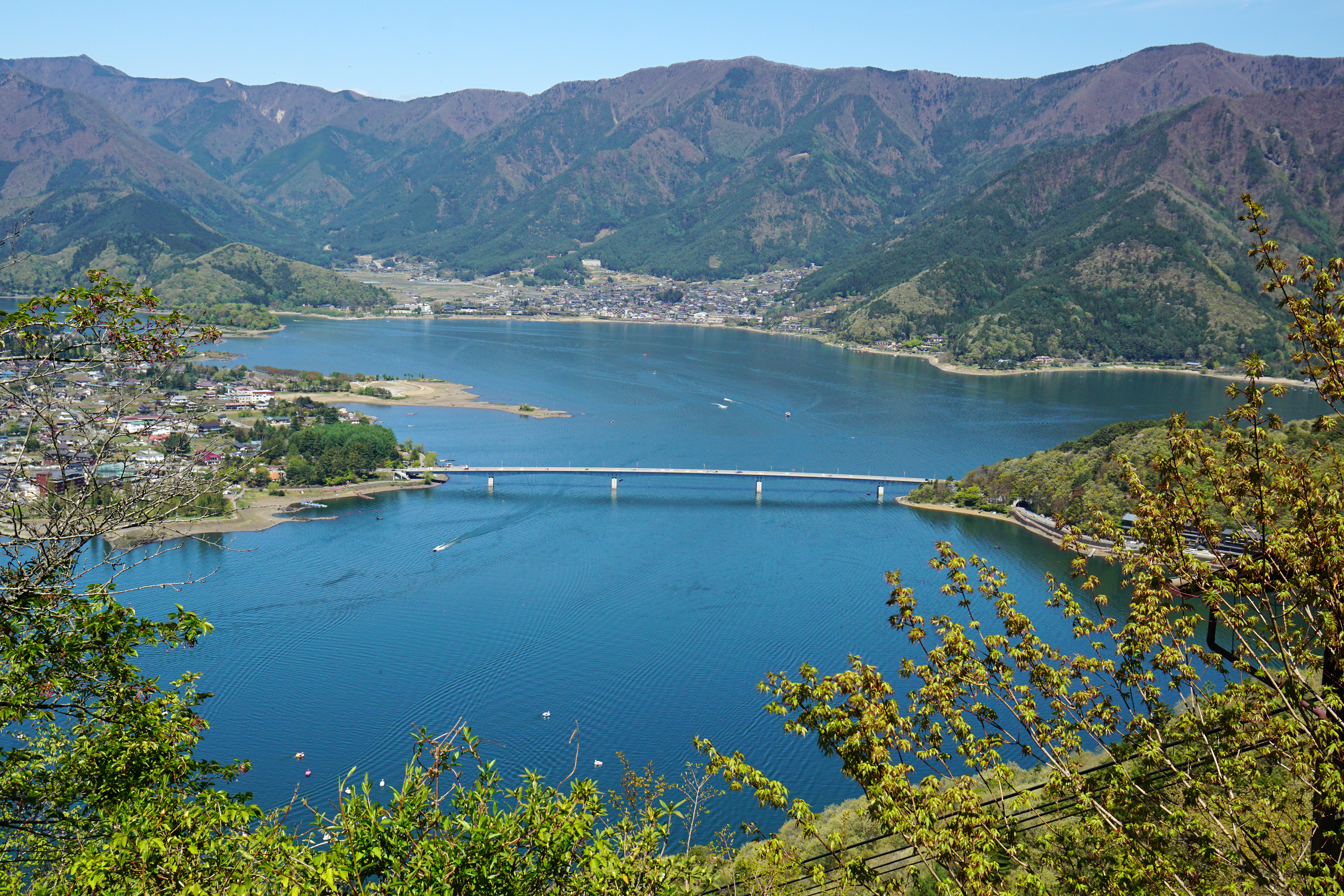
Lake Kawaguchi
Katsushika Hokusai stood at Misaka Pass sometime around 1830, gazing down at a lake that held two mountains. The real Mount Fuji rose to the south, its summer slopes bare of snow. But the reflection in Lake Kawaguchi told a different story, showing a snow-capped peak larger than the original. Hokusai painted both versions in his famous Thirty-six Views of Mount Fuji series, creating a visual koan: which Fuji is the real one? Nearly two centuries later, photographers still crowd the northern shore of this lake chasing the same paradox, waiting for the water to go still enough to hold the mountain's double.
The Mirror at Fuji's Feet
Lake Kawaguchi sits at roughly 830 meters elevation in the town of Fujikawaguchiko, Yamanashi Prefecture, cradled in the northern foothills of Mount Fuji. It is the second largest of the Fuji Five Lakes by surface area, covering about 5.7 square kilometers, and it has the longest shoreline of any of the five. Ancient lava flows from Fuji's eruptions dammed rivers across this highland plateau, and the resulting lakes have no natural outlets. For Kawaguchi, that meant centuries of flooding until 1914, when engineers completed a canal linking it to a tributary of the Sagami River. The lake is shallow, just 14.6 meters at its deepest, and its surface freezes in winter, turning the Fuji reflection into a sheet of white ice. In spring, cherry blossoms frame the mountain views. In autumn, the maple corridor along the northern shore ignites in crimson and gold. Each season rewrites the same composition.
Sacred Water, Secular Pleasures
Mount Fuji's designation as a UNESCO World Heritage Site in 2013 included Lake Kawaguchi as a component of the Fujisan Cultural Site, recognition that the mountain's spiritual significance extends to the waters that mirror it. The lake sits within the boundaries of Fuji-Hakone-Izu National Park, a vast protected landscape stretching from the volcanic highlands down to the Izu Peninsula. But Kawaguchi is no pristine wilderness. It is the most visited and most developed of the Fuji Five Lakes, its shores lined with resort hotels, campgrounds, and excursion boat docks. Japanese white crucian carp and wakasagi, a type of smelt, were introduced during the Meiji period in the late 1800s, and sport fishing remains popular. Windsurfers carve across the surface in summer, while every July and August the town becomes a staging ground for the tens of thousands who climb Fuji during the brief official season.
The Photographer's Obsession
There is a reason Lake Kawaguchi appears on more postcards and Instagram feeds than any of the other Fuji Five Lakes. The geometry is perfect. The northern shore sits at the ideal distance and angle to capture Fuji's full symmetrical cone reflected in calm water. Professionals know that the best conditions arrive at dawn on cold, windless mornings, when mist rises from the surface and Fuji turns from shadow to pink to blazing white in a matter of minutes. The Tenjoyama Park ropeway lifts visitors to a panoramic overlook above the lake, offering the classic aerial composition of water, town, and volcano. But the lake-level view remains the one that stopped Hokusai in his tracks. He rendered it with the mountain and its reflection slightly offset, the snow appearing only in the water, inviting viewers to question what they see. That tension between the real and the reflected, between permanence and illusion, is what keeps people coming back.
Gateway to the Mountain
Lake Kawaguchi is not just a destination. It is a threshold. The JR Limited Express Fuji Excursion runs up to three times daily from Shinjuku Station in Tokyo, delivering passengers to Kawaguchiko Station in under two hours. Highway buses operated by Fuji Kyuko depart from Shinjuku, Tokyo Station, and Shibuya. The infrastructure exists because Kawaguchi serves as the primary base camp for Fuji climbers approaching via the Yoshida Trail, the most popular of the four routes to the summit. Beyond the climbing season, the town sustains itself on the mountain's visual magnetism. The Kawaguchiko Music Forest plays European melodies amid gardens designed to frame Fuji. Hot spring baths along the eastern shore let visitors soak while watching the mountain change color at sunset. The lake functions as both mirror and stage, reflecting Fuji while hosting the human spectacle of millions drawn to its presence.
From the Air
Lake Kawaguchi is at 35.515N, 138.757E, elevation approximately 830 meters. The lake appears as a distinctive irregular water body directly north of Mount Fuji's summit. Best viewed from 3,000-5,000 feet AGL approaching from the north or east. The Fuji Five Lakes chain is visible stretching east to west along Fuji's northern base. Nearest airports: RJAH (Hyakuri/Ibaraki Airport) approximately 150 km east, RJTT (Tokyo Haneda) approximately 100 km east-southeast. The Kofu Basin lies to the northwest. In clear weather, Mount Fuji's cone provides an unmistakable visual reference.