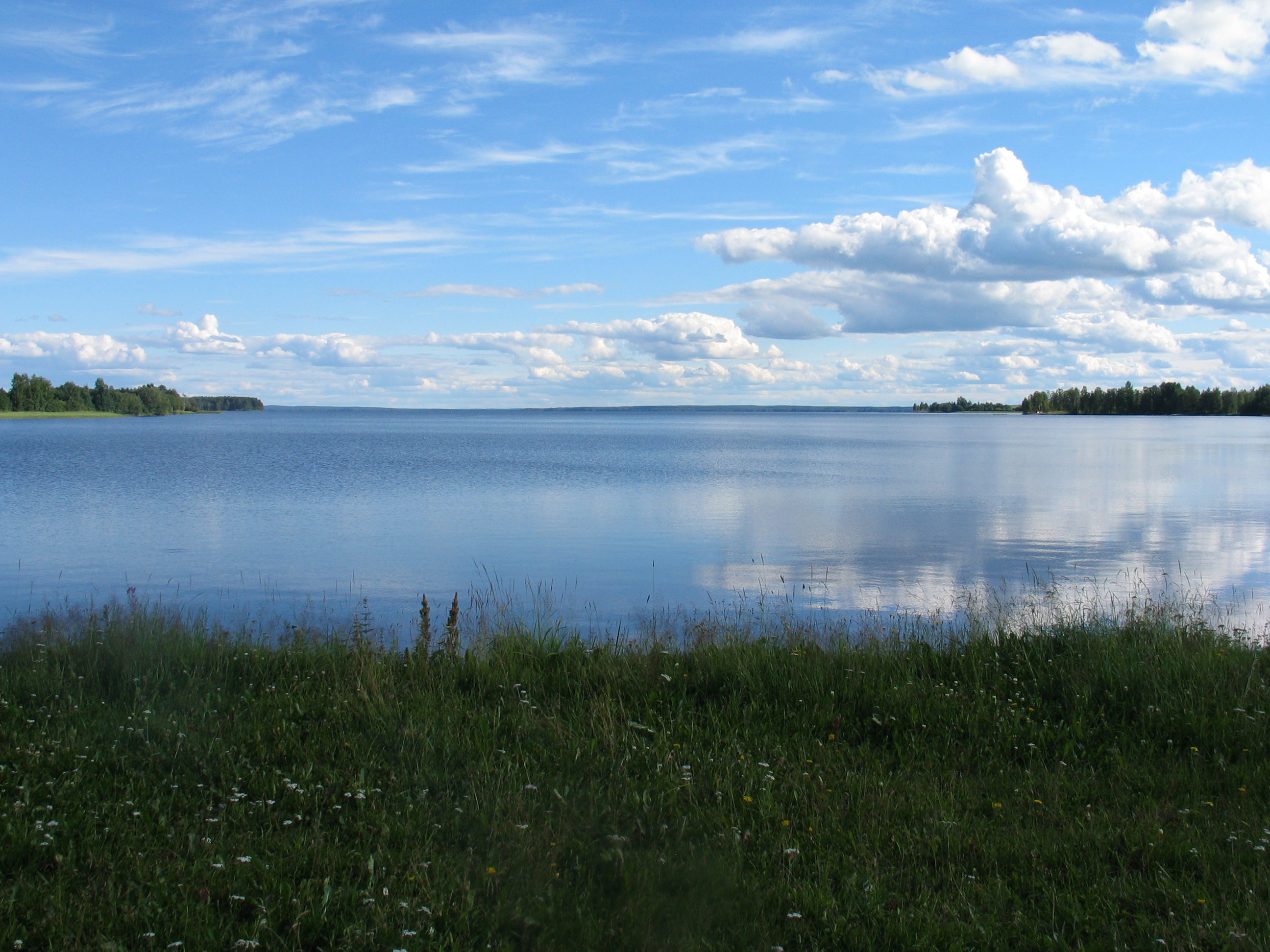
Lake Lappajarvi
For more than a hundred years, geologists looked at Lake Lappajarvi and saw a volcano. The black rock on Karnansaari island, the elevated rim along the southeastern shore, the sheer circular shape of the basin -- all of it pointed to ancient volcanism in a land that had no business having volcanoes. It was not until 1967 that researchers realized they had the story exactly backward. The lake was not born from something rising out of the earth. It was made by something falling from the sky.
An Asteroid's Signature
Approximately 77.85 million years ago, during the Late Cretaceous, an H-type chondrite asteroid roughly 1.6 kilometers across slammed into what is now western Finland. The impact excavated a crater 22 to 23 kilometers in diameter and 750 meters deep -- the largest or second-largest meteorite crater in Finland, and the first one ever identified in the country. The violence of the collision produced temperatures and pressures that melted bedrock into a black glass-like substance called karnaite, named after Karnansaari, the island at the lake's center that may represent the crater's central uplift. The bedrock needed somewhere between one hundred thousand and one million years to cool. Impact diamonds, coesite, suevite, and breccia -- the geological fingerprints of extraterrestrial violence -- all lie embedded in the surrounding rock.
A Century of Mistaken Identity
Henrik Holmberg first described an unusual volcanic rock at Lappajarvi in 1858. Geologist Eero Makinen analyzed the karnaite in 1916 and classified it as dacite, a type of lava rock, which seemed to confirm the volcanic theory. When the eminent geologist Pentti Eskola visited in 1926, he agreed: this was a volcanic lake. The misidentification persisted for decades. As late as 1964, Professor Ahti Simonen was still writing about the lake's ancient volcanic activity. The breakthrough came in 1967, when Professor Thure Georg Sahama -- fresh from studying the Nordlinger Ries crater in Germany -- recognized the resemblance. He dispatched researcher Martti Lehtinen to investigate. That same year, Swedish researcher Nils-Bertil Svensson noticed that quartz in the karnaite was shattered in patterns identical to those at confirmed impact sites worldwide. Svensson published his findings in Nature in February 1968, and Lehtinen's 1976 doctoral dissertation provided the definitive proof.
Drilling Into Deep Time
The question of the crater's age proved nearly as stubborn as its origin. In 1980, German researchers used argon-argon dating to estimate 77.3 million years. In 1992, paleomagnetic methods wildly overshot, suggesting 195 million years. Uranium-lead dating in 2001 yielded 73.3 million years, give or take five million. Argon-argon analysis in 2013 refined the figure to 76.2 million years. Between 1988 and 1990, the Geological Survey of Finland drilled into the crater floor, reaching 217 meters at Harkaniemi -- finding karnaite extending 145 meters below the surface before giving way to suevite and breccia. A 2018 uranium-lead study proposed 77.8 million years, and after peer review the age settled at 77.85 million years, plus or minus 780,000 -- placing the impact squarely in the Campanian age, during a period of intensified asteroid bombardment across the solar system.
Diamonds, Drinking Water, and Deep Futures
The asteroid did more than leave a scar. In 1997, researchers discovered small impact diamonds in suevite boulders around the lake -- tiny crystals forged in the instant of collision. The shattered bedrock also created favorable groundwater aquifers, and today the town of Lappajarvi draws drinking water from the fractured rock of the crater itself. Scientists from Finland's Onkalo spent nuclear fuel repository have studied Lappajarvi to model how Finnish landscapes might evolve over the next million years. In September 2023, UNESCO accepted the area's Impact Crater Lake Geopark application for possible endorsement. Even a nearby lake, Iso-Rayrinki in Alajarvi, has been proposed as a secondary crater -- possibly formed by a small moon orbiting the asteroid at the moment of impact.
Still Water, Violent Past
From the air, Lappajarvi is a near-perfect oval of dark water set in the green and brown patchwork of Ostrobothnia. In winter, it freezes solid, and northern lights ripple above its white surface. Karnansaari sits at its heart like a bullseye, the last visible remnant of a collision that shook a continent. The crater rim traces an arc along the southeastern shore, elevated just enough to notice from altitude. It is one of those rare places where the deep past breaks the surface of the present -- where the water you drink and the rock beneath your feet carry the memory of an event 78 million years old.
From the Air
Located at 63.14N, 23.64E in western Finland. The lake's near-circular shape (approximately 15 km across) is clearly visible from altitude, with Karnansaari island at center. The elevated crater rim is discernible along the southeastern shore. Nearest airports: Seinajoki (EFSI) approximately 80 km south, Kokkola-Pietarsaari (EFKK) approximately 70 km northwest. Flat agricultural terrain surrounding the lake basin. Best viewed at 10,000-15,000 ft to appreciate the crater's circular geometry.