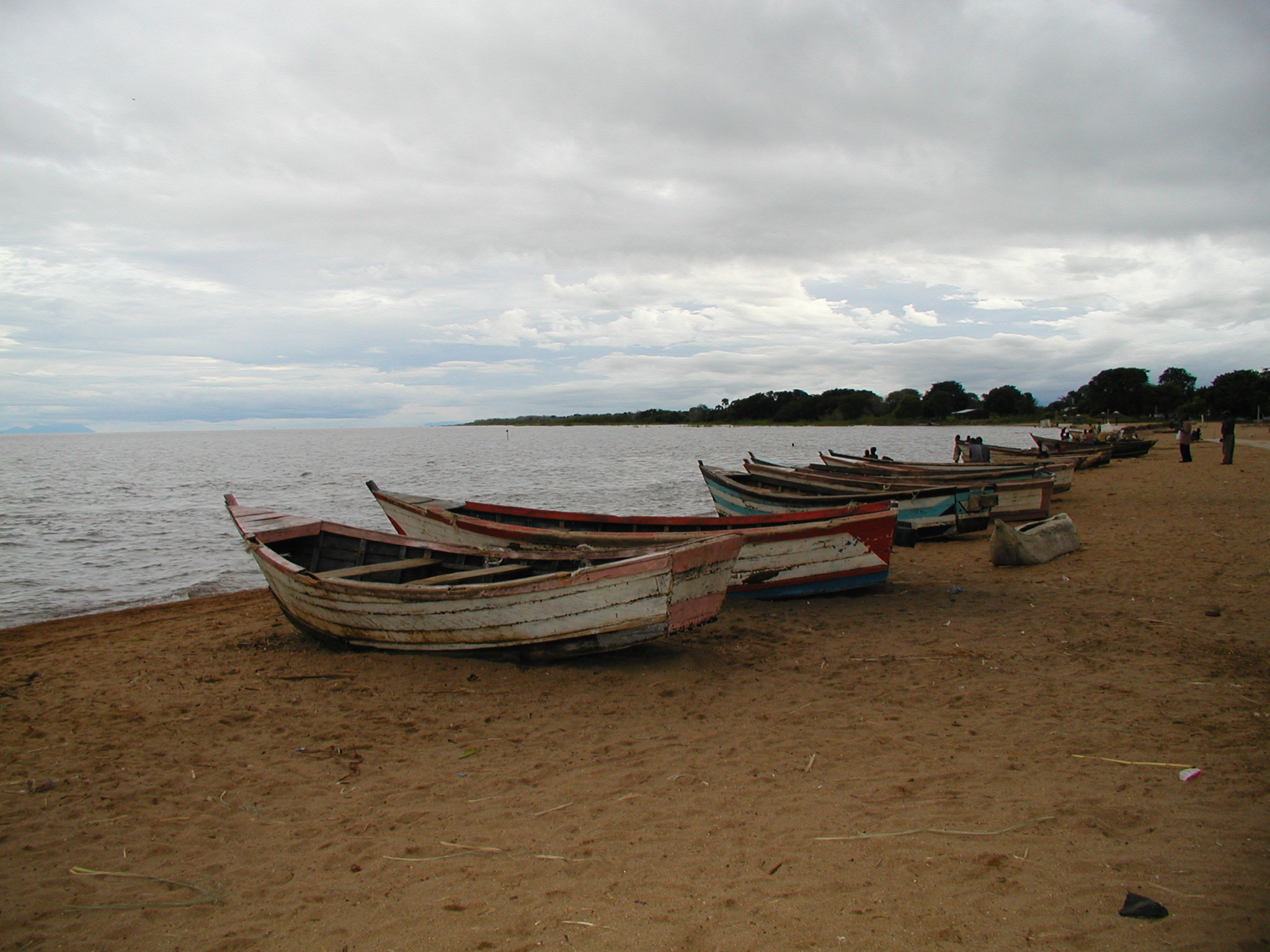
Lake Malawi National Park
Charles Darwin had his finches. Lake Malawi has its cichlids. In the clear waters at the southern end of Africa's third-largest lake, an estimated 700 species of fish have evolved from common ancestors into an explosion of forms so diverse that scientists compare it directly to the Galapagos -- except this evolutionary laboratory is underwater, and most of its inhabitants have not yet been formally described. Lake Malawi National Park exists to protect this aquatic spectacle, and in 1984, UNESCO agreed it mattered enough to designate it a World Heritage Site for its "global importance for biodiversity conservation."
A Rift in the Earth, a Cradle of Species
Lake Malawi sits in the Great Rift Valley, 500 meters above sea level, its waters plunging to 700 meters at the deepest points -- making it one of the deepest lakes on Earth. The national park covers approximately 95 square kilometers of land and water at the lake's southern end, encompassing most of the Nankumbu Peninsula, 13 islands, and the surrounding aquatic zone. The peninsula rises steeply from the lakeshore to Nkhunguni Peak at 1,143 meters in the west and Dzimwe Peak at 963 meters in the east, its slopes cloaked in dense forest. The craggy landscape above water contrasts sharply with the clear, calm waters below, creating a park that is as much about what lies beneath the surface as what rises above it.
The Mbuna and Their Miniature Kingdoms
The cichlids of Lake Malawi, known locally as mbuna, represent one of the most remarkable examples of evolutionary radiation on the planet. Over millions of years, as lake levels fluctuated, fish populations were repeatedly isolated and reconnected, creating an engine of speciation. The result: approximately 700 species, nearly all of them endemic, found nowhere else on Earth. Some occupy ranges absurdly small -- a single bay, one rocky islet, a few hundred meters of shoreline. Many remain unknown to science, undescribed and unnamed, swimming in waters that researchers have only begun to catalog. The comparison to Darwin's finches in the Galapagos is apt but undersells the scale. Darwin documented fourteen species of finch. Lake Malawi's cichlids number fifty times that, each adapted to a specific niche in a freshwater ecosystem that has been refining its biodiversity for longer than humans have existed.
Beyond the Fish
The park's fame rests on its cichlids, but the land above the waterline holds its own ecological richness. Chacma baboons and vervet monkeys move through the forested slopes. Hippopotamuses inhabit the shallows. Leopards, common duikers, bushbucks, greater kudus, and klipspringers occupy the peninsula's interior. Nile crocodiles patrol the shoreline where it meets the deeper water. The birdlife is exceptional: African fish eagles hunting from above, white-breasted cormorants diving below, kingfishers flashing between the two. Hornbills, nightjars, kestrels, and swallow-tailed bee-eaters populate the forest canopy, their calls layering over the sounds of water lapping against rock. Several fishing villages, including Chembe near Cape Maclear, sit inside the park's boundaries but are not technically part of it -- a jurisdictional compromise that acknowledges people were here long before the park was drawn on a map.
Livingstone's Baobab
In 1859, Dr. David Livingstone became the first European to see the lake, which he called Lake Nyassa. By 1875, the Scottish Presbyterian Church had established a mission on Cape Maclear, drawn by Livingstone's accounts of a vast inland sea surrounded by African communities engaged in both trade and the slave trafficking he abhorred. A large baobab tree at the mission site, said to be over 800 years old, is reputed to have been Livingstone's favorite spot for giving sermons and speaking with fellow missionaries. The graves of five early missionaries remain in the park, their headstones weathered but legible. These markers are a reminder that the European encounter with Lake Malawi was not merely exploratory -- it was evangelical, commercial, and ultimately colonial, setting in motion changes that would reshape the entire region.
Islands in a Living Museum
The park's 13 islands form an archipelago of ecological isolation. Otter, Domwe, Thumbi West, Mumbo, Zimbabwe, Thumbi East, Mpanda, Boadzulu, and the smaller rocks and islets each host their own communities of cichlids, some species confined to a single island's rocky perimeter. Mumbo Island, about four kilometers offshore, serves as both a research site and a minimalist eco-lodge destination. The islands' rocky substrates provide the habitat structure that mbuna require -- crevices for shelter, algae-covered surfaces for grazing, territorial boundaries defined by stone rather than sand. From above, the islands appear as dark shapes in crystalline water, their significance invisible until you look beneath the surface. That is the essential character of Lake Malawi National Park: a World Heritage Site whose greatest treasures are hidden in plain sight, swimming in water so clear you can watch evolution at work.
From the Air
Located at 14.03S, 34.88E at the southern end of Lake Malawi. The Nankumbu Peninsula and its offshore islands (Mumbo, Thumbi West, Domwe, and others) are clearly visible from altitude. The park covers approximately 95 square kilometers of land and water. Monkey Bay airstrip is nearby. Chileka International Airport (FWCL) near Blantyre is the nearest major airport, approximately 250 km southwest. Lake Malawi stretches over 500 km to the north, making it one of the most prominent freshwater features visible from cruising altitude in southeast Africa.