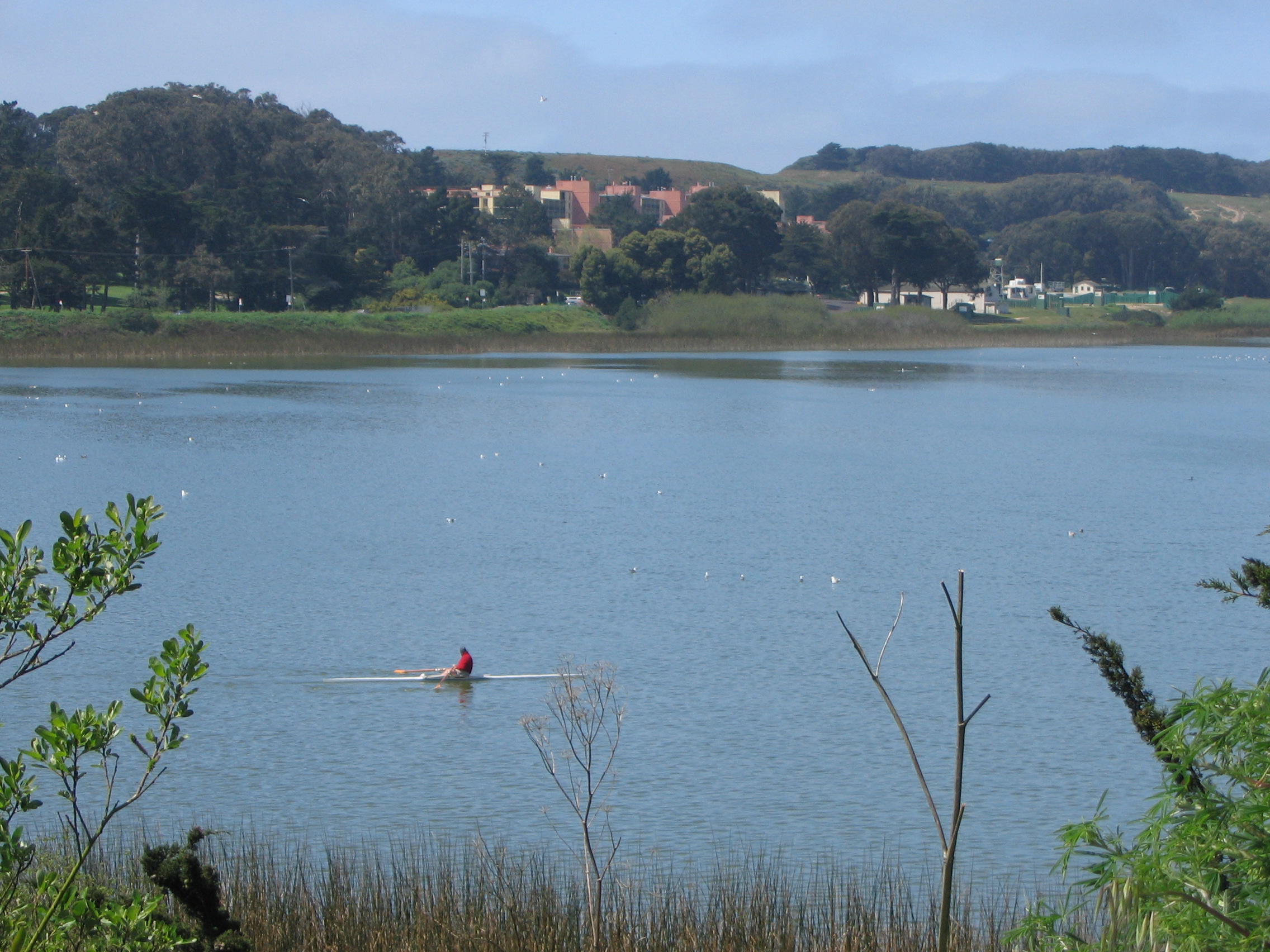
Lake Merced
Father Pedro Font spotted it first, or at least wrote it down. Traveling with the de Anza Expedition in March 1776 to found the Presidio of San Francisco, he recorded in his diary seeing a grove of live oaks near the Laguna de la Merced, where Captain Ribera had stopped. He also noted many bears. They were California grizzlies, and they are long gone now. The lake remains, a freshwater anomaly in the southwest corner of a city surrounded by salt water, tucked between three golf courses, a university, and the Pacific Ocean.
Named by Explorers, Owned by Speculators
Captain Don Bruno de Heceta christened the lake Laguna de Nuestra Senora de la Merced in 1775. Francisco De Haro, San Francisco's first Alcalde, owned it as part of the Galindo ranch. In 1868, the Spring Valley Water Company bought the water rights, then systematically purchased the surrounding watershed, creating a monopoly on San Francisco's water supply. The company controlled the city's drinking water for four decades. It was not until 1908, when voters approved construction of O'Shaughnessy Dam to create the Hetch Hetchy Reservoir in the Sierra Nevada, that the city broke free. Before Hetch Hetchy, Lake Merced was planned to be expanded into the city's main reservoir, with designs that would have swallowed what is now the San Francisco State University campus. Instead, Spring Valley sold off land around the lake, and golf courses filled the space. In 1940, Metropolitan Life bought the last parcel to build the Parkmerced apartment complex.
The Night the Lake Drained
At approximately 11 p.m. on November 22, 1852, a shock rattled the ground around the lake. The next day, residents discovered a fissure half a mile wide and three hundred yards long through which the waters of Lake Merced were flowing directly to the sea. The lake dropped thirty feet. The most likely cause was heavy rain forcing a passage through the sandbank on the northwest side. An 1881 map shows the lake still had a passage to the ocean twenty-nine years later. Today the lake is fed by an underground spring and sealed from the ocean, one of only three natural freshwater lakes in San Francisco, alongside Pine Lake and Mountain Lake. Water levels have been rising since 1990 thanks to better aquifer management.
Blood on the Shore
On September 13, 1859, the most famous duel in California history took place on the shores of Lake Merced. Former Chief Justice of the California Supreme Court David S. Terry shot and killed United States Senator David C. Broderick. The duel grew from political disagreements over slavery and the future of the Democratic Party in California. Terry was a pro-slavery firebrand; Broderick opposed the expansion of slavery into new territories. Broderick's pistol misfired. Terry's did not. The senator died three days later, and his final words, whether apocryphal or authentic, became legend: he said he had been killed because he opposed a corrupt administration and the extension of slavery. Terry was acquitted of murder but his reputation never recovered. A monument near the lake marks the approximate site.
The Lake Today
Walk the path around Lake Merced and you pass through layers of San Francisco that most visitors never see. The Olympic Club and San Francisco Golf Club occupy the eastern shore, their fairways manicured to country-club perfection. San Francisco State University sprawls to the north. The SFPD shooting range echoes from the south. Rowing shells from Pacific Rowing Club and St. Ignatius College Prep cut across the water in the early morning. The California Office of Environmental Health Hazard Assessment has issued a safe eating advisory for fish caught here due to mercury levels, an irony for a lake named for Our Lady of Mercy. But the views are real, the water is fresh, and on a fogless evening, the lake reflects a sky that the grizzly bears would still recognize.
From the Air
Located at 37.72°N, 122.50°W in San Francisco's southwest corner. The lake is a distinctive oval freshwater body clearly visible from altitude, bordered by golf courses and residential development. Nearest airports: SFO (KSFO, 5 nm south), Oakland (KOAK, 15 nm east). Fort Funston and the Pacific Ocean shoreline are immediately to the west.