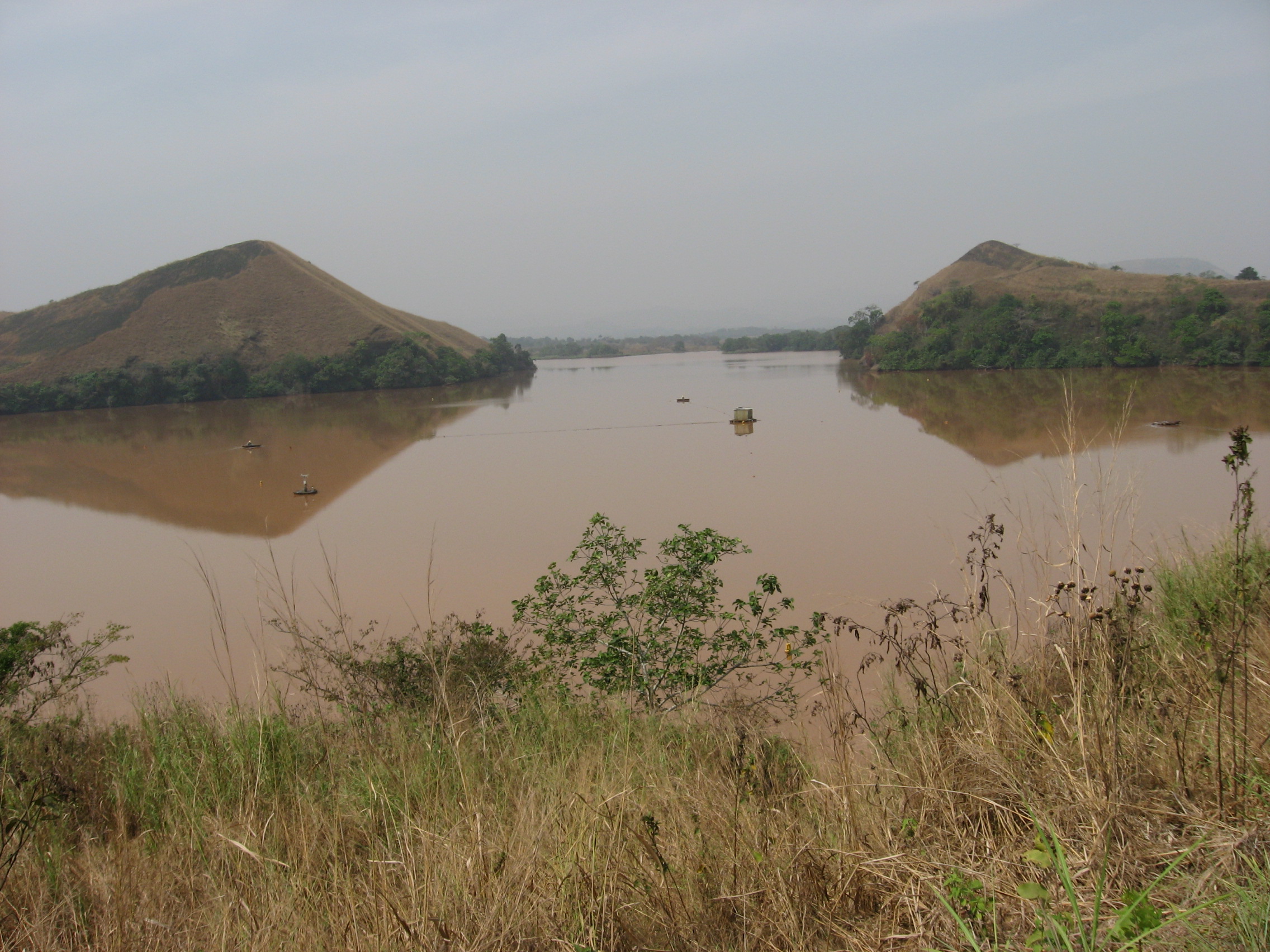
Lake Monoun
On August 15, 1984, residents near a small lake in Cameroon's West Province heard a loud noise around half past ten at night. By dawn, 37 people in the low-lying area nearby were dead. Their bodies showed strange skin discoloration. Survivors described a whitish, smoke-like cloud that smelled bitter and acidic drifting through the darkness. At first, investigators suspected terrorism. The real explanation was stranger and more terrifying: the lake itself had exhaled a massive cloud of carbon dioxide, and the invisible gas had pooled in the valley, suffocating everyone in its path.
A Lake That Breathes Poison
Lake Monoun is a maar -- a crater lake formed by a volcanic explosion -- sitting within the Oku Volcanic Field of western Cameroon. Beneath its surface, carbon dioxide seeps upward from magmatic sources and dissolves into the deep, cold, pressurized water. Under normal conditions, the gas stays trapped. But if something disturbs the stratified layers -- a landslide, a sudden temperature shift, heavy rain -- the dissolved CO2 can rush out of solution in a catastrophic chain reaction known as a limnic eruption. The gas cloud that emerged from Lake Monoun's eastern crater flattened vegetation and generated a wave estimated at five meters in height. Along with Lake Nyos and Lake Kivu, Monoun is one of only three lakes in the world known to hold the right conditions for this kind of deadly event.
The Night the Valley Fell Silent
Carbon dioxide is heavier than air. When it erupts from a lake in massive quantities, it flows downhill like an invisible flood, displacing oxygen and settling into depressions and valleys. The 37 people who died near Lake Monoun were in a low-lying area where the gas concentrated. Because CO2 is colorless and odorless in pure form -- though the volcanic mixture carried a bitter, acidic smell -- victims had little warning. Two years later, in 1986, the far larger Lake Nyos suffered the same phenomenon on a catastrophic scale, releasing a cloud that killed over 1,700 people and thousands of livestock within a 25-kilometer radius. It was the Lake Nyos disaster that finally confirmed what had happened at Monoun, giving scientists the framework to understand both events as limnic eruptions.
Draining a Time Bomb
Once scientists understood the mechanism, the question became urgent: how do you defuse a lake? In 1992, engineers began preliminary tests at Monoun using a gas-lift technique borrowed from the petroleum industry. The concept is elegantly simple. A pipe extends from the lake's surface down to the CO2-saturated depths. When deep water is drawn upward, the decreasing pressure allows dissolved gas to come out of solution, creating bubbles that make the water column buoyant -- a self-sustaining fountain that requires no external energy once started. The challenge was practical. With minimal funding, the team used high-density polyethylene pipes, which have a density close to water and can be assembled from standard six-meter segments using portable electric welders. Deployed from rubber boats and anchored rafts, the pipes hung freely like pendulums into the deep water.
An Ongoing Vigil
In February 2003, a permanent venting pipe was inserted into Lake Monoun, producing an eight-meter fountain as gas-laden water from 73 meters below surged to the surface. The initial success, however, revealed new complications. The deep water is rich in iron, which oxidizes into limonite on contact with air -- a concern for the local villagers who fish the lake and depend on its health. By December 2013, the original pipe had lost its self-sustaining lift because so much CO2 had been removed from the bottom layers that the natural buoyancy effect weakened. Engineers upgraded the system with a small solar-powered rotary pump. But the degassing rate remains lower than the natural inflow of CO2-rich water from below, meaning additional pumps are needed to prevent the lake from slowly reloading its lethal cargo. The vigil at Lake Monoun continues -- a quiet, underfunded effort to keep a beautiful crater lake from killing again.
From the Air
Lake Monoun sits at 5.58N, 10.587E in Cameroon's West Province, within the Oku Volcanic Field at an elevation of approximately 1,080 meters. The maar crater is visible as a distinct oval water body amid the volcanic highlands. From 5,000-8,000 feet AGL, the lake's eastern crater and the degassing fountain may be visible in clear conditions. The nearest significant airport is Douala International Airport (FKKD), approximately 200 km to the southwest. Lake Nyos, the site of the larger 1986 disaster, lies roughly 100 km to the northwest. The terrain is hilly volcanic highland with significant cloud cover common, especially during the rainy season from March to October.