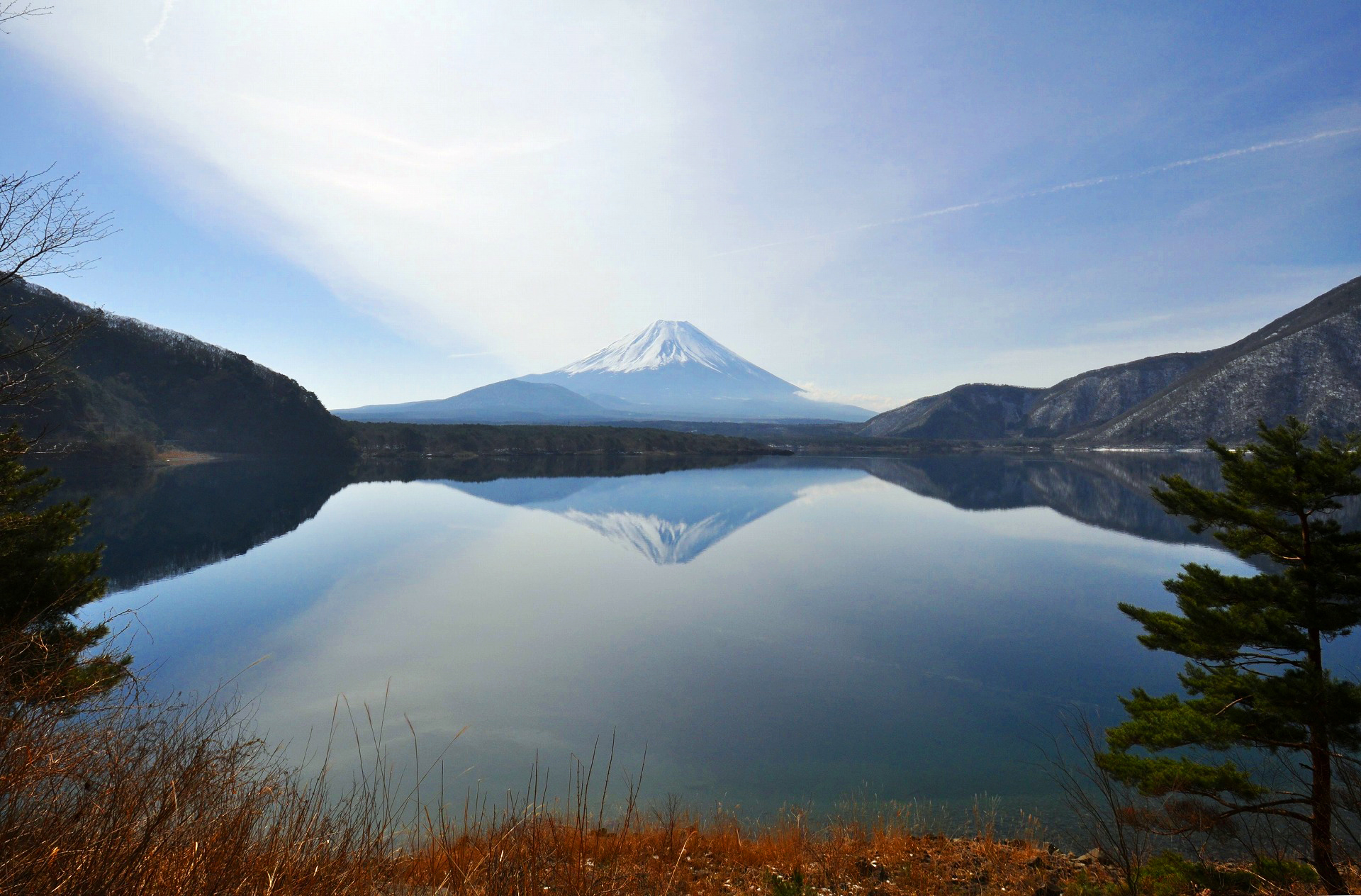
Lake Motosu
Reach into your pocket in Japan, pull out a 1,000-yen note, and flip it over. The image on the reverse -- Mount Fuji reflected in still water -- was photographed from the shores of Lake Motosu. This is the westernmost of the Fuji Five Lakes, and its most enigmatic. At 121.6 meters deep, Motosu plunges to depths that most visitors never suspect, making it the ninth-deepest lake in Japan and by far the deepest in the Fuji Five Lakes chain. Its waters are so clear that the mountain's reflection reads like a mirror image, which is precisely why it ended up on the nation's currency.
Three Lakes That Were Once One
Lake Motosu sits at a surface elevation of 900 meters, identical to neighboring Lake Shoji and Lake Sai. This is not coincidence. Geologists confirmed that these three lakes were originally a single large body of water, split apart by an enormous lava flow from Mount Fuji. The remnants of that ancient flow now lie beneath the dense canopy of Aokigahara, the infamous sea-of-trees forest that occupies the hardened lava field between them. More remarkable still, evidence indicates that the three lakes remain connected through underground waterways, their waters mingling in hidden channels beneath the volcanic rock. What appears on the surface as three separate lakes is, deep below, still one body of water sharing the same ancient plumbing.
The Face on the Money
Lake Motosu's claim to national fame is literal: it appears on Japanese currency. The view of Mount Fuji from the lake's northern shore was featured on the reverse of the Series D 5,000-yen note and later on the Series E 1,000-yen note. The specific photograph captures Fuji's symmetrical cone reflected in Motosu's famously clear surface, creating the iconic upside-down Fuji image. This particular vantage point has become a pilgrimage site in its own right, with visitors hiking to the exact spot to compare the view with the bill in their hand. The lake's transparency, which makes the reflection so crisp, is the same quality that has drawn photographers and artists for generations.
Trout, Tourism, and Trouble
Like its siblings in the Fuji Five Lakes, Motosu has evolved into a popular resort area. Lakeside hotels, windsurfing facilities, campgrounds, and excursion boats line portions of the shore. Rainbow trout and brown trout were introduced during the Meiji period in the late 19th century, and sport fishing remains a draw. But this popularity has come at a cost. In recent years, reduced water transparency from pollution generated by tourism and recreational activities has become a growing concern. The very clarity that made the lake famous enough to print on money is slowly diminishing -- an irony that conservationists have been working to address. The tension between preservation and access is an ongoing challenge for the communities of Fujikawaguchiko and Minobu that share the lake's shoreline.
Anime Pilgrimage and Literary Landscape
Lake Motosu has found a second life in popular culture. The anime series Laid-Back Camp prominently features the lake, and after the first season aired, visitor numbers to the area rose sharply. Fans arrive with screenshots on their phones, seeking out the exact camping spots and scenic overlooks depicted in the show. The lake also appears in Haruki Murakami's novel 1Q84, where it serves as the backdrop for a tense confrontation between extremists and Japanese police. These cultural touchpoints have layered new meaning onto a landscape already rich with geological and historical significance, drawing visitors who might never have come for the fishing or the Fuji views alone.
From the Air
Located at 35.4639N, 138.5856E at 900 meters elevation in the Fuji Five Lakes region. From the air, Lake Motosu is the westernmost of five clearly visible lakes arrayed along Mount Fuji's northern base. Its roughly oval shape and deep blue color distinguish it from the lighter, shallower lakes nearby. Look for the dark mass of Aokigahara forest between Motosu and the neighboring lakes to the east. Nearest airports include RJTO (Oshima) and RJTF (Chofu). Mount Fuji's summit at 3,776 meters dominates the visual landscape to the southeast. Best visibility on clear autumn and winter days when haze is minimal.