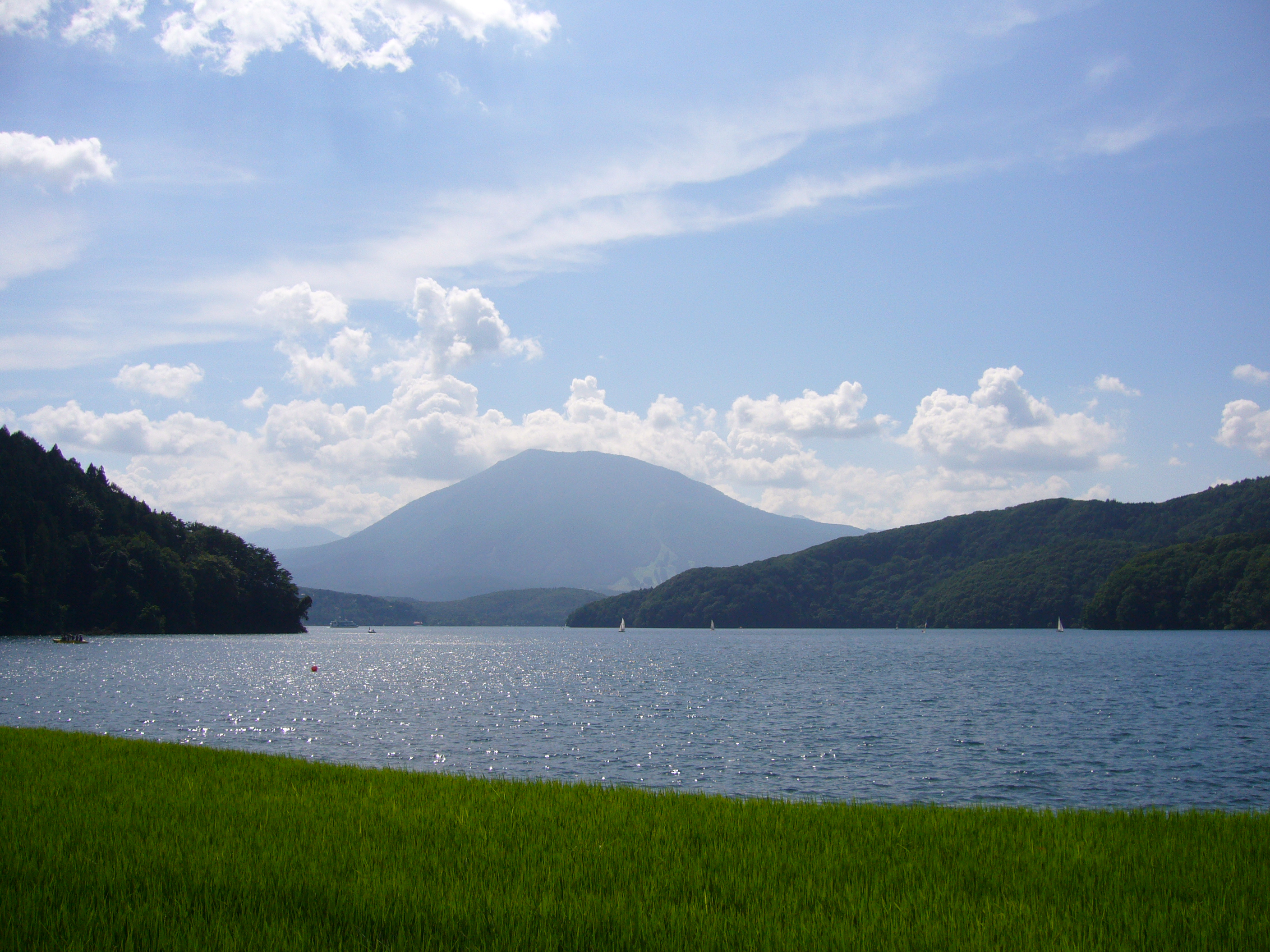
Lake Nojiri
In 1946, someone pulled a tusk from the mud at the edge of Lake Nojiri and changed everything scientists thought they knew about prehistoric Japan. The tusk belonged to a Naumann's elephant, a species that vanished from these islands tens of thousands of years ago. Further excavation revealed stone tools, bone implements, and the butchered remains of elephants and deer scattered across a submerged promontory called Tategahana. The conclusion was extraordinary: 40,000 years ago, Paleolithic hunters used this lakeshore as a kill-butchering site, processing megafauna on a rocky point that now lies beneath five meters of clear mountain water. Lake Nojiri is a quiet resort destination in Nagano Prefecture, nestled on a 654-meter plateau between Mount Madarao and Mount Kurohime. But beneath its calm surface, the bones of an ancient world are still giving up their secrets.
Born from Fire, Shaped by Water
Lake Nojiri sits in a basin that owes its existence to volcanic violence. Geologists debate the exact mechanism -- some attribute the damming to an eruption of Mount Madarao to the east, others to a mudflow triggered by Mount Kurohime to the west -- but the result is the same: a body of water covering 4.56 square kilometers, making it the second largest natural lake in Nagano Prefecture after Lake Suwa. What Nojiri lacks in surface area it makes up in depth. At 39.1 meters, its storage volume actually exceeds that of the much broader Lake Suwa. The water drains through the Ikejiri River, joins the Seki River, and eventually reaches the Sea of Japan. The lake's transparency ranges between five and seven meters, a clarity that invites you to peer into the depths and wonder what else might be waiting down there.
The Tategahana Hunters
The accidental tusk discovery in 1946 led to formal excavations beginning in 1962, both along the lakeshore and on the submerged lakebed itself. Archaeologists working at the Tategahana promontory on the western shore pulled up a remarkable collection: stone implements, tools carved from bone, fossils of Palaeoloxodon naumanni -- the Naumann's elephant, named for German geologist Heinrich Edmund Naumann, who first identified the species in Japan -- and remains of deer. Through analysis of diatoms, pollen, paleomagnetism, and volcanic ash deposits, researchers placed the site firmly in the Pleistocene, roughly 40,000 years before the present. The Nojiri-ko Research Group, led by Y. Kondo, concluded that Tategahana was a dedicated kill-butchering site where early humans processed large game. A museum on the lakeshore, the Lake Nojiri Naumann Elephant Museum, now houses the finds and tells the story of the hunters who once worked this shoreline.
Dome Boats and Vanishing Trout
Lake Nojiri rarely freezes over in winter, a trait that sets it apart from many highland lakes in this region. That open water draws anglers year-round, and the winter fishing tradition here has produced an ingenious adaptation: dome boats, small enclosed vessels outfitted with stoves, allowing fishermen to sit in warmth while jigging for smelt through openings in the hull. The target is Hypomesus nipponensis, the Japanese pond smelt, a small silver fish pulled from the cold lake by the thousands. But the lake's ecology has shifted over the decades. Native Japanese trout once thrived here. They are gone now, replaced by bass introduced from the United States, a familiar story of invasive species reshaping a waterway. The smelt persist, though, and the sight of dome boats clustered on Nojiri's surface on a gray winter morning remains one of the quieter spectacles of the Japanese highlands.
A Highland Crossroads
Lake Nojiri also holds a place in Japan's energy history. It was the site of the country's first pumped-storage hydroelectric facility, a technology that uses elevation differences to store and generate electricity by moving water between reservoirs at different heights. The lake's plateau setting between two volcanic peaks provided the ideal geography. Today, the area around Nojiri is resort country -- a landscape of forested slopes, clean air, and seasonal visitors drawn by the water in summer and the snow that blankets the surrounding mountains in winter. The town of Shinano, in Kamiminochi District, wraps around the lake's northern shore. It is a place where deep time and modern leisure overlap, where you can fish from a heated boat in the morning and visit a museum full of elephant bones in the afternoon, all at 654 meters above sea level on a plateau that two volcanoes accidentally conspired to create.
From the Air
Lake Nojiri is located at 36.826N, 138.222E on a highland plateau at 654 meters elevation in Nagano Prefecture, Japan. The lake covers 4.56 square kilometers and is clearly visible from the air, situated between Mount Madarao to the east and Mount Kurohime to the west. Nearest major airport: Niigata Airport (RJSN), approximately 80nm northwest. Matsumoto Airport (RJAF) lies roughly 70nm to the south. The Hokuriku Shinkansen corridor passes nearby through the town of Iiyama. Expect mountain weather patterns with cloud buildup around the flanking peaks, especially in afternoon hours. Winter brings heavy snowfall to this region.
Sources
- Lake Nojiri
- On the origin of Lake Nojiri
- Palaeoloxodon naumanni and its environment at the paleolithic site of Lake Nojiri
- Lake Nojiri Naumann Elephant Museum (Nojiriko Museum)
- Lake Nojiri - Wikipedia