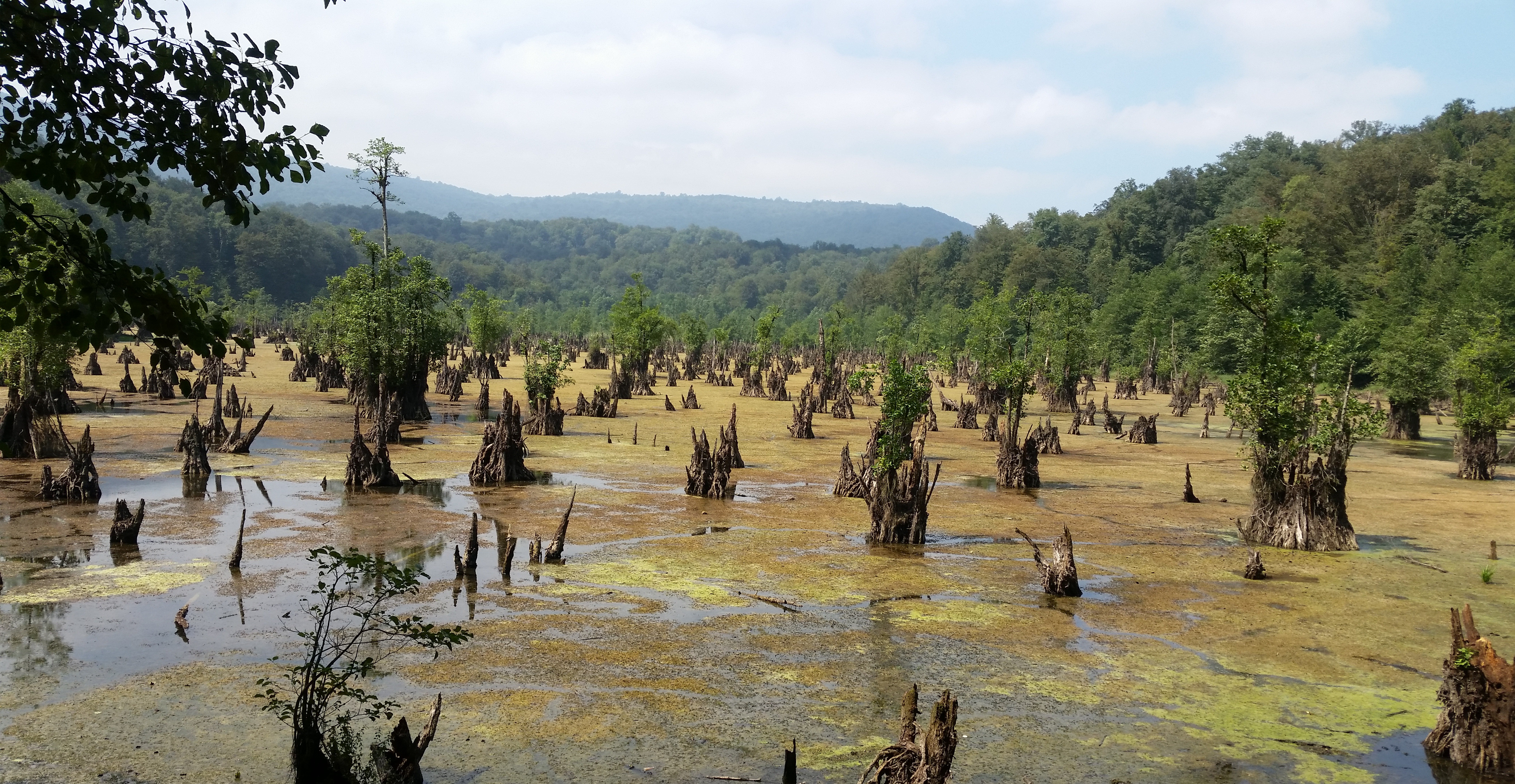
Lake of Ghosts
The trees stand in the water like drowned figures, arms raised, bark peeling away in gray strips. Mist drifts between them most mornings, blurring the boundary between air and water, trunk and reflection. Locals call this place Mamraz Lake -- mamraz meaning hornbeam in Persian -- but visitors have given it a more evocative name: the Lake of Ghosts. Tucked into the richly forested mountains of Mazandaran province, 48 kilometers from the city of Nowshahr on Iran's Caspian coast, this 40-hectare swamp lake is one of the strangest and most beautiful natural sites in the country. It is also one of the hardest to reach.
Phantoms in the Water
The ghostly appearance of the lake comes from its hornbeam trees. Hornbeams are native to Iran, capable of growing tall with smooth, gray-green bark. But the specimens in this lake have been partially submerged for years, and the water has slowly killed them. Their trunks and branches protrude from the surface in various states of decay -- some still bearing a few leaves, others reduced to skeletal frameworks that catch the mist and hold it. The effect is haunting, especially at dawn when fog pools in the basin and the trees emerge from the whiteness like figures frozen mid-step. Unlike the hornbeams, the alder trees around the lake are well-adapted to wetland conditions and remain healthy, their green canopy providing a vivid contrast to the ghostly gray of the dying hornbeams.
Ancient Origins
The lake formed over geological timescales stretching from the middle Cretaceous period to the Quaternary -- a process spanning tens of millions of years. The surrounding forests of Mazandaran are among the most biodiverse in Iran, home to a rich flora of both woody and herbaceous plant species. The Iranian government has recognized the lake's ecological significance, registering it with the Cultural Heritage, Handicrafts and Tourism Organization under registration number 402, a designation intended to protect its animal and plant species. The forests surrounding the lake are part of the Hyrcanian forests, a relic woodland stretching along the southern coast of the Caspian Sea that has survived since the last ice age.
Roads That Barely Exist
For all its strange beauty, the Lake of Ghosts remains largely undeveloped. There are no visitor facilities, no boardwalks, no interpretive signs. Access requires a four-wheel-drive vehicle on rough roads, and even then only safely at certain times of year -- the mountain roads of Mazandaran become impassable during heavy rains and winter snows. The nearest settlement is the village of Vanush, a small community that offers no tourist infrastructure. This inaccessibility has kept the lake in a state of near-pristine isolation, visited mainly by adventurous Iranians and the occasional documentary film crew. Filmmaker Reza Jafari Jozani has produced a documentary titled The Lake of Ghosts, capturing the site's otherworldly atmosphere.
Where the Forest Meets the Water
Standing at the edge of the Lake of Ghosts, the landscape feels pulled from another era. The Caspian forests of northern Iran receive far more rainfall than the arid plateau to the south, and the vegetation is lush and deciduous -- oaks, beeches, hornbeams, and alders crowd together in a density that would surprise anyone whose image of Iran is limited to desert. The lake sits within this green world like a wound, a place where the forest has been reclaimed by water and the trees have lost the battle. Birds move through the mist. The water is dark and still. There is no sound of traffic, no sound of construction -- only the occasional crack of a dead branch falling into the water. The Lake of Ghosts earns its name not through any supernatural legend but through the simple, uncanny reality of what it looks like.
From the Air
Located at 36.505N, 51.837E in the forested mountains of Mazandaran province, approximately 48 km from Nowshahr on the Caspian coast. The lake covers 40 hectares in a densely forested mountain basin. The area is characterized by heavy forest cover and frequent fog, especially in morning hours. Nearest airport: Noshahr Airport (OINN) approximately 48 km northwest. The Alborz Mountains rise to the south, and the Caspian Sea coast is visible to the north. Exercise caution for mountain weather and limited visibility due to fog.