Lake Onega
From the air, Lake Onega's northern shoreline looks like the silhouette of a giant crayfish, its elongated bays reaching inland like claws. This is Europe's second-largest lake -- after nearby Lake Ladoga -- and it sprawls across three Russian administrative regions: the Republic of Karelia, Leningrad Oblast, and Vologda Oblast. Fed by roughly fifty rivers and drained by a single one, the Svir, it covers an area slightly smaller than Lebanon. Its 1,650 islands include one that may contain the most extraordinary collection of wooden architecture on Earth.
Carved by Ice, Written in Stone
Lake Onega is young in geological terms, carved about 12,000 years ago by retreating glaciers at the end of the last ice age. But the rocks along its eastern shore carry messages far older than any civilization the region has known. Approximately 1,200 petroglyphs -- engravings of animals, people, boats, and geometric shapes -- are scattered across several capes, including Besov Nos. Dating to between the fourth and second millennia BC, they represent one of the largest concentrations of Neolithic rock art in northern Europe. In 2021, the Onega petroglyphs were inscribed as a UNESCO World Heritage Site for what the organization called their "significant artistic qualities that testify the creativity of the Stone Age." These engravings survived millennia of ice, erosion, and human indifference, and they endure on the same granite that forms the lake's bedrock.
Twenty-Two Domes on an Island
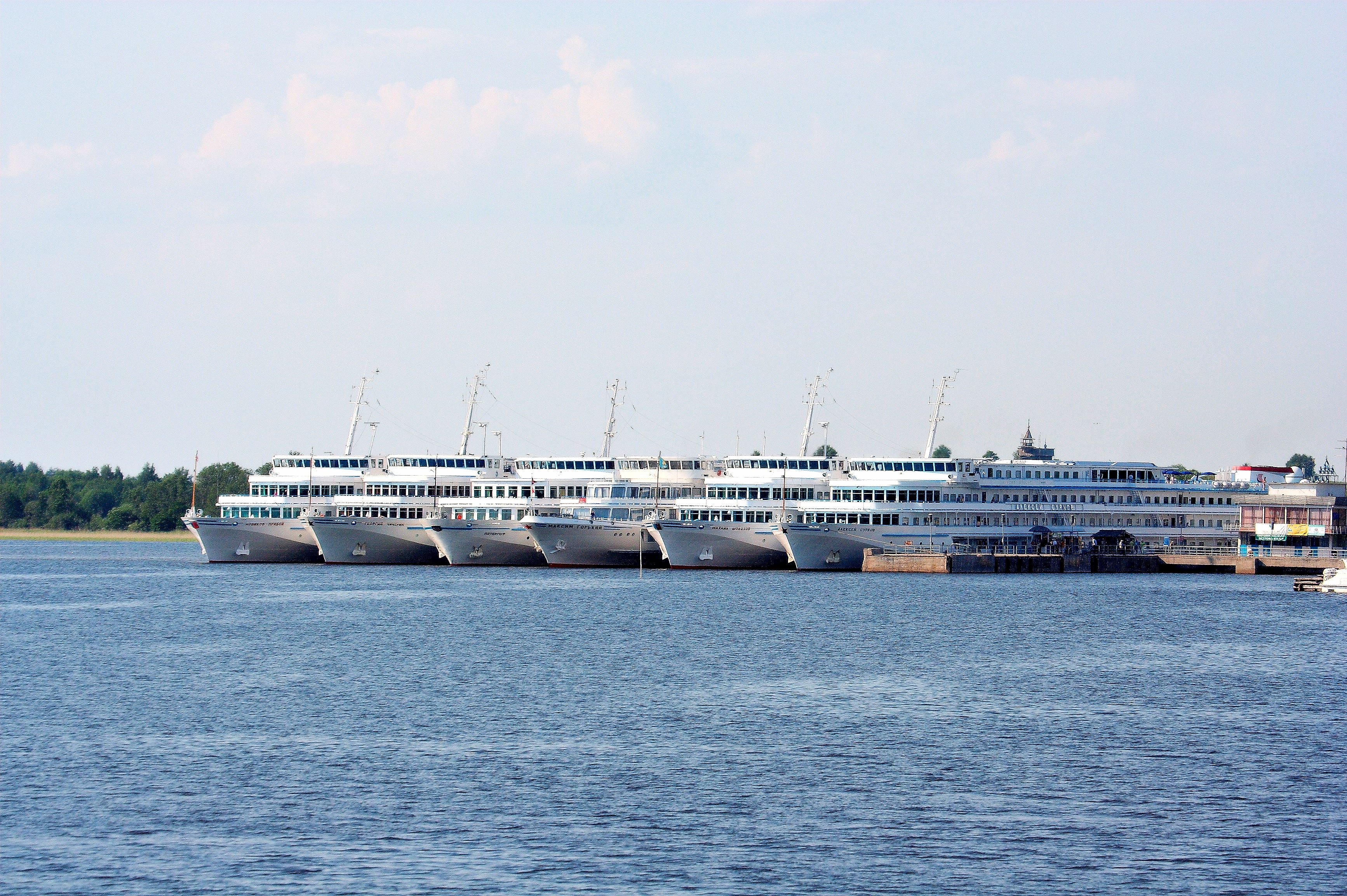
Kizhi island sits in the lake's northern waters, and it is one of those places that seems too improbable to exist. The island hosts 89 wooden architectural monuments spanning the fifteenth to twentieth centuries, collectively forming a State Historical, Architectural and Ethnographic Preservation Area. The centerpiece is Kizhi Pogost, an early-eighteenth-century ensemble comprising a summer church crowned with 22 wooden domes, a nine-domed winter church, and a belfry. The pogost was inscribed as a UNESCO World Heritage Site in 1990. In summer, daily boats from Petrozavodsk carry visitors to the island, where the wooden domes -- assembled without a single nail, according to tradition -- catch the subarctic light in ways that make them appear to shift and breathe.
Three Cities and a Waterway
Petrozavodsk, the capital of the Republic of Karelia with roughly 270,000 residents, was founded in 1703 by Peter the Great to exploit the region's ore deposits. Its embankment along Lake Onega features a series of sculptures gifted by twin cities around the world. Kondopoga, known since 1495, once possessed the tallest wooden church in the Russian North: the 42-meter Uspenskaya Church, built in 1774 and tragically destroyed by arson in 2018. Medvezhyegorsk, founded in 1916, served as the construction base for the White Sea-Baltic Canal in the 1930s. The lake itself forms a critical node in Russian waterway infrastructure, connecting the Volga-Baltic Waterway to the White Sea-Baltic Canal and linking the basins of the Baltic, Caspian, and northern seas. Ships from this lake can reach ports from Germany to Iran.
A Living Ecosystem Under Pressure
Beneath its surface, Lake Onega harbors 47 fish species from 13 families, including sturgeon, landlocked salmon, and glacial relicts like lamprey. Brown bears, wolves, lynxes, and elk roam its forested shores, and some 200 bird species have been recorded in the basin. But the lake's ecology is under growing strain. Roughly 80 percent of the basin's population and over 90 percent of its industry concentrate around the three major cities in the north and northwest. Each year, those cities discharge approximately 190 million cubic meters of sewage and drainage water. Ships and roughly 8,000 motorboats contribute an estimated 830 tonnes of oil pollution per navigation season. Since 1972, the lake has hosted Russia's largest annual sailing regatta every July -- a celebration of the water that is also a reminder of what stands to be lost if the pressures of habitation and industry go unchecked.
From the Air
Located at 61.69N, 35.66E in northwestern Russia, Lake Onega is an enormous visual feature spanning roughly 250 km north-south and 80 km east-west. The lake's distinctive crayfish-shaped northern shoreline, the island of Kizhi, and the city of Petrozavodsk on the western shore are identifiable from altitude. Nearest airport is Petrozavodsk (Besovets, ULPB) on the western shore. At cruise altitude, the lake and nearby Lake Ladoga form the two dominant water features of northwestern Russia. The Volga-Baltic Waterway passes through the lake's southern end.