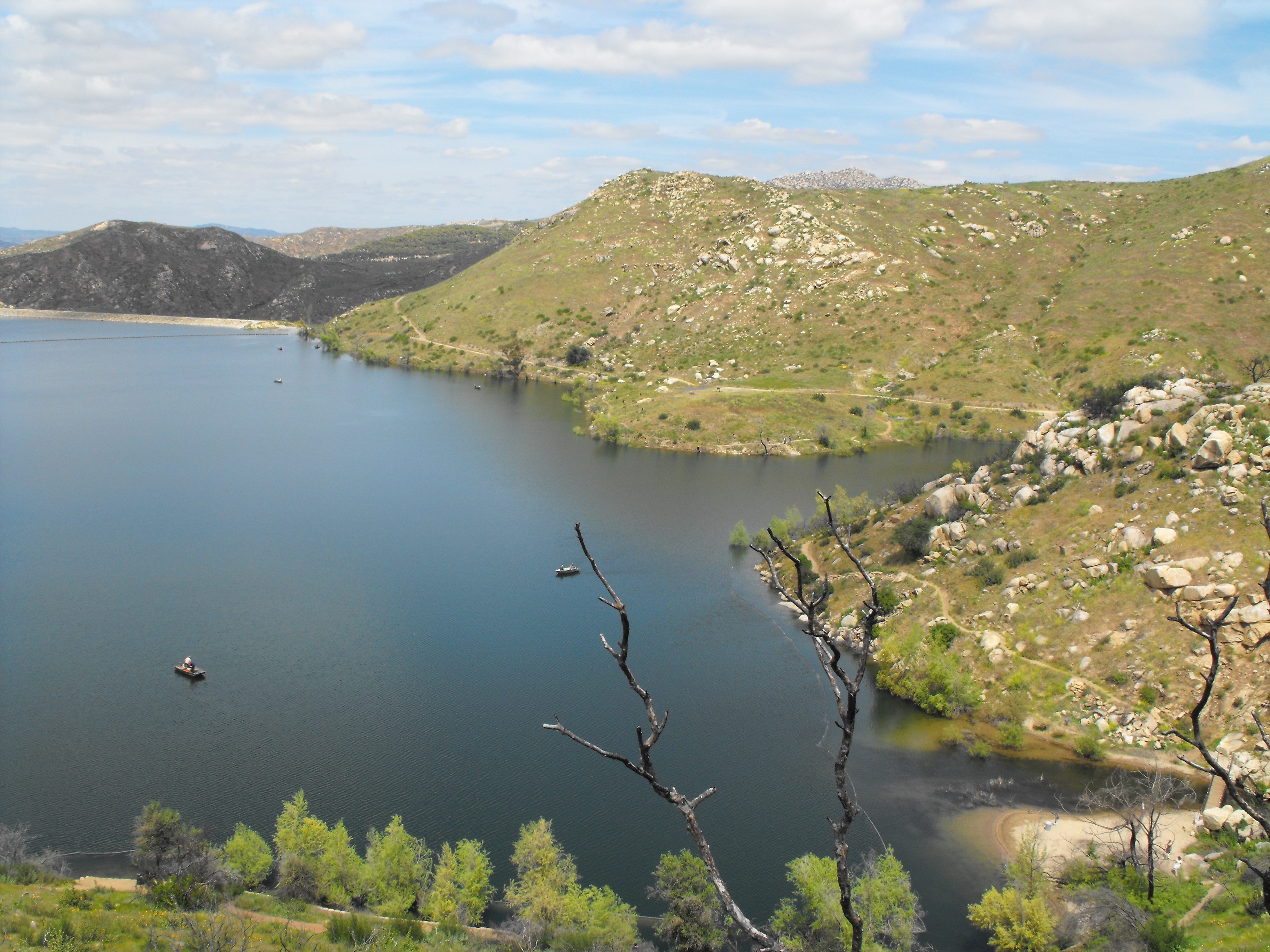
Lake Poway
In 1964, residents of Poway voted on whether to build a dam. Most said yes — but not enough of them. The measure needed a two-thirds majority. It failed again in 1966 for the same reason. Finally, in June 1969, the bond passed with 87 percent in favor. Something had changed in the five years since the first vote: people had started to realize how fragile their water supply was. An earthquake or an aqueduct failure could leave Poway without water from the Colorado River for weeks. The lake was built as insurance. What emerged from Warren Canyon was something more.
The Dam That Took Three Tries
Groundbreaking came in December 1970. Water began filling the 165-foot earthen dam in late 1971, and recreational facilities opened in October 1972. The reservoir covers 35 acres and holds 3,800 acre-feet — modest by San Diego County standards, but perfectly sized for a community that wanted a local facility rather than dependence on distant infrastructure. The Lester J. Berglund water treatment plant processes water delivered by the San Diego County Water Authority. In 2019, that system almost failed spectacularly: a storm drain pipe backed up during heavy November rains, a valve failed, and storm water contaminated the clearwell reservoir with mud. The county ordered businesses to shut down for a week. The incident led to a planned $70 million overhaul of the entire water system.
Tony Gwynn's Bronze Shore
On May 9, 2017, a bronze statue was unveiled at the lakeside — a memorial to Tony Gwynn, the San Diego Padres Hall of Famer who spent much of his life in Poway. Gwynn was a rare constant in a city that cycles through sports loyalty the way it cycles through championship droughts. He played twenty seasons with the Padres, hit .338 for his career, and never left San Diego for a bigger contract. The statue, designed by Seth Vandable, stands near the water as a reminder that some people choose a place and stay. Near the statue, the high schools hold their annual rivalry softball game — Poway High versus Rancho Bernardo High — a tradition since 1997 called the Game at the Lake.
Trails Through Four Worlds
The lake loop trail runs 2.75 miles around the reservoir's perimeter, passing through four distinct ecological zones in a single walk: coastal sage scrub, chaparral, oak woodland, and riparian woodland. Near the water's edge in season, arroyo lupine blooms purple against the brown hills, and Wild Canterbury bells offer their lavender cups to pollinators. The trail connects to the Blue Sky Ecological Reserve and, for those willing to gain significant elevation, to the summit of Mount Woodson — where Potato Chip Rock juts out above the valley below. The lake also serves as a launching point for this popular hike, which draws thousands of visitors each weekend.
What Lives in the Water
The lake is stocked with rainbow trout through winter and offers bass, catfish, sunfish, and bluegill year-round. The records in the logbook tell a story of patient mornings and lucky casts: a 47-pound blue catfish pulled from the lake in 2017; a bass at nine pounds five ounces in 2020; a channel catfish at 28 pounds that stood as a record since 1981. The lake hosts an annual youth fishing derby that has run for more than 25 years. These numbers suggest not just good stocking but something that accumulates over time — a place that has been tended, returned to, and cared for across decades by a community that voted for it three times before it existed.
From the Air
Lake Poway lies at 33.0069°N, 117.01°W in the hills above Poway. The 35-acre reservoir is clearly visible from altitude as a compact blue oval surrounded by chaparral. Recommended viewing altitude 3,500–6,000 ft MSL. Nearby airports: KSEE (Gillespie Field, ~8 nm south), KMYF (Montgomery-Gibbs Executive, ~12 nm southwest). Mount Woodson and Potato Chip Rock are visible to the northeast.