Lake Quinault Lodge
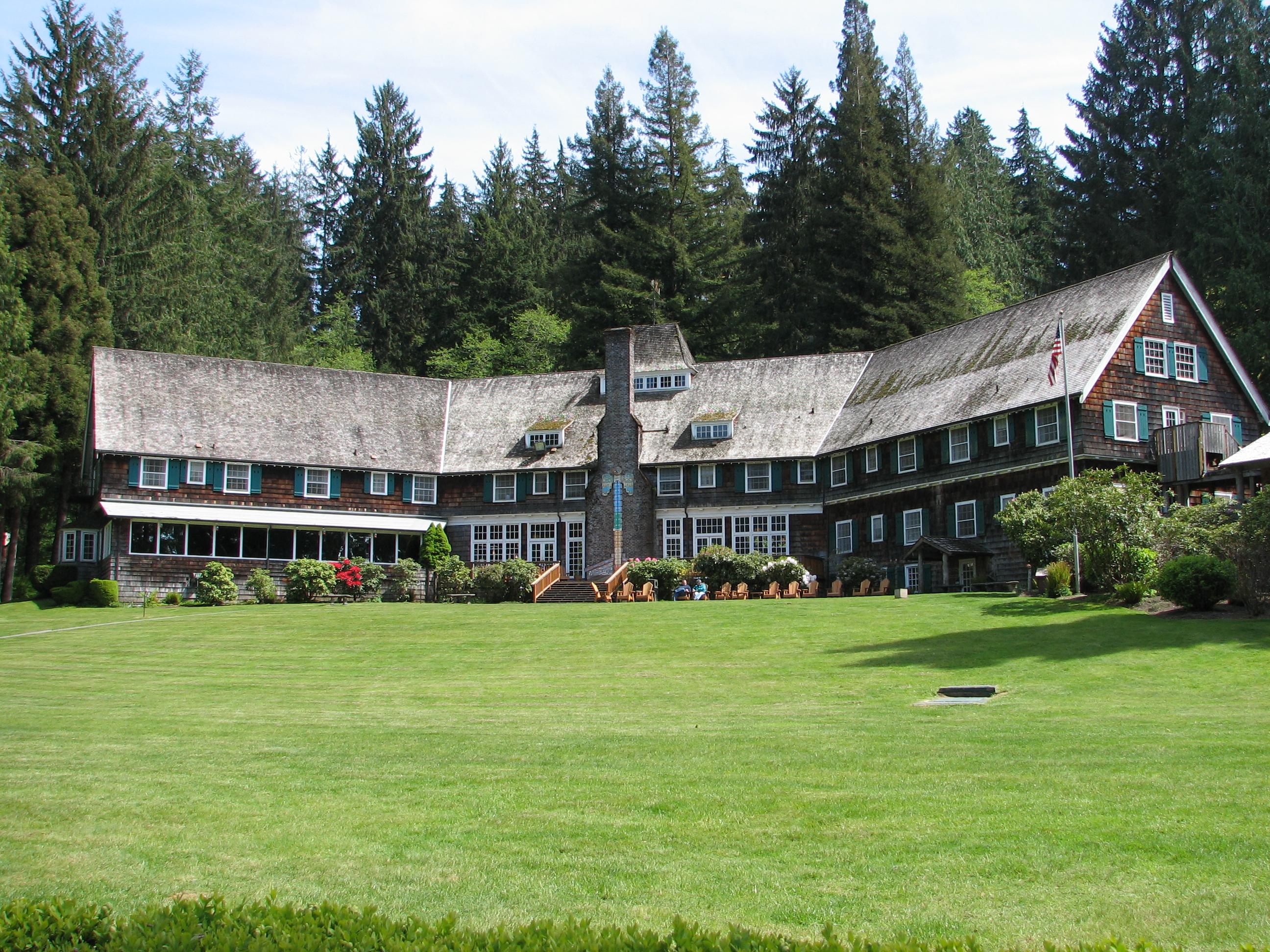
The rain gauge on the chimney is shaped like a totem pole, and it measures rainfall in feet. Not inches -- feet. That single detail tells you everything about where Lake Quinault Lodge sits: on the soggy, magnificent southeast shore of Lake Quinault, where the Olympic Mountains wring moisture from Pacific storms at a rate that would drown most buildings into ruin. Yet this cedar-shingled lodge, designed in 1926 by Robert Reamer -- the architect who gave Yellowstone its iconic Old Faithful Inn -- has outlasted nearly a century of downpours, looking as though it grew from the forest floor rather than being built upon it.
From Ashes to Architecture
The lodge standing today is not the first to occupy this lakeshore. Jack Ewell built the original structure, which passed through a string of owners -- the Higleys bought it in 1905, Herbert Olson took over around 1907, and the Seaman family acquired it in 1921. On August 24, 1924, fire consumed the building entirely. Lumberman Ralph Emerson of Hoquiam bought out the Seamans and funded the replacement. The first stage was a modest structure that still stands as the annex, restored in 2007. But the lodge proved so popular that Emerson commissioned something grander, hiring Robert Reamer to design the main building. Reamer brought the same philosophy he had applied at Yellowstone: let the architecture defer to the landscape. The result was a roughly V-shaped lodge, clad in cedar shingles, with its lobby positioned at the angle of the V so that anyone sitting by the masonry fireplace looks straight out across the water.
Built to Disappear Into the Trees
Reamer understood something about wilderness lodges that lesser architects missed: the building should feel inevitable, as though the trees had simply parted to make room for it. The Lake Quinault Lodge is a two-story wood-frame structure where the wings follow the slope of the ground, creating a three-story facade at the ends without the building ever appearing to tower over anything. The upper floor walls project slightly outward from the ground floor, a subtle technique that gives the lodge a grounded, settled appearance. Inside, smooth finished timbers support the upper floor, their grain visible and warm. Large expanses of windows face in both directions from the central lobby, framing the lake on one side and the forest on the other. Dormers and a cupola punctuate the steep roof above the central wing, drawing the eye upward in a way that echoes the surrounding conifers. Two smaller wings extend from the reception side, creating an entrance court that feels sheltered even before you step inside.
Wartime Silence and Postwar Revival
Emerson sold the lodge in 1939, and the building went dark during World War II -- windows shuttered, the great fireplace cold. After the war, the Walker family took over operations and brought the lodge back to life. For decades it served as an informal retreat, a counterpart to the Rosemary Inn and Lake Crescent Lodge elsewhere on the Olympic Peninsula. In 1988, the Aramark corporation purchased the property, adding it to their portfolio of national park concessions. Through all these transitions, the essential character of the place remained unchanged: a warm hearth surrounded by wet forest, where the sound of rain on cedar shingles is as constant as breathing.
Where Rainfall Is Measured by the Foot
The lodge earned its place on the National Register of Historic Places on July 9, 1998, recognized not just for its architecture but for what it represents -- a particular American impulse to build something beautiful in a place so remote and wet that beauty seems beside the point. Lake Quinault receives an average of 131 inches of precipitation per year, more than eleven feet. The totem pole rain gauge on the chimney is not a joke but a necessity. Moss colonizes every surface that holds still long enough. The surrounding Quinault Rainforest -- a temperate jungle of Sitka spruce, western red cedar, and Douglas-fir -- presses against the lodge on three sides, its canopy so dense that even midday light arrives filtered and green. Standing on the lodge's lakeside porch, watching fog lift off the water while rain patters on the roof above you, the distinction between indoors and outdoors feels like a polite suggestion rather than a boundary.
From the Air
Located at 47.47°N, 123.85°W on the southeast shore of Lake Quinault, at the southern edge of Olympic National Park. The lodge sits where the forest meets the lake and is visible as a clearing along the shoreline. Lake Quinault itself is a glacial lake roughly 3 miles long, easily spotted as a dark water feature in the dense green canopy of the Quinault Valley. Nearest airports: Bowerman Airport (KHQM) in Hoquiam, approximately 35nm southwest; Olympia Regional Airport (KOLM) roughly 65nm southeast. The Olympic Mountains rise dramatically to the north. Expect frequent low cloud cover and rain -- VFR conditions can be challenging in this valley.