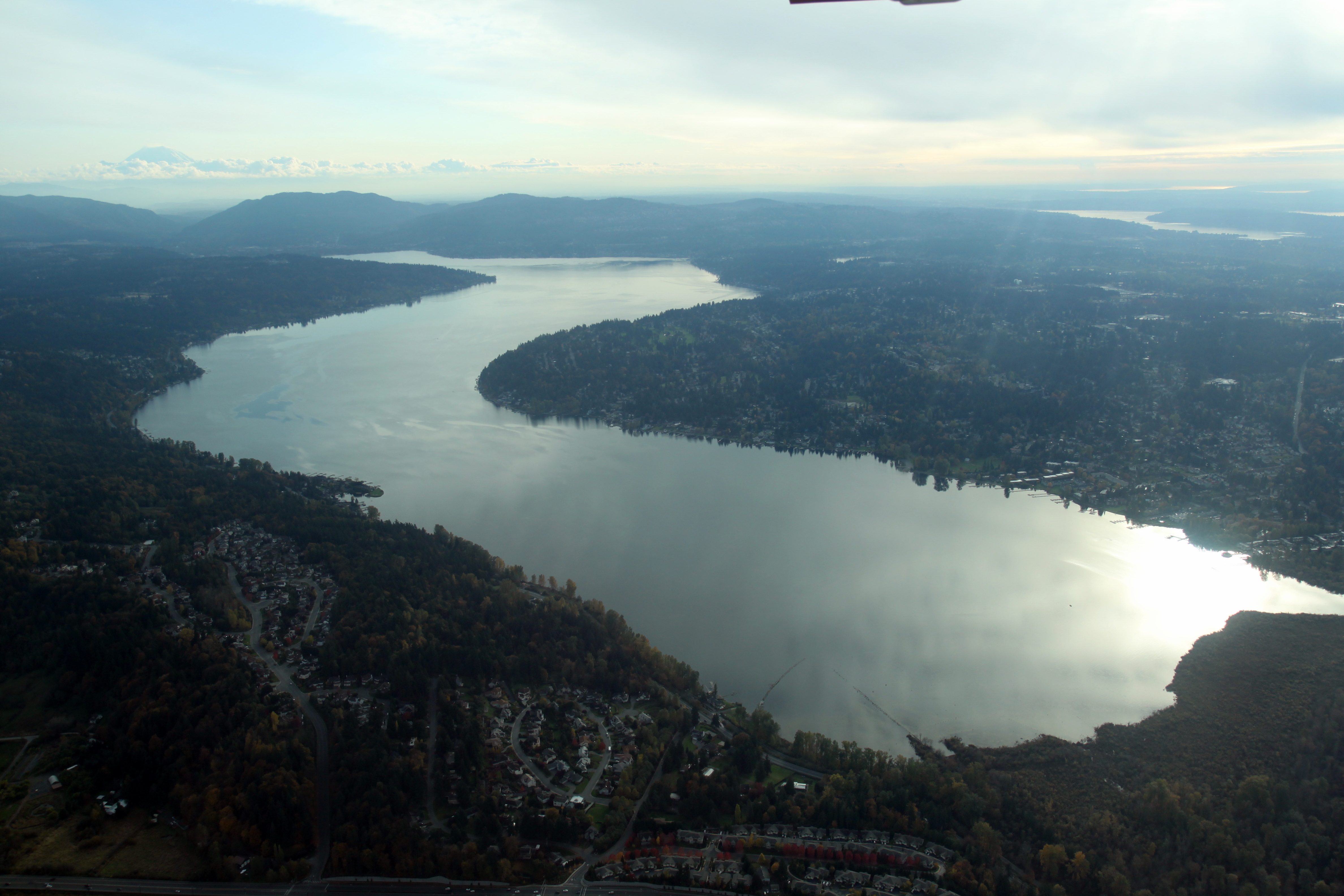
Lake Sammamish
From the air, Lake Sammamish appears as a long blue finger pointing north through the green suburbs east of Seattle. This glacial lake stretches seven miles from Issaquah to Redmond, its waters draining through the Sammamish River to Lake Washington and ultimately Puget Sound. The Sammamish people who gave it their name are largely gone now, but their lake remains, caught between preservation and development in one of America's fastest-growing metropolitan areas.
Waters Under Pressure
The Lake Sammamish watershed receives nearly twice the rainfall of downtown Seattle, precipitation that once filtered through old-growth forest before reaching the lake. Today, that runoff courses over parking lots and lawns, carrying sediment and pollutants that cloud the waters and threaten the fish below. Kokanee salmon, a landlocked variety that once thrived here, now teeter on the edge of local extinction. The federal government has asked surrounding cities to restrict shoreline development, a request that has met resistance from communities built on growth.
The Return of the Beaver
In recent years, North American beavers have returned to Lake Sammamish, building dams on tributary creeks and creating the ponds that once sustained this watershed. City officials worry about flooding and blocked salmon runs, calling for the animals' relocation. Yet research from the nearby Stillaguamish River tells a different story: watersheds that lost their beaver ponds saw coho salmon production drop by 89 percent. The debate over these industrious rodents mirrors the larger tension between development and ecology that defines this lake.
Recreation and Memory
Marymoor Park anchors the lake's northern shore, while Lake Sammamish State Park occupies the south. On summer weekends, the lake fills with waterskiers, wakeboarders, and fishing boats pursuing bass, trout, and the occasional salmon. But the state park carries darker memories. On July 14, 1974, a warm Sunday afternoon, a man with his arm in a sling approached young women on the beach, asking for help loading his sailboat. Two women who agreed to help were never seen alive again. The man was Ted Bundy, and Lake Sammamish became one of the most infamous crime scenes of the twentieth century.
From the Air
Lake Sammamish is unmistakable from the air as a long north-south oriented lake east of Lake Washington. The city of Sammamish occupies the plateau to the east, while Bellevue sprawls to the west. Marymoor Park's distinctive velodrome is visible at the lake's north end near Redmond. Interstate 90 crosses just south of the lake at Issaquah. Nearest airports: Renton Municipal (KRNT) 10nm southwest, Boeing Field (KBFI) 12nm west, Seattle-Tacoma International (KSEA) 18nm southwest.