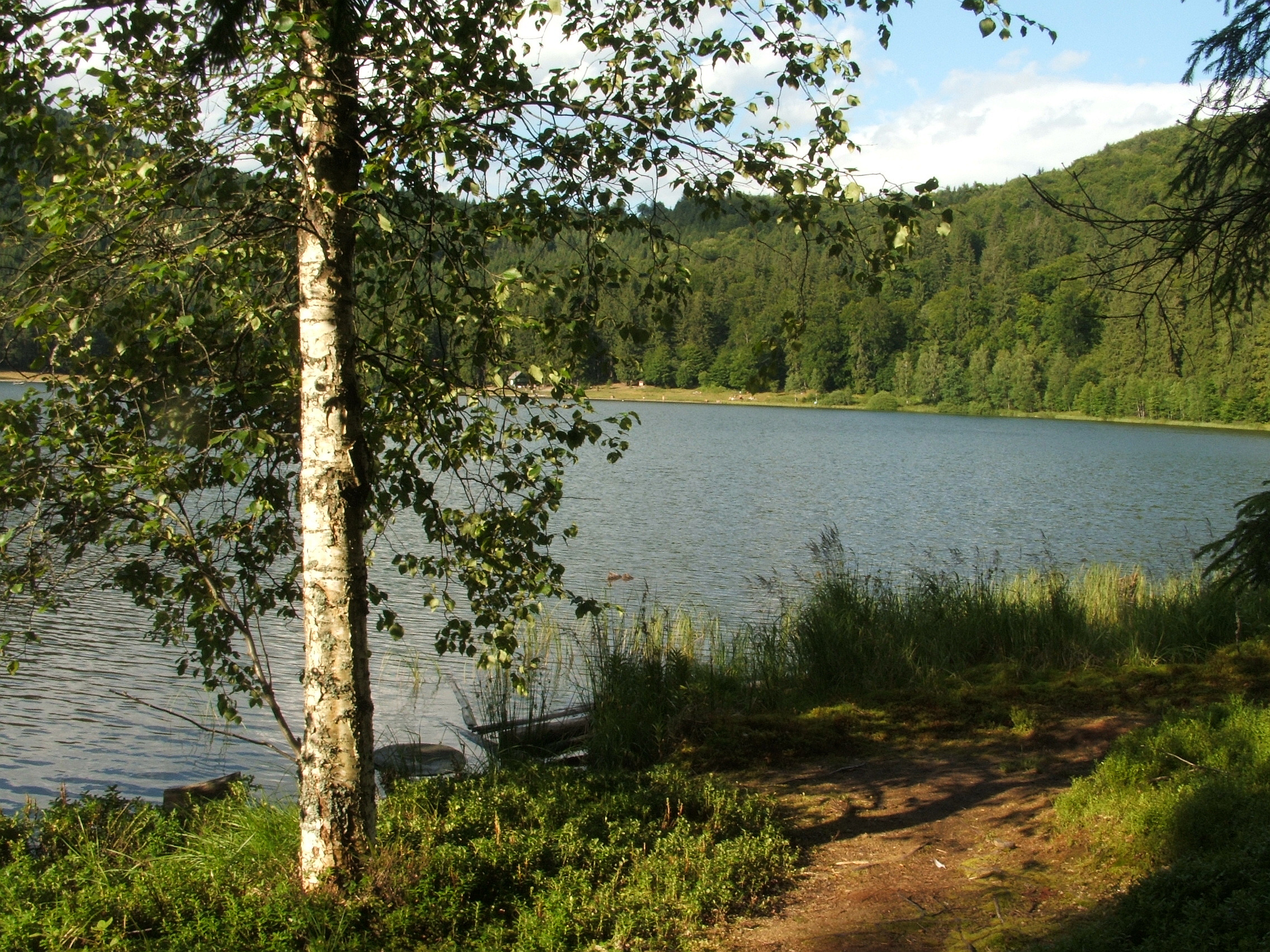
Lake Sfânta Ana
The water is almost too clean. With a mineral content of just 0.0029 milliliters per liter, Lake Sfanta Ana holds water so pure it rivals what comes out of a laboratory distillation apparatus. Fed by nothing but rain and snowmelt, unconnected to any stream or spring, this near-circular lake sits in a volcanic crater in the Eastern Carpathians of Romania, surrounded by dense beech and spruce forest that climbs the caldera walls on all sides. It is the only crater lake in the country, and the volcano beneath it may not be finished.
The Youngest Fire in the Carpathians
Ciomad is the youngest volcano in the Carpathian chain, sitting at the southeastern end of the volcanic arc that sweeps across Transylvania. The mountain's explosive history stretches back roughly a million years, but its most significant eruptions occurred between 56,000 and 32,000 years ago. Researchers have debated the timing of the last eruption: estimates range from 32,000 years ago to as recently as 9,800 years ago, based on palynology studies of pollen layers preserved in the lake's sediments. What is not debated is that the volcano is not dead. A 2019 study published in geophysical journals found evidence of a persistent magma reservoir with significant melt content beneath Ciomad, meaning the volcano retains the potential for future reactivation. The quiet lake on the surface belies what simmers below.
A Palette Drawn by Rain
Seen from above, the lake resembles a painter's palette, almost circular but slightly elongated: 620 meters long, 460 meters at its widest, covering 19.5 hectares at an altitude of 946 meters. Because the lake has no inlet or outlet, receiving water solely from precipitation, it exists in a kind of hydrological isolation. This makes its chemistry extraordinarily simple and its water exceptionally transparent. The depth, however, is shrinking. In 1867, measurements recorded a maximum depth of 12 meters. By 2005, that figure had dropped to 6.4 meters, with roughly four meters of sediment accumulated on the bottom. The lake is slowly filling in, a natural process of sedimentation that, over geological time, will transform it from open water to marsh to meadow. In winter, ice up to a meter thick seals the surface, and the surrounding forest goes silent under heavy snow.
Saint Anne's Chapel and the Pilgrims
A small Roman Catholic chapel dedicated to Saint Anne stands near the lakeshore, giving the lake its name. For centuries, the site has drawn pilgrims, particularly ethnic Hungarians from the Szekely communities of Harghita County, who consider the lake a place of spiritual significance. The pilgrimage tradition reflects the cultural complexity of this corner of Romania, where Hungarian-speaking Szekely communities have lived for centuries alongside Romanian populations in the valleys below the Carpathian ridge. The lake sits within the Mohos Nature Reserve, a protected area that also encompasses the neighboring Mohos peat bog, one of the most important paleobotanical sites in the region. Since April 2018, swimming in the lake has been prohibited to protect its fragile water quality, though sporting events may still be permitted under special authorization.
The Breathing Caldera
The broader landscape around Lake Sfanta Ana tells a volcanic story that extends well beyond the lake itself. The Mohos crater, adjacent to Sfanta Ana's caldera, contains a peat bog rather than open water, representing a later stage in the same geological process that will eventually claim the lake. Carbon dioxide emissions from the ground around both craters confirm ongoing degassing from the magma system below, a reminder that Ciomad's geological clock has not stopped ticking. For scientists, this makes the area one of the most closely watched volcanic sites in the Carpathians. For visitors hiking the forested trail from Tusnad to the crater rim, the first glimpse of the lake comes suddenly: a break in the trees reveals an almost impossibly calm oval of water set into the mountain like a gemstone in a ring of green. The stillness is deceptive. Beneath the surface, sediments record thousands of years of climate and volcanic history. Beneath the sediments, the earth is warm.
From the Air
Lake Sfanta Ana is located at 46.126N, 25.888E at 946 meters elevation in the Ciomad volcanic crater. From the air, the near-circular lake is a striking blue-green disc set within a forested caldera, clearly visible at 3,000-5,000 feet AGL. The adjacent Mohos peat bog crater is visible just to the northwest. Nearest airport is Targu Mures (LRTM), approximately 100 km northwest. The spa town of Baile Tusnad lies in the valley to the west.