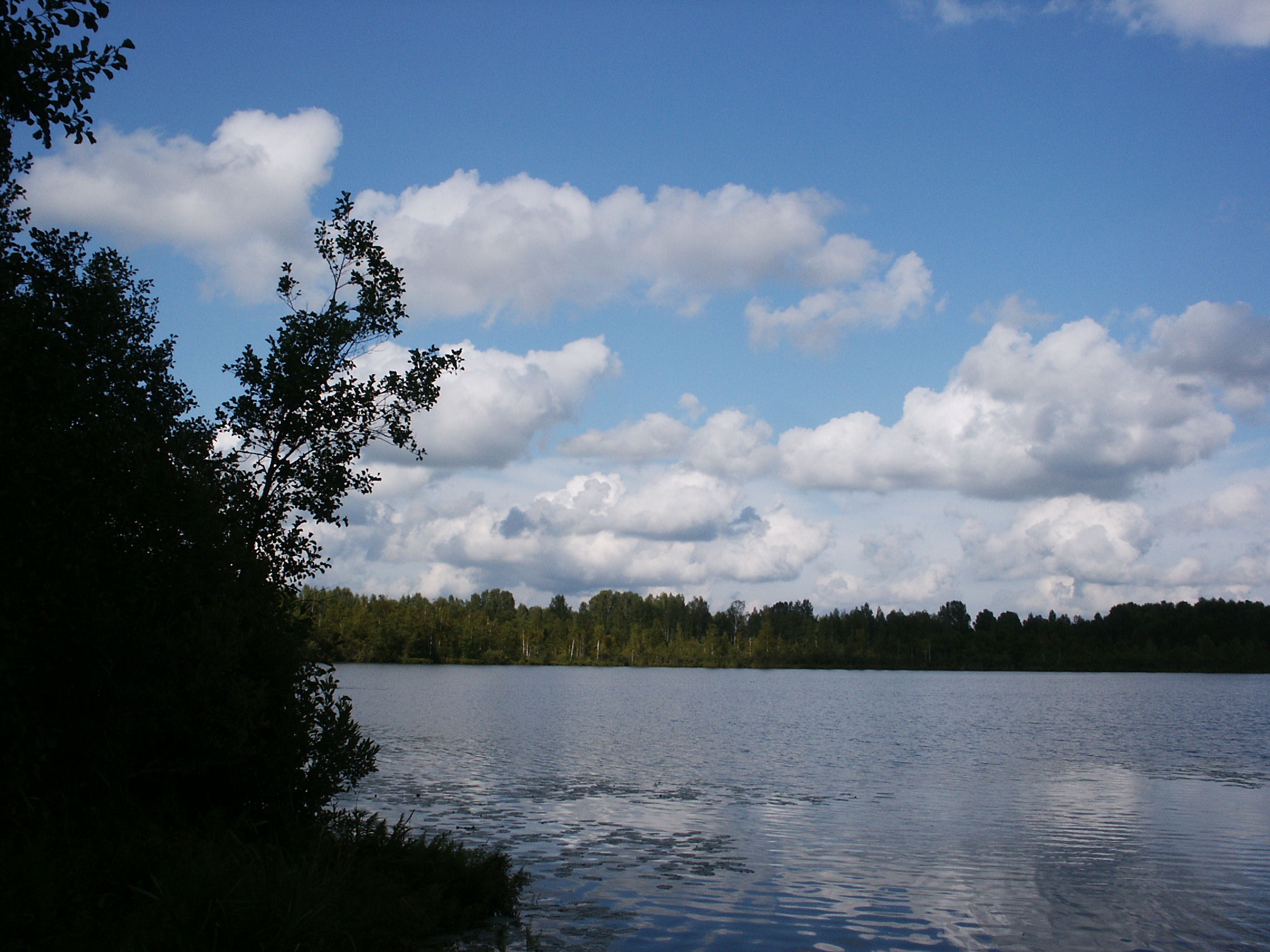
Lake Svetloyar
Something struck this spot roughly 3,000 years ago. The evidence is written in the geology: fused rock fragments, teardrop-shaped formations ejected from a foamy black vitreous mass resembling impactites, and a perfectly oval basin punched into the earth at a depth wildly disproportionate to its surface area. Lake Svetloyar, tucked into the forests between the Kerzhenets and Vetluga rivers in the Nizhny Novgorod Oblast, measures just 470 by 350 meters yet plunges to 33.4 meters -- a depth that helped spawn one of Russia's most resilient legends. Somewhere down there, the faithful say, lies the invisible city of Kitezh.
The Crater in the Forest
Lake Svetloyar sits in a distinct basin, its shores slightly elevated, ringed by hills that climb 13 to 15 meters above the waterline. The hills are most prominent to the south, where they form a curving arc separated by deep ravines. The lake's surface rests 109 meters above sea level. In 2009, field studies confirmed what geologists had long suspected: the lake was formed by a meteoric impact approximately 3,000 to 3,200 years ago. The evidence includes the stratigraphy of bottom sediments, fragments of fused rocks, and rounded teardrop formations consistent with impact debris. Researchers calculated that the meteor traveled from north to south along a low trajectory, striking the Earth's surface at an angle of 30 to 40 degrees. Stone Age tools found on the surrounding hills suggest that people inhabited this landscape long before the impact reshaped it.
Terraces Beneath the Surface
In 1969, a team led by Mark M. Barinov sent scuba divers into the lake with sonar bathymetry equipment and mapped a bottom far more complex than the simple bowl its surface suggests. The central depression is ringed by two underwater terraces -- broader in the northern section, narrower in the south -- sitting at depths of 9 to 10 meters and 18 to 20 meters respectively. The deepest point, 33.4 meters, lies in the southern portion of the lake, where the bottom drops away from a shallow platform at 22 to 24 meters. Barinov's team proposed that the lake formed in stages: the central basin appearing roughly 1,100 to 1,200 years ago, with the lower terrace subsiding some 700 to 800 years later. Whether the multistage formation reflects the original impact's structure or subsequent geological activity remains a subject of study.
Where Paganism Met the Cross
Long before the Kitezh legend took its familiar form, the lake drew pilgrims of a different kind. In his 19th-century novel In the Forests, the ethnographer Pavel Melnikov-Pechersky described Svetloyar as an ancient site of folk pilgrimage where vestiges of pagan worship persisted -- nighttime celebrations with tambourines, singing, and bacchanalian dancing that scandalized the elders of nearby Orthodox monasteries. The monks and their communities responded by christianizing the site. They declared the shores holy ground, brought icons and crosses to the water's edge, and began reading from the psalter where people once danced for Yarilo, the old Slavic deity. They composed the Chronicle of Kitezh and read it aloud to pilgrims, replacing pagan rites with the story of a city preserved by prayer. The transformation was deliberate, documented, and remarkably effective.
A Lake Between Worlds
In 2008, the area surrounding Lake Svetloyar was designated a natural park. In 2015, the lake and the village of Vladimirskoe were formally entered into Russia's Register of Cultural Heritage Objects as a site of local significance. The name Svetloyar itself carries layered meaning: "the bright bank" or "the ravine of light," possibly connected to Yarilo, whose festivals the lake once hosted. The 1993 documentary The Tale of the Great and Invisible City of Kitezh brought national attention to the site, airing on Central Television on Easter Day. Today the lake occupies a peculiar space between science and myth -- a verified meteorite crater that also serves as the most sacred geography in Russian folklore. Pilgrims still walk the path to its shores, and on quiet evenings, some still listen for bells.
From the Air
Located at 56.82N, 45.09E in the Voskresensky District, Nizhny Novgorod Oblast, between the Kerzhenets and Vetluga rivers (both Volga tributaries). The lake is small and oval (470 x 350 m) but distinctively deep, set in a basin surrounded by forested hills. Look for the circular clearing in the trees with elevated southern ridgeline. Nearest major airport: Nizhny Novgorod (UWGG), approximately 130 km west. Best spotted at 2,000-4,000 feet AGL. The area is heavily forested; the lake's open water contrasts sharply with the surrounding canopy.