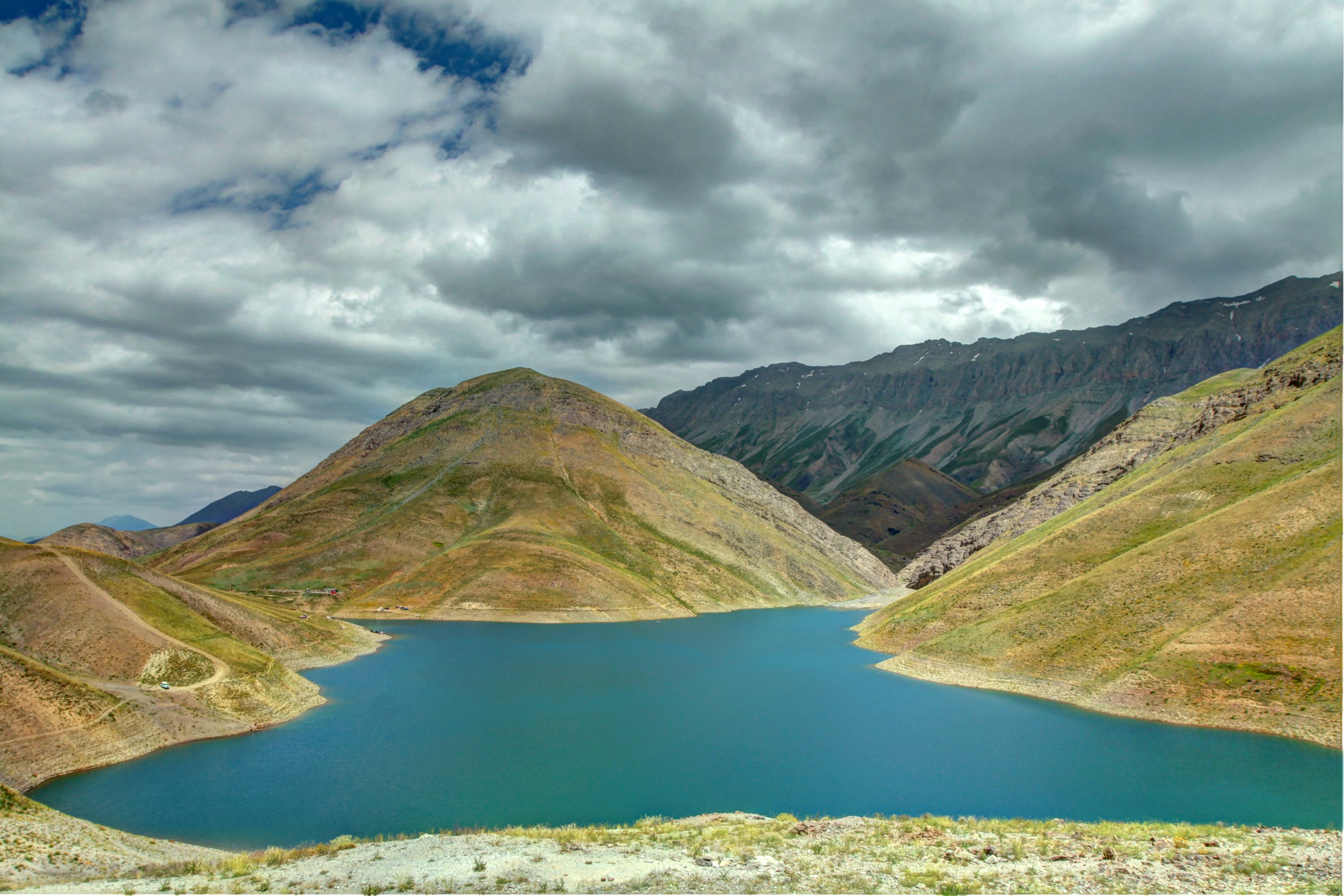
Lake Tar
Local legend insists that something lives in the water. Villagers around the Alborz Mountains have told stories for generations about mythical creatures inhabiting Lake Tar, a freshwater lake at 3,200 meters elevation where the air is too thin for trees and the water runs so cold it stays uninhabitable for months at a stretch. The lake covers seven square kilometers between the Qara Dagh range to the north and the Zarinkuh Mountains to the south, formed when a massive landslide from Zarinkuh dammed a natural valley. Whatever lurks in the stories, what actually inhabits the lake is remarkable enough: red-spotted trout and rainbow trout thrive in its frigid, spring-fed waters.
Born from a Collapsing Mountain
Lake Tar owes its existence to geological catastrophe. A massive landslide from Zarinkuh blocked the natural drainage of the valley, creating a basin that filled with water from boiling mineral springs, snowmelt from surrounding peaks, and seasonal rivers flowing from the south. The lake sits in the northern part of Damavand City's territory, east of Tehran. Its companion, the smaller Lake Hoyer, lies nearby along the same unpaved mountain road. The route from Damavand to the lakes passes through villages with names like Dalichay, Yeher, Momag, and Dehnar, each progressively more remote. Beyond Hoyer village, the road turns to dirt and demands a sturdy vehicle. The landscape surrounding both lakes is stripped bare by altitude -- no trees, no shrubs, just rock, water, and sky.
Springs That Boil from the Earth
The Karadagh Mountains harbor numerous boiling springs that feed Lake Tar from below, giving the water a mineral richness unusual for such a high-altitude lake. Seasonal rivers supplement this flow, and the outflow feeds the Tar River, which winds its way down to the city of Damavand. The combination of underground heat and freezing mountain air creates a microclimate around the lake that remains cold year-round, with persistent westerly winds sweeping across the water. June is the only reliable window for visiting, when the snowmelt eases and the mountain passes open. Even then, the temperature demands warm clothing. The Persian name itself hints at the water's character: 'badab' means 'gassed water,' referring to the carbonated mineral springs found throughout this region of the Alborz.
Trout, Treasure, and Tall Tales
Anglers have long made the difficult journey to Lake Tar for its trout fishing, particularly during spring when red-spotted trout congregate near the surface. Iran's Environment Bureau has supplemented the native fish populations by releasing redfish and zebrafish into the lake in recent years. But the lake's appeal extends beyond fishing. Historical accounts mention buried treasure somewhere in the surrounding mountains, a claim that has drawn hopeful searchers for centuries without any confirmed discovery. The purported magical properties of the lake's water have similarly persisted in local tradition. Whether these stories reflect actual historical events -- perhaps the hiding of valuables during one of Iran's many periods of invasion -- or simply the natural tendency of remote, beautiful places to generate mythology, they have made Lake Tar a destination for curious travelers as much as serious anglers.
A High-Altitude Mirror
From above, Lake Tar appears as a dark mirror set into barren mountainside. The absence of vegetation along its margins gives it a stark, almost lunar quality that distinguishes it from the green valleys far below. On calm days, the surrounding peaks reflect perfectly in the surface, doubling the landscape. The western slopes show the scars of rock quarries, while pine forests fill the northern approaches. To the east, low shrubs mark the transition between the treeless lake basin and the more hospitable elevations below. The lake sits within the broader landscape of the Alborz range, which runs roughly east-west across northern Iran, separating the Caspian coastal lowlands from the arid Iranian plateau. Damavand itself, the highest peak in Western Asia at 5,609 meters, looms to the northwest, a volcanic cone whose snow-capped summit is visible from Tehran on clear days.
From the Air
Located at 35.73N, 52.23E at approximately 3,200 meters elevation in the Alborz Mountains of northern Iran. The lake is a visible dark water feature amid barren terrain. Mount Damavand (5,609 m) is visible to the northwest. The nearest major airport is Tehran Imam Khomeini International Airport (OIIE) roughly 100 km southwest. Mehrabad International Airport (OIII) lies about 70 km west. Expect mountainous terrain and potential turbulence near the Alborz ridgeline.