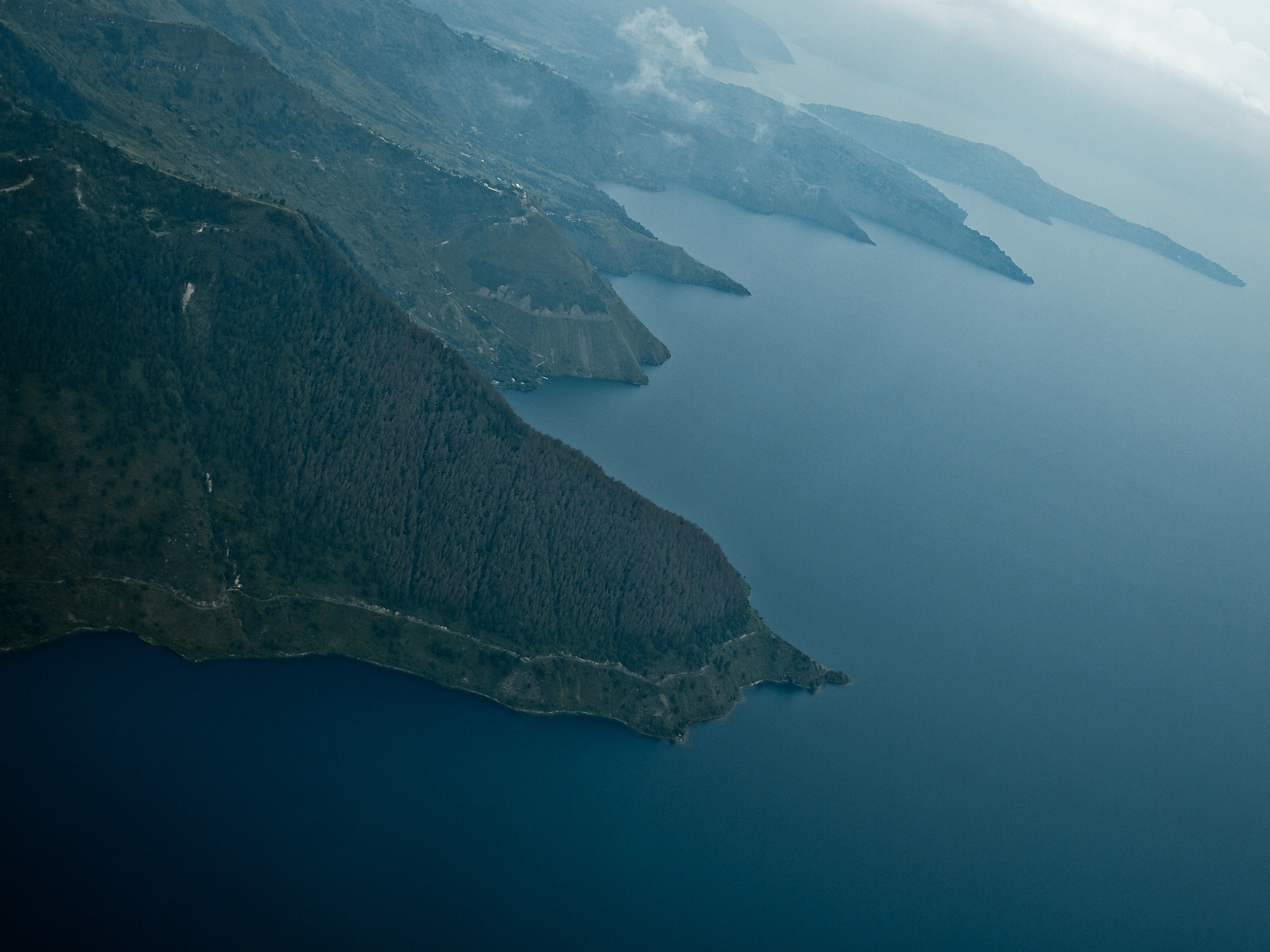
Lake Toba
Seventy thousand years ago, an explosion tore through the island of Sumatra with a force that makes every recorded eruption look like a campfire. The Toba supervolcano ejected roughly 2,800 cubic kilometers of material into the atmosphere, triggering a volcanic winter that may have lasted a decade. Genetic evidence suggests the global human population crashed to just a few thousand survivors. Today, the crater left behind holds something astonishing: a lake so vast it contains an island nearly the size of Singapore, which itself contains smaller lakes of its own. Lake Toba is an island within an island, a body of water born from the most catastrophic event in human prehistory, now ringed by pine forests and the traditional homes of the Batak people who have made this caldera their cultural heartland.
The Scar That Became a Sea
Lake Toba covers approximately 1,130 square kilometers of northern Sumatra, making it the largest volcanic lake in the world and probably the largest resurgent caldera on Earth. The numbers barely convey the scale. From the air, the lake stretches to the horizon in every direction, its deep blue surface broken only by the massive hump of Samosir Island rising from the center. Samosir was once connected to the caldera wall by a narrow isthmus; the Batak people eventually cut through it to let boats pass, and a road bridge now spans the gap. The lake sits at roughly 900 meters above sea level, giving the surrounding highlands a climate that feels more like the temperate zones than equatorial Indonesia. At night, temperatures drop enough to make a blanket welcome, a rarity in a country that straddles the equator.
Homeland of the Batak
Samosir Island is the cultural center of the Toba Batak people, one of several Batak ethnic groups who inhabit the highlands of North Sumatra. Their traditional houses, with dramatically swooping saddleback roofs, still dot the island's villages, and the tombs and monuments of Batak kings mark the landscape with a history that predates European contact by centuries. The Batak greeting is "Horas" - a word that means welcome, good morning, and farewell all at once. Most Toba Batak are Christian today, a legacy of German Lutheran missionaries who arrived in the nineteenth century, though older animist traditions still color daily life. The Batak script, an ancient writing system derived from Indian Brahmic scripts, survives in ceremonial contexts even as Indonesian and Latin letters dominate everyday communication.
Flavors from the Caldera
The cuisine around Lake Toba reflects a culture shaped by highland isolation and freshwater abundance. Arsik, the signature dish, slow-cooks carp with firewood until the fish absorbs a complex blend of savory, spicy, and faintly sour flavors; tradition dictates that the fish head faces the person who will eat it. Naniura takes the same carp in a different direction entirely - salt-cured in lime juice and coated in spices, it is essentially a Batak ceviche. Then there is tuak, a mildly intoxicating palm wine drawn from the sugar palm tree. Marco Polo noted in 1290 that the Batak people loved to drink it, and the tradition endures despite periodic local opposition. In the Toba Batak tradition, tuak was once reserved for kings engaged in deliberation. Now it flows more freely, though it remains a drink that carries cultural weight.
A Slower Rhythm
Lake Toba occupies a curious position in Southeast Asian travel. It was once a major stop on the so-called Banana Pancake Trail, the backpacker circuit that threads through the region's budget guesthouses and ferry routes. It has quieted since those peak years, but that is part of its appeal. The pace on Samosir Island moves at the speed of the ferries that connect it to the mainland town of Parapat - one per hour, the last at six in the evening. Travelers swim in volcanically warmed waters, rent bicycles from guesthouses in the village of Tuktuk, and watch traditional Batak dances performed in the open air. The infrastructure has improved - the Indonesian government has invested heavily in roads and amenities - but the lake's sheer remoteness, four hours by road from Medan, insulates it from the kind of overdevelopment that has overtaken other Indonesian destinations.
Deep Time, Present Tense
What makes Lake Toba extraordinary is the tension between its catastrophic origins and its present tranquility. The eruption that created it was so severe that some researchers have linked it to a genetic bottleneck that nearly extinguished Homo sapiens. The volcanic winter it triggered may have accelerated glaciation across the planet. And yet today the caldera is a place where people collect stranded fish from the shallows, where children ride the school ferry across glass-calm water, where pine forests climb the inner walls of what was once a magma chamber. The 2005 Nias-Simeulue earthquake even triggered renewed activity at Toba, a reminder that the supervolcano beneath the lake is not extinct but merely sleeping. For now, though, the dominant sound is the low hum of a ferry engine crossing the largest volcanic lake on Earth, carrying passengers toward an island born from the most violent event in human memory.
From the Air
Lake Toba sits at 2.67°N, 98.89°E in North Sumatra, Indonesia, at approximately 900 meters elevation. The caldera is unmistakable from altitude - a massive oblong lake roughly 100 km long and 30 km wide with Samosir Island clearly visible at center. The nearest major airport is Silangit Airport (WIMN) on the lake's southern shore, with Kualanamu International Airport (WIMM) near Medan approximately 175 km to the northeast. Approach from the east for the most dramatic view of the caldera walls. Best visibility in dry season (May-September); morning haze common over the lake.