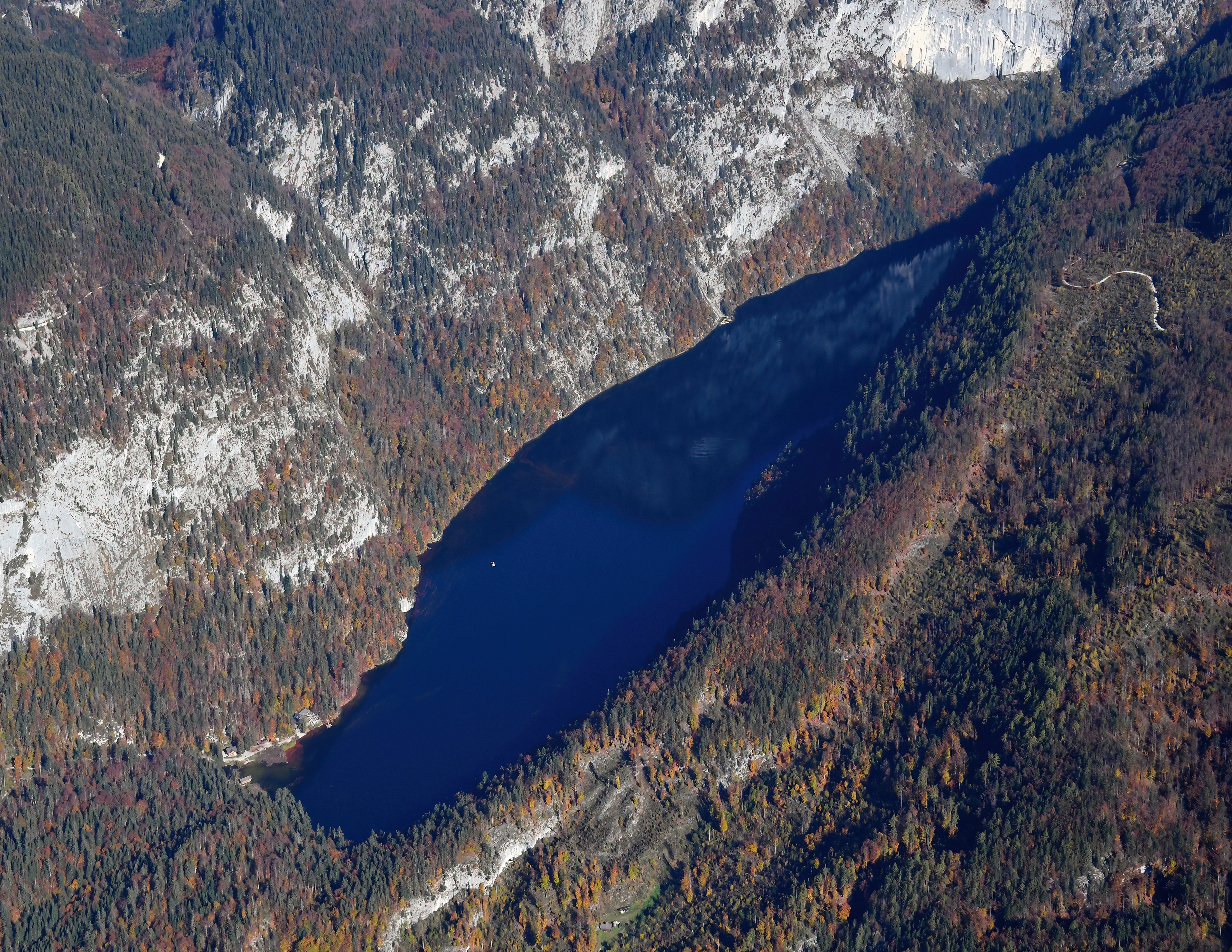
Lake Toplitz: The Alpine Lake That Swallowed Nazi Secrets
Below 20 meters, Lake Toplitz has no dissolved oxygen. Fish survive only in the top 18 meters. The deeper water is salty, lifeless except for bacteria and worms adapted to an anoxic world - and somewhere down there, beneath a layer of waterlogged timber that floats suspended halfway to the bottom like a false floor, lie the remnants of one of the strangest operations of the Second World War. The Nazis chose this lake precisely because of these qualities. Remote, deep, surrounded by cliffs and dense forest in the Totes Gebirge - the Dead Mountains - of the Austrian Alps, Lake Toplitz was a place designed by geology to keep secrets.
Operation Bernhard and a Lake Full of Counterfeits
In 1943 and 1944, the shore of Lake Toplitz served as a Nazi naval testing station. Scientists used copper diaphragms to experiment with underwater explosives, detonating charges of up to 4,000 kilograms at various depths. But the lake's most infamous cargo came from Operation Bernhard, a scheme to counterfeit British pound sterling notes on a massive scale and flood the British economy with fake currency. The operation, run from the Sachsenhausen concentration camp using imprisoned engravers and printers forced to produce the forgeries, generated an estimated 132 million pounds in counterfeit notes. As the war ended and the operation collapsed, cases of these notes were dumped into Lake Toplitz. How much went in and what else accompanied the counterfeits has been a matter of speculation, investigation, and obsession ever since.
The 1959 Recovery
Fourteen years after the war ended, investigators mounted an expedition to recover what the Nazis had sunk. In 1959, divers pulled counterfeit notes with a face value of approximately £9 million from the lake - a fraction of the 132 million pounds that Operation Bernhard produced in total. The notes were part of what Hitler had planned to use as economic warfare against Britain, though Operation Bernhard never achieved its full intended scale. But the divers encountered a problem that has frustrated every subsequent expedition: a layer of sunken logs, waterlogged but buoyant enough to hang suspended in the water column, creates a natural barrier partway down. Gerhard Zauner, one of the 1959 divers, reported seeing a sunken aircraft beneath this wooden ceiling. Whether the logs concealed additional valuables, war materiel, or nothing at all has never been definitively established. The suspended timber makes deep exploration hazardous, and the anoxic lower waters add another layer of difficulty.
A Landscape Built for Mystery
Lake Toplitz sits 98 kilometers from Salzburg in the Salzkammergut lake district, surrounded by the limestone peaks of the Totes Gebirge. The area is accessible only on foot, via a private mile-long track that leads to the Fischerhutte restaurant at the lake's western end. No road reaches the shore. The cliffs and dense forest create a natural amphitheater of silence, and the lake's unusual chemistry - oxygenated surface water over a salty, dead lower layer - gives it a stratified, almost geological quality. The name of the surrounding mountains, Totes Gebirge, translates as Dead Mountains, a reference to the barren limestone karst landscape rather than any wartime history, but the coincidence has not been lost on the writers, filmmakers, and treasure hunters who have made Lake Toplitz a recurring subject.
From Bond Villains to Buried Saucers
The lake's reputation has generated a cultural afterlife as strange as its history. In the 1964 James Bond film Goldfinger, the gold bar used to tempt Auric Goldfinger is said to have come from a Nazi hoard recovered from Lake Toplitz - a tongue-in-cheek reference for actor Gert Frobe, who had played a similar antagonist in the 1959 German film Der Schatz vom Toplitzsee. Helen MacInnes set her Cold War novel The Salzburg Connection around Nazi files hidden in a lake modeled on Toplitz. The 1981 BBC series Private Schulz depicted Nazis dumping 50 million forged pounds into the lake, though the scene was actually filmed at a reservoir in South Wales. Each retelling adds another layer of legend to a place already thick with it. The real Lake Toplitz remains what it has always been: quiet, cold, deep, and not entirely willing to give up what it holds.
From the Air
Located at 47.642N, 13.928E in the Salzkammergut lake district of Austria, within the Totes Gebirge mountain range. The lake is a narrow body of water nestled in a steep, forested valley - visible from the air as a dark sliver of water surrounded by dense coniferous forest and limestone cliffs. It sits approximately 98 km east-southeast of Salzburg. The nearest significant airport is Salzburg (LOWS), about 80 km to the northwest. The lake is at approximately 718 meters elevation. Best viewed at 3,000-5,000 feet AGL to appreciate its isolation in the mountain landscape. Look for the chain of lakes in the area - Toplitzsee connects via a short waterfall to the larger Grundlsee to the north.