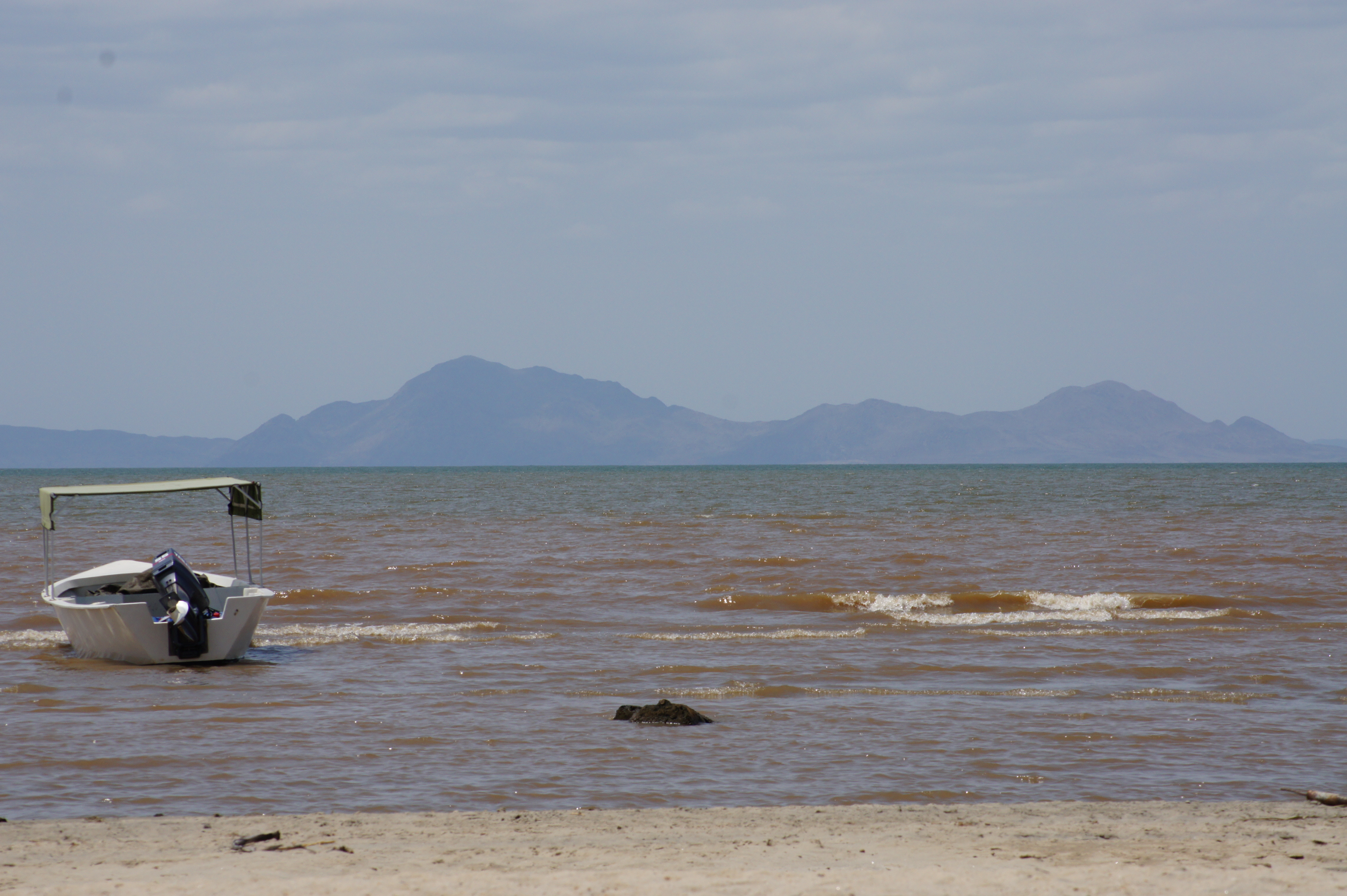
Lake Turkana
The water is green. Not the friendly green of a temperate lake on a summer afternoon, but a deep, mineral jade that gave Lake Turkana its other name: the Jade Sea. Stretching 250 kilometers through Kenya's northern desert, fed by the Omo River flowing south from Ethiopia, this is the largest permanent desert lake on the planet and the largest alkaline lake in Africa. Its waters are too saline to drink. Its winds can capsize a boat without warning. Its shores teem with Nile crocodiles. At its deepest, the lake plunges to 109 meters. And yet, for at least three and a half million years, hominids have chosen to live here, making the land around Lake Turkana one of the most important fossil sites in the story of human origins.
The Cradle No One Expected
Sibiloi National Park, on the lake's northeastern shore, has earned the title "Cradle of Mankind" for the fossils pulled from its sediments. In 1984, a team led by Richard Leakey and Kamoya Kimeu discovered a near-complete Homo erectus skeleton on the lake's western shore. The specimen, known as Turkana Boy, was approximately 1.5 million years old and belonged to an adolescent who stood about five feet three inches tall. It remains one of the most complete early human skeletons ever found. But the lake's paleontological record reaches back further still. Kenyanthropus platyops, a 3.5-million-year-old hominid discovered near the lake in 1999, is among the oldest tool-making ancestors yet identified. The oldest known stone tools, dating to roughly 3.3 million years, were also found in this region at a site called Lomekwi 3. Layer after layer of volcanic ash and lake sediment have preserved a timeline of evolution that few places on Earth can match.
Crocodile Island and Volcanic Fire
Central Island rises from the middle of the lake, a cluster of over a dozen volcanic cones whose crater lakes serve as some of the most important Nile crocodile breeding grounds in Africa. The island is also called Crocodile Island, and the name is not metaphorical. Reaching it requires a boat crossing that locals approach with caution, because Lake Turkana's winds build fast and the open water offers no shelter. South Island, at the lake's southern end, is equally volcanic and equally forbidding. The entire lake basin sits within the East African Rift system, and volcanic activity has shaped it for millions of years. Lava flows and cinder cones dot the shoreline, some dormant, some merely sleeping. The Barrier volcanic complex at the lake's southern tip last erupted in the early twentieth century. This is geology in motion, a landscape still being built and torn apart by the forces that are slowly splitting Africa in two.
The People of the Jade Sea
Two peoples define life on Lake Turkana's shores today. The El Molo, numbering perhaps a thousand, are one of Kenya's smallest ethnic groups. They live on the southeastern shore, fishing the alkaline waters and hunting hippos as their ancestors did, though their traditional way of life is under increasing pressure. On the western shore, the Turkana people are far more numerous, roughly a million strong across Turkana County. They are semi-nomadic pastoralists renowned as warriors and craftsmen. Turkana jewelry, carved from bone, shell, and metal, reflects a fierce aesthetic tradition. Their ostrich-feathered headdresses and intricately beaded necklaces are among the most distinctive personal adornments in East Africa. The Turkana have adapted to one of the harshest environments any pastoral people inhabit, reading the land for water and grazing with a precision that outsiders find almost incomprehensible.
Getting There Is the Point
Lake Turkana does not welcome casual visitors. From Marsabit to the east, the journey by matatu takes eight to ten hours over rough roads with no food stops along the way. From Lodwar to the west, dirt tracks lead to the remote village of Eliye Springs, where white sand beaches meet the alkaline water. Either approach requires a four-wheel-drive vehicle and a willingness to arrive exhausted, covered in dust, and uncertain whether the boat you need will be available. The nearest settlement of any size, Loiyangalani, sits on the eastern shore and serves as the usual base for visitors. Safaris can be arranged from Nairobi, but they cost upward of two thousand dollars and take four to five days. Airstrips exist but are rudimentary. The difficulty of access is not a bug but a feature. Lake Turkana remains one of the least-visited major natural wonders in Africa, and that isolation has preserved both its wildlife and its strangeness.
From the Air
Lake Turkana stretches from approximately 2.5N to 4.5N at 36.0E in northern Kenya, running roughly north-south for 250 km. From 15,000-20,000 feet, the jade-green lake is unmistakable against the surrounding desert terrain. Central Island and South Island are visible as dark volcanic forms within the water. The nearest significant airport is Lodwar Airstrip (HKLO) to the west. Marsabit Airport (HKMB) lies to the east. Extreme heat, strong surface winds, and dust storms are common, particularly during afternoon hours. The Omo River delta is visible at the northern end where the Ethiopian border begins.