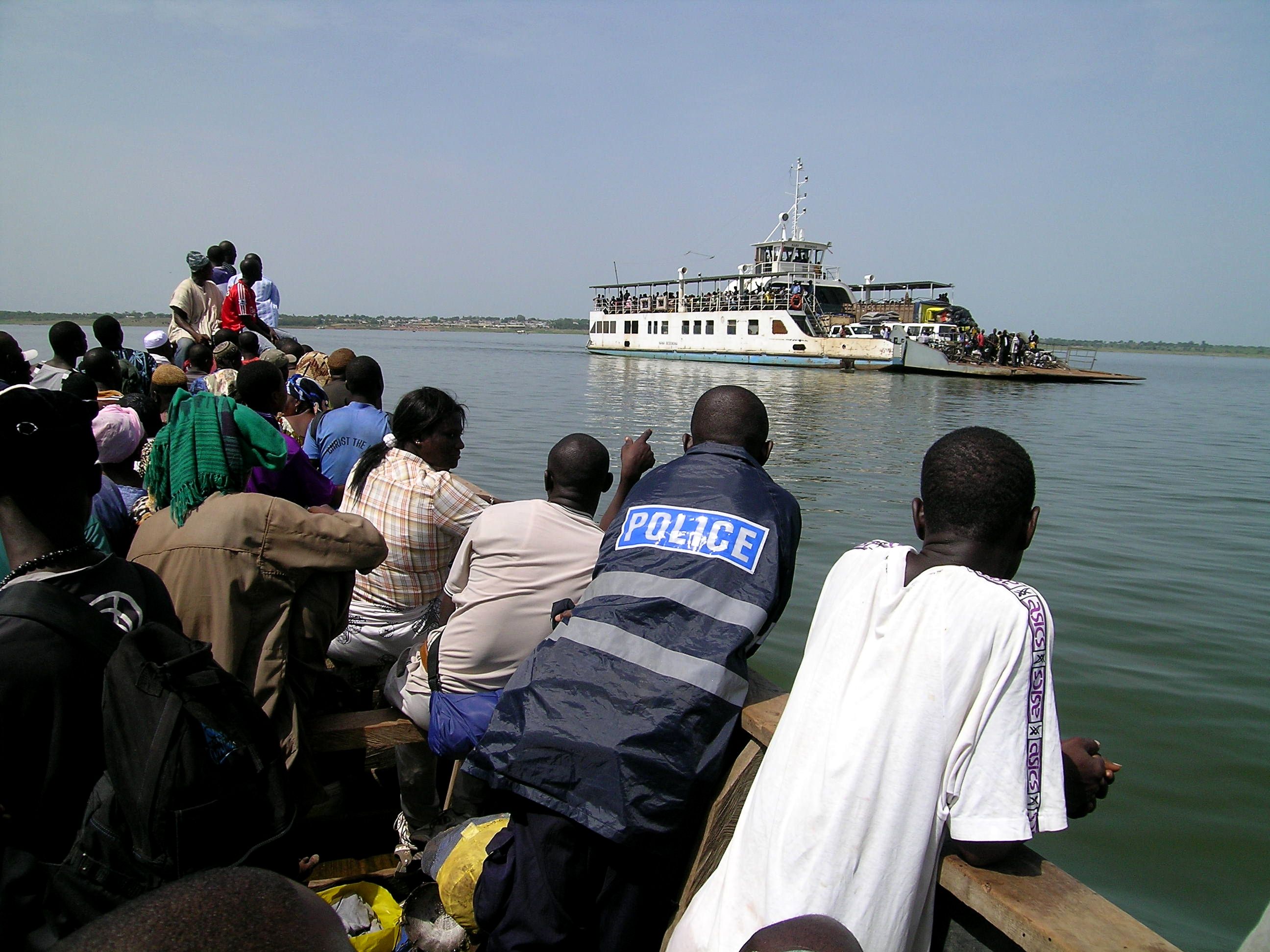
Lake Volta
Somewhere in the middle of Lake Volta, two rivers used to meet. The White Volta flowed south from Burkina Faso, the Black Volta curved in from the west, and they converged in what is now central Ghana to form the single Volta River. That confluence disappeared in 1965, drowned beneath a reservoir so vast it stretches 520 kilometers from the Akosombo Dam in the south nearly to the country's northern border. At 8,502 square kilometers, Lake Volta is the largest artificial lake in the world by surface area. It sits astride the prime meridian, six degrees north of the equator, and from the air it looks less like a lake than a dendritic fracture in the green landscape, its fingers reaching into every valley the Volta once drained.
A Geologist's Sketch, a President's Dream
The idea began in 1915 with Albert Ernest Kitson, a British geologist who surveyed the Gold Coast colony and realized the Volta River gorge near Akosombo could be dammed to generate electricity for smelting locally mined bauxite into aluminum. The plan languished for decades. It resurfaced after World War II, when Kwame Nkrumah rose to lead the Gold Coast's independence movement and began imagining a modern, industrialized Ghana. A joint British-Ghanaian commission studied the proposal and concluded that construction would require relocating more than 60,000 people. They also warned of malaria, schistosomiasis, and other waterborne diseases that a massive reservoir would inevitably breed. The commission weighed these costs against the promise of fisheries that could feed the region and hydroelectric power that could fuel an industrial economy. Nkrumah pressed forward.
The Price of the Flood
When Ghana gained independence in 1957, the original industrial sponsor, Aluminium Limited, withdrew. Revised plans abandoned the integrated bauxite-to-aluminum vision in favor of smelting imported ore, and Kaiser Aluminum stepped in. Funding negotiations dragged on for years, and cost-cutting measures eroded protections for the communities in the dam's path. Construction of the Akosombo Dam began before the government had finalized resettlement plans. A public agency eventually organized the building of 52 replacement towns, intended as models of modern rural development. The reality proved far grimmer. When waters began rising in 1964, the relocation was chaotic and poorly coordinated. An estimated 80,000 people were uprooted from ancestral lands, scattered into hastily built settlements, and left to rebuild livelihoods in unfamiliar places. The hardships did not end with the move; many displaced communities struggled for years afterward with inadequate housing, lost farmland, and fractured social networks.
Power and Timber Beneath the Surface
Today the Akosombo Dam generates 1,020 megawatts of electricity (upgraded from its original 912 MW capacity in 2006), powering much of Ghana and exporting energy to Togo, Benin, and neighboring countries. The dam transformed Ghana's economy, but the lake itself holds another resource few anticipated. When the reservoir filled, it submerged vast tracts of tropical forest. Decades later, those hardwood trees remain preserved underwater, and a large-scale timber harvesting enterprise now extracts them from the lake bed. The operation yields high-value tropical hardwood without additional logging or deforestation, and its advocates describe it as potentially the world's largest source of sustainably sourced natural tropical timber. Beyond the economics, removing submerged trees has improved navigation safety on a lake where ferries and fishing boats are the primary mode of transport between communities that the water both connects and isolates.
Life on the Water
Lake Volta's islands and shoreline communities depend on fishing for survival. Dodi, Dwarf, and Kporve islands dot the reservoir, and Digya National Park lines its western shore. Ferries link towns that would otherwise require long overland detours, and the lake has become central to the regional economy in ways both productive and troubling. International media reports have highlighted the use of child labor on fishing boats, though Ghanaian scholars like Samuel Okyere and Betty Mensah argue that much of this reporting oversimplifies a complex tradition of apprenticeship among fishing families, while acknowledging that exploitative labor conditions do exist and demand attention. Safety on the water remains a persistent concern. Boats are frequently overloaded, navigation hazards abound among submerged tree trunks, and the Ghana Maritime Authority continues to push for stronger enforcement after accidents that have claimed lives across the lake's vast expanse.
A Landscape Remade
From above, Lake Volta is unmistakable: a branching web of water that reshapes the entire geography of eastern Ghana. It is simultaneously a monument to postcolonial ambition, a source of national pride, and a reminder of the human costs that large-scale development exacts. The communities relocated to make way for its creation are still grappling with that legacy. The diseases the 1950s commission predicted materialized. The fishing economy it promised did emerge, but unevenly, and with complications no one fully anticipated. What the geologist Kitson sketched in 1915 and the president Nkrumah championed in the 1960s became something far more complex than either man imagined: not just a dam and a lake, but an entire ecosystem, economy, and society reorganized around the presence of water where there had been none.
From the Air
Lake Volta is centered near 7.4°N, 0.2°W, straddling the prime meridian in eastern Ghana. From cruising altitude the reservoir is immediately recognizable as an enormous dendritic water body stretching north-south across the country. The Akosombo Dam anchors the southern end near the town of Akosombo. At lower altitudes, submerged tree trunks are visible breaking the surface. Nearest significant airports include Kotoka International Airport (DGAA) in Accra, approximately 100 km south of the dam, and Tamale Airport (DGLE) to the north. Weather is tropical with haze common during the Harmattan season (December-February).