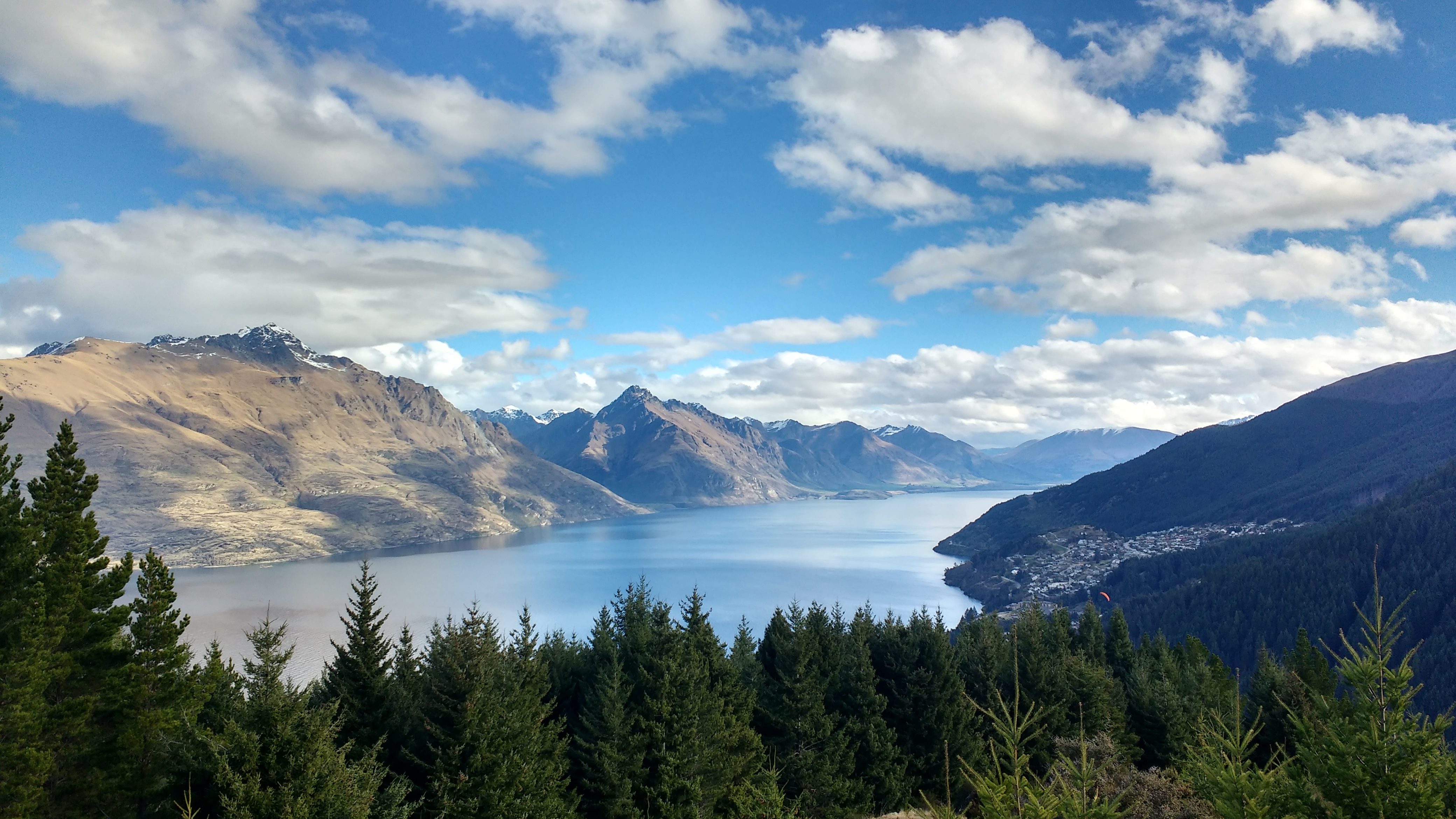
Lake Wakatipu
Every twenty-seven minutes, the water in Queenstown Bay rises by about twenty centimetres. Then it falls again. Rise, fall, rise, fall, a rhythm as steady as breathing. Scientists call it a seiche, a standing wave triggered by wind and atmospheric pressure oscillating in an enclosed body of water. The Maori had a better story. A giant named Matau kidnapped a young woman called Manata and carried her into the mountains. Her lover Matakauri tracked them down, waited until the giant slept, and set fire to the dry bracken surrounding him. The flames burned so hot they melted the earth, carving a trench that filled with water. The giant's body was consumed, all but his heart, which still beats beneath the lake. That heartbeat is the seiche.
Carved by Ice, Shaped Like a Letter
Lake Wakatipu occupies a glacial trough gouged from the Southern Alps roughly fifteen thousand years ago. At eighty kilometres, it is the longest lake in New Zealand. At 295 square kilometres, it is the third largest. Its shape traces a reversed "N" or dog-leg, running south from Glenorchy for thirty kilometres before turning sharply east, then bending south again for another thirty kilometres to Kingston. The Dart River feeds the northern end; the Kawarau River drains it through the Frankton Arm near Queenstown. The lake is extraordinarily deep. Its maximum depth reaches 420 metres, and its floor lies 111 metres below sea level, pressed down by the weight of the water above. Until about eighteen thousand years ago, the lake drained southward through what is now the Mataura River valley, until glacial moraine blocked that exit and forced the water to find a new way out to the east.
The Lady of the Lake
In 1912, the same year the Titanic sank, a coal-fired steamship slid into Lake Wakatipu for the first time. The TSS Earnslaw was 51.2 metres long, the largest steamship built in New Zealand, and she was put to work immediately. For decades she was not a tourist attraction but a lifeline, connecting isolated farming communities along the lakeshore with the outside world. Wool, livestock, and supplies moved across the lake because no roads reached the stations on the far side. The Earnslaw earned the nickname "The Lady of the Lake," and more than a century later she is still running, the only remaining commercial coal-fired passenger steamship in the Southern Hemisphere. Her twin triple-expansion engines still burn coal, her kauri deck still flexes underfoot, and she still crosses to Walter Peak, though now her passengers carry cameras instead of fence posts.
Gold, Film, and Adventure
William Gilbert Rees and Nicholas von Tunzelmann arrived at the lake in 1860 and were granted grazing runs along its shores. Two years later, gold was found at Dunstan, and the Otago gold rush delivered thousands of prospectors to the Wakatipu basin almost overnight. Queenstown grew from nothing into a town in months. The gold eventually ran out, but the landscape did not. In the twentieth century, the lake and its surrounding mountains became a backdrop for filmmakers. Peter Jackson used it as Middle-earth, filming scenes from The Lord of the Rings along its shores. The lake doubled as Scotland's Loch Ness in the 2007 film The Water Horse. Television followed: the lake is the setting for Jane Campion's murder mystery series Top of the Lake. Today the basin around Wakatipu is New Zealand's adventure tourism capital, offering bungy jumping, paragliding, jet boating, and skiing, all of it set against a lake whose scale makes every activity feel slightly more consequential than it probably is.
Mountains on Every Side
The lake does not exist in isolation. It is defined by the mountains that contain it. Along the southeastern edge, The Remarkables rise as a near-vertical wall of schist, their serrated ridgeline catching the last light of day in a way that earned their name from early settlers who found the range remarkable for running almost perfectly north-south. Cecil Peak and Walter Peak guard the western shore, accessible only by boat. Ben Lomond dominates the view from Queenstown, its 1,748-metre summit the most popular day hike in the region. To the north, the Dart River valley leads toward Mount Aspiring and the heart of the Southern Alps. Vineyards at Gibbston, in the Kawarau Gorge east of the lake, produce pinot noir at some of the most southerly commercial latitudes in the world. It is a landscape of extremes compressed into a small area, the kind of place where you can ski in the morning, taste wine at lunch, and watch a steamship from 1912 cross the lake at sunset.
From the Air
Located at 45.09°S, 168.56°E in the Otago region of New Zealand's South Island. The lake's distinctive reversed-N shape is clearly visible from altitude, stretching 80 km from Glenorchy in the north to Kingston in the south. Queenstown sits on the northern shore near the Frankton Arm. The Remarkables ski field is visible along the southeast edge. Nearest airport: Queenstown Airport (NZQN) on the Frankton Arm. The TSS Earnslaw's route to Walter Peak is often visible as a wake line on the water. Best viewed from 8,000-15,000 feet for the full shape of the lake. The Dart River delta at the northern end and the Kawarau River outlet at Frankton are distinctive features.