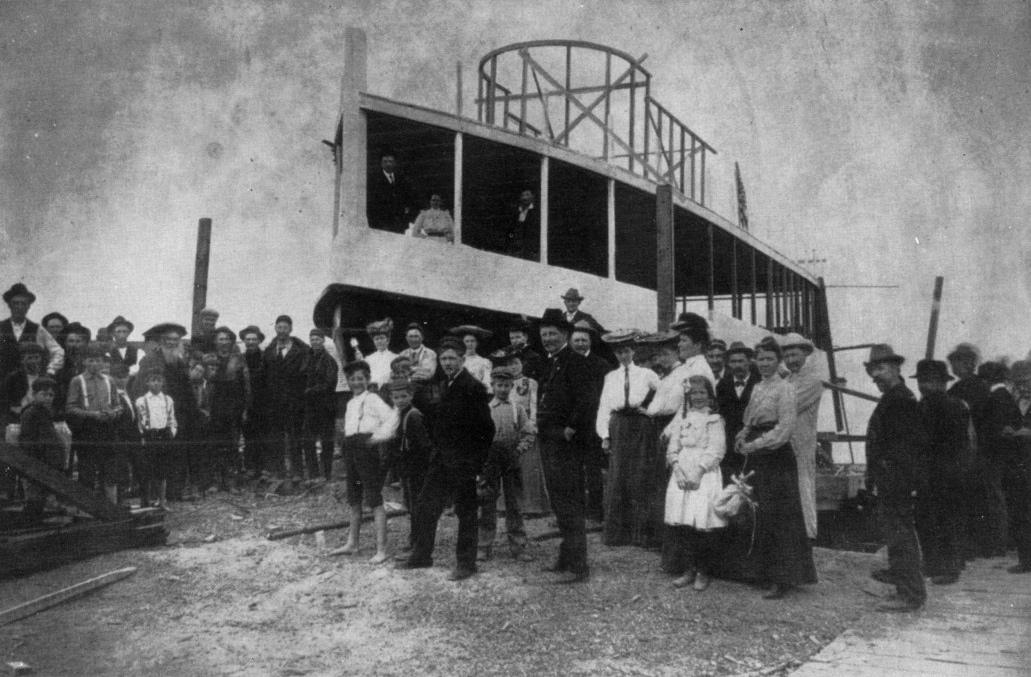
Lake Washington Shipyard
Most shipyards sit on salt water. Lake Washington Shipyards sat on a freshwater lake, fifteen miles from Puget Sound, building vessels that had to pass through the Ballard Locks just to reach the ocean. That geographic oddity defined the yard's entire history. Founded in the nineteenth century as a small operation turning out wooden tugs and ferries for lake service, the shipyard grew into a major wartime industrial facility employing nine thousand workers, launched seaplane tenders and net layers for the U.S. Navy, and then, when the contracts dried up, quietly faded until nothing remained but the shoreline it once occupied. Today the site is Carillon Point, a business park in Kirkland where office workers eat lunch on a waterfront that once rang with the sound of rivet guns.
From Wooden Tugs to Steel Hulls
The yard began life as Anderson Shipyard, a modest wooden-boat operation in what was then the town of Houghton on Lake Washington's eastern shore. Wooden tugs and passenger ferries for lake routes were the bread and butter. In 1923, Charles Burckardt purchased the yard and renamed it Lake Washington Shipyards, converting the facility from wood to steel construction. The transition opened new possibilities. Steel hulls meant larger vessels, longer service lives, and, critically, Navy contracts. Through the 1920s and 1930s, the yard built a steady stream of ferries and commercial vessels for Puget Sound service, including the MV Kitsap in 1925 and a series of ferries for the Puget Sound Navigation Company. Fishing vessels, recreational boats, and freight barges rolled off the ways alongside them, each one sliding into the calm freshwater of the lake before making the journey west to open ocean.
The Kalakala and the Art of Reinvention
The yard's most famous creation began as a catastrophe. In October 1933, the burnt-out hull of the ferry Peralta arrived at Lake Washington Shipyards after being towed north from San Francisco Bay, where the Peralta had burned to her waterline in May of that year. The Puget Sound Navigation Company saw an opportunity to rebuild it as something entirely new. What emerged the following year was the MV Kalakala, a streamlined, Art Deco ferry whose rounded silver profile looked more like a spaceship than a commuter boat. The Kalakala made her maiden voyage on July 3, 1935, and for the next three decades she carried passengers across Puget Sound as the most recognizable vessel in the Pacific Northwest. The Kalakala was not just a ship; she was proof that a freshwater shipyard in Houghton could produce something that captured the imagination of an entire region.
Nine Thousand Strong
When the United States entered World War II, Lake Washington Shipyards transformed. The workforce swelled from a peacetime crew to nine thousand employees, and the yard became a critical facility for the Navy's Pacific operations. Lake Washington Shipyards became the Navy's largest producer of Barnegat-class seaplane tenders, completing 21 of the class across the war years. Seaplane tenders rolled off the ways alongside net tenders and support vessels, including ships such as the USS Chincoteague and USS Bering Strait. Many of these vessels served double duty after the war: transferred to the Coast Guard, they were redeployed as high-endurance cutters and ocean station vessels patrolling the North Pacific. The yard also built net barges, patrol vessels, and survey ships for the Coast and Geodetic Survey. By the time peace returned, the Lake Washington waterfront at Houghton had launched dozens of vessels into a lake that connected to the ocean only through the narrow passage of the Ship Canal.
Gridiron and Aftermath
Shipbuilding wound down after the war. The yard stopped constructing new vessels and shifted to repair work, keeping older ships in service as the Navy's appetite for new hulls faded. By the 1960s, even the repair business had dried up, and the shipyard closed. But the property found one more unexpected use before its final transformation. In 1976, the expansion Seattle Seahawks of the National Football League set up their first training facility at the southern end of the former shipyard site. For ten seasons, NFL players ran drills where welders had once assembled warship hulls. The Seahawks departed in 1985, and the site was eventually redeveloped as Carillon Point, a mixed commercial and residential complex on the Kirkland waterfront. The shipyard's physical traces are gone, but the vessels it built still float in maritime registries, and the lakefront it once occupied remains one of the most pleasant stretches of shoreline on Lake Washington's eastern side.
From the Air
Located at 47.657N, 122.207W on the eastern shore of Lake Washington in Kirkland (formerly Houghton). The former shipyard site is now Carillon Point, a business park visible as a developed waterfront along the lake's east side. Lake Washington is the large freshwater body between Seattle and the Eastside communities. Nearest airports: Renton Municipal (KRNT) 6nm south, Boeing Field (KBFI) 8nm southwest, Kenmore Air Harbor (S60) 5nm north. Best viewed at 2,000-3,000 feet approaching from the west over Lake Washington, where the Kirkland waterfront and Carillon Point marina are clearly visible.