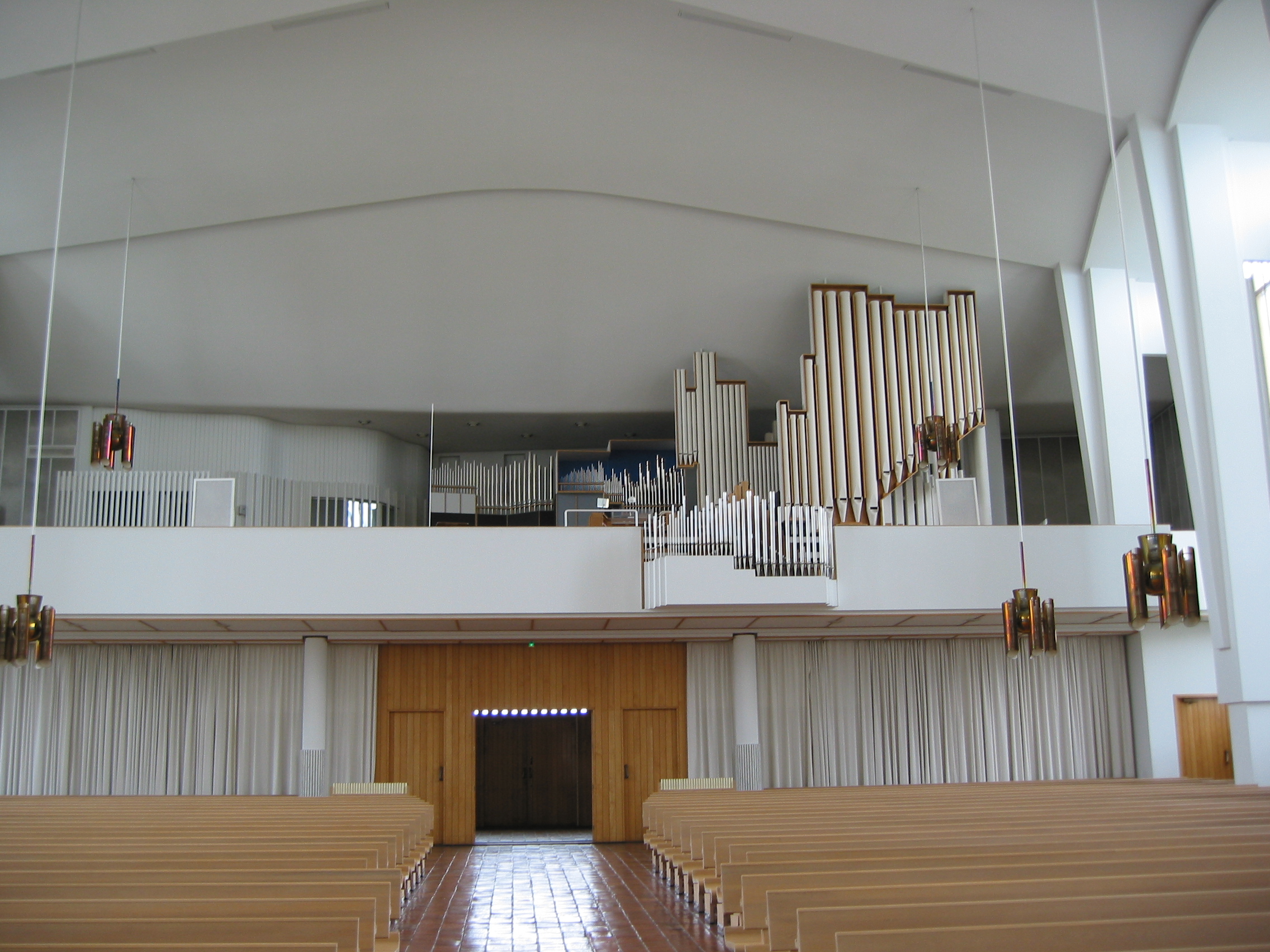
Lakeuden Risti Church
Sixty-five meters above the Ostrobothnian flatland, a cross-shaped bell tower catches the light. It is not perched on a hill -- there are no hills here. The plains of western Finland stretch unbroken to the horizon, and Alvar Aalto designed the tower of Lakeuden Risti Church to be the one vertical interruption, a landmark that can be seen for kilometers in every direction. The name means Cross of the Plains, and Aalto chose it himself when he submitted his competition entry in 1951. Built between 1957 and 1960, the church was the first completed piece of what would become the Aalto Centre, a six-building civic ensemble that transformed the center of Seinajoki.
A Cathedral for the Flatland
The church interior is described as cathedral-like, and the scale supports the comparison: the main hall seats 1,200 worshippers, with another 124 in the organ gallery. The slightly wedge-shaped, symmetrical nave extends 47 meters in length, drawing the eye toward the altar along clean modernist lines that avoid both the austerity of pure functionalism and the ornamental excess of traditional church design. Aalto's signature touch is evident in the way natural light enters the space -- controlled, diffused, warm. The white exterior walls and the vertical emphasis of the bell tower give the building a presence that belies its relatively modest materials. This is not a church built to impress with gilding or stained glass but one that achieves its effect through proportion, light, and the stark contrast between its geometric forms and the horizontal landscape surrounding it.
From Competition to Cornerstone
Aalto's path to building the church was characteristically unconventional. His 1951 competition entry for Seinajoki's new church envisioned a grand public piazza sloping down toward the main facade, an approach so space-hungry it exceeded the prescribed building area by twenty meters. The jury could not formally award him the prize, but they purchased his design and recommended it for implementation. Construction did not begin for another six years, starting in 1957 and finishing in 1960. The church became the anchor for Aalto's larger vision: a complete civic center designed by a single hand. Over the following decades, a city hall, library, parish center, office building, and theater would join the church around a central square, but Lakeuden Risti came first and set the architectural language for everything that followed.
The Cross and Its Echoes
The bell tower is the building's most recognizable feature -- a slender shaft crowned with a cross form that gives the church its name. At 65 meters, it dominates the skyline of a city with no competing tall structures and few natural elevation changes. Aalto returned to similar themes in other church designs: the Church of the Three Crosses, also from the 1950s, and Ristinkirkko in Lahti are often compared to Lakeuden Risti. But the Seinajoki church benefits from its setting. On the plains, the tower has nothing to compete with. It functions as both religious symbol and navigational landmark, the kind of structure that orients an entire town.
A Parish Beyond the Walls
Between 1964 and 1966, Aalto added a parish center next to the church -- a cluster of white one-storey and two-storey buildings that extend the church's architectural language into the everyday life of the congregation. Aalto also designed the surrounding park, creating a unified landscape that ties the sacred and secular spaces together. The parish center hosts the administrative and social functions that keep a Lutheran congregation running: meeting rooms, offices, gathering spaces for events that are less about worship and more about community. Walking from the church through the parish center and into Citizens' Square beyond, the transition from spiritual to civic feels seamless, which is precisely what Aalto intended. He did not design a church in isolation; he designed a church as the first act in a larger civic composition that would take decades to complete and that continues to function exactly as he envisioned.
From the Air
Located at 62.79°N, 22.85°E in the center of Seinajoki, Finland. The 65-meter cross-shaped bell tower is the most prominent vertical landmark in the flat Ostrobothnian landscape and is easily identifiable from the air. Nearest airport is Seinajoki Airport (EFSI), approximately 10 km south. The church sits at the heart of the Aalto Centre complex; the white modernist buildings clustered around Citizens' Square are visible against the surrounding townscape. Recommended viewing altitude: 2,000-3,000 ft for the tower; 4,000-6,000 ft to see the full Aalto Centre layout.