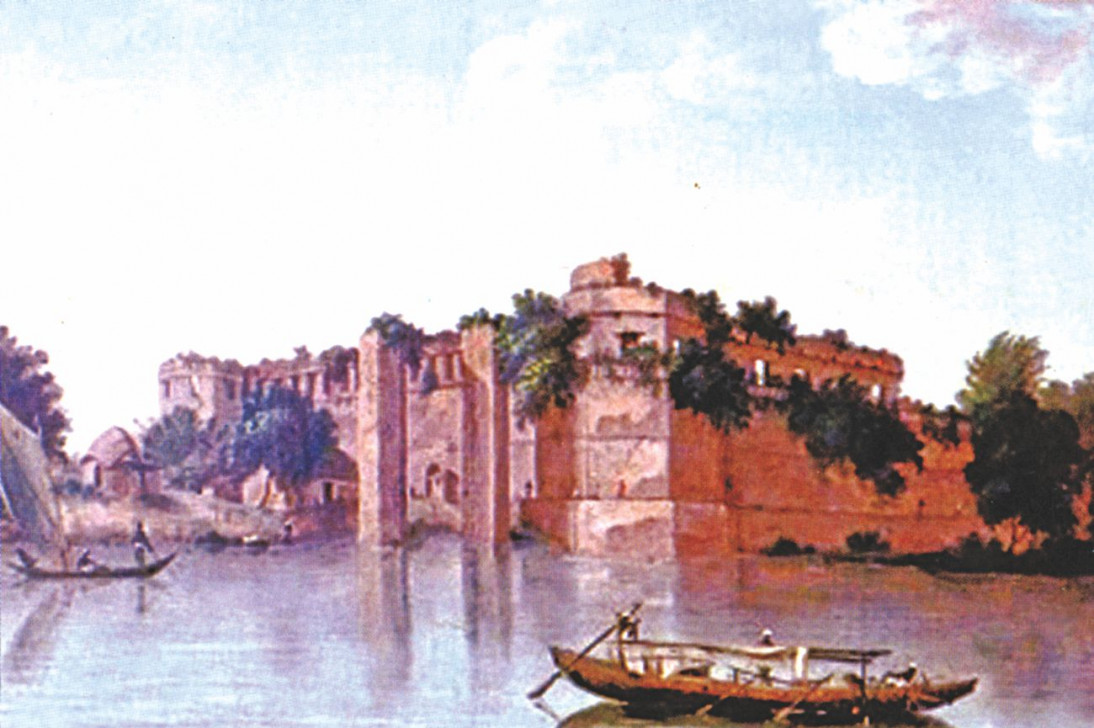
Lalbagh Fort
The fort was never finished. That fact haunts every archway, every fountain channel, every bastion along the southern wall. In 1678, Prince Muhammad Azam Shah, third son of the Mughal emperor Aurangzeb, began building Fort Aurangabad as the official residence of Bengal's governor. He stayed fifteen months before his father called him away to fight the Marathas. His successor, the governor Shaista Khan, continued the work -- until his daughter died within the fort's walls. Pari Bibi, the "Fairy Lady," was buried where she fell, and Shaista Khan, convinced the place was cursed, walked away from the project forever. Today her tomb stands at the geometric center of the complex, flanked by a mosque and an audience hall, a memorial around which the rest of the fort remains perpetually incomplete.
Bengal's Paradise in Miniature
Emperor Aurangzeb called Bengal the "Paradise of Nations," and the fort his son conceived was meant to prove it. Modeled as a miniature version of the Red Fort in Delhi and Fatehpur Sikri, Lalbagh Fort was designed with lawns, fountains, and water channels connecting three central structures along an east-west axis: the Diwan-i-Aam, the tomb of Pari Bibi, and a mosque. A hammamkhana -- one of only seven Mughal-era bathhouses still standing in ruins in Bangladesh -- occupied the southern wing, its underground rooms still bearing black scorch marks from the fires that once heated bathwater. The southern fortification wall bristled with five bastions at regular intervals, each two stories high, connected by tunnels that would later spawn their own legends. During Aurangzeb's reign, Dhaka had grown into an imperial city with one of the richest elites in the Mughal Empire, and the fort was meant to match that status.
The Fairy Lady's Tomb
Who was Pari Bibi? The question has occupied historians for centuries. The prevailing belief holds she was Shaista Khan's beloved daughter Iran Dukht, who died in 1684 while engaged to Prince Azam. But some researchers argue she was a nine-year-old Ahom princess, seized during Mir Jumla's military expedition near the Garo hills and later forcibly converted and married to the prince. Whatever her origin, her death transformed the fort from an unfinished construction project into a monument of grief. Shaista Khan abandoned both the fort and eventually Dhaka itself. When the Mughal capital shifted to Murshidabad, the complex fell into ruin. It was not until 1844 that the area acquired the name Lalbagh -- "Red Garden" -- for the reddish and pinkish tones of its Mughal stonework, replacing the original name Aurangabad entirely.
Sealed Passages and Vanished Soldiers
Beneath the fort's foundations run tunnels that no one has fully explored. Two are said to lead across the Buriganga River to the now-ruined Zinzira Fort on the opposite bank. A third was reportedly constructed as a maze. During the Sepoy Rebellion of 1857, defeated soldiers are said to have fled into the labyrinth and never emerged. British soldiers who pursued them also vanished. According to local accounts, British investigators later sent an elephant and dogs into the tunnel; neither returned. The passages were sealed afterward and remain closed. Archaeologists have since discovered that the fort's main walls continue eastward beneath modern Shaista Khan Road, suggesting the present complex represents only half the original plan -- the eastern half, likely intended for administrative purposes, was either never completed or has long since disappeared.
A River's Retreat, a City's Memory
The Buriganga River once lapped at the fort's foundations. European painters in the 18th and 19th centuries depicted it from the water, its bastions rising directly from the riverbank. The river has since retreated, leaving the fort landlocked in the dense fabric of Old Dhaka. Mughal artillery pieces still line the grounds, silent witnesses to an era when Bengal generated more wealth than most European nations. The Ambassadors Fund for Cultural Preservation has funded restoration of parts of the complex, and recent excavations by Bangladesh's Department of Archaeology continue to reveal structures hidden for centuries -- utility buildings, stables, an administration block, and a rooftop garden with arrangements for fountains and a water reservoir. Lalbagh Fort remains one of the most visited sites in Dhaka, a place where the ambitions of empire, the weight of superstition, and the passage of four centuries converge in a single incomplete compound.
From the Air
Located at 23.719N, 90.388E on the north bank of the Buriganga River in Old Dhaka. The fort complex is visible from low altitude as a walled rectangular compound amid dense urban fabric. Nearest airport is Hazrat Shahjalal International Airport (VGHS), approximately 12 km to the north. Best viewed at 2,000-3,000 ft AGL for the contrast between the fort's green lawns and the surrounding city.