Laleli Mosque
The walls inside the Laleli Mosque do not behave like walls in other Ottoman mosques. They flash red, blue, yellow, brown, the colored bands of variegated marble inset with medallions of onyx and jasper. Light pours through windows of clear and stained glass, picking out the seams. Sultan Mustafa III, who commissioned the building, broke a tradition while ordering it: imperial mosques were supposed to commemorate military victories, and Mustafa had not won any. Construction began on April 5, 1760, and finished on March 9, 1764. The official name was Nur Mustafa, the Light of Mustafa, but the neighborhood was called Laleli, the Tulips, and the popular name stuck. People have called it the Mosque of the Tulips for two and a half centuries.
An Imperial Mosque Without a War
Earlier sultans had built their imperial mosques as thanksgiving for conquests, the Süleymaniye for victories under Süleyman the Magnificent, the Sultanahmet (the Blue Mosque) for the wars of Ahmed I. Mustafa III ignored the convention. Construction began without a triumph to commemorate. The architect of record is uncertain, but most art historians attribute the design to Mehmed Tahir Agha, the chief imperial architect when the mosque was completed. About 770 workers labored on it on average, and roughly two-thirds of them were non-Muslim, the rest Muslim. The composition of the workforce was typical of large Ottoman building projects: skilled Greek, Armenian, and Italian masons, carpenters, and tile-setters worked alongside Muslim craftsmen. Mustafa III was buried in 1774 in the mausoleum attached to the complex; his son Selim III, the reformist sultan whose janissaries would eventually murder him, was buried beside him in 1808.
Baroque on Top of Classical
The Laleli is a key building in the Ottoman Baroque style, but a thoughtful one. The plan, an octagon inscribed within a rectangle, draws on the Selimiye Mosque of Edirne, the great work of Mimar Sinan from the classical period. Mustafa III specifically asked for that connection. But the decoration is firmly baroque, drawing on the precedent of the Nuruosmaniye Mosque, completed by Mustafa's predecessor in 1755 as the first imperial mosque in the new style. The Laleli softens the Nuruosmaniye's exuberance, integrating baroque ornament with the more disciplined geometry of earlier Ottoman tradition. The dome is 12.5 meters across and 24.5 meters high, supported on an octagonal drum of eight arches. Semi-domes spring at the corners and above the mihrab and the central narthex bay.
The Shopping Center Underneath
Walk around to the side and you find one of the most unusual features of any Ottoman imperial mosque: a working bazaar in the substructure. The mosque was built on a high terrace over a complex of vaulted shops, whose rents were designed to fund the upkeep of the religious complex above. The arrangement made financial sense and gave the building two parallel lives. Beneath the prayer hall sits a great vaulted space supported by eight massive pillars with a fountain in the center. The shops still operate today, much as they did in the 1760s, selling textiles and household goods to a steady stream of locals. Mustafa III's external endowment included two caravanserais elsewhere in the city, the Taş Han next door and the larger Büyük Yeni Han north of the Grand Bazaar, both providing additional revenue.
Fire, Earthquake, Restoration
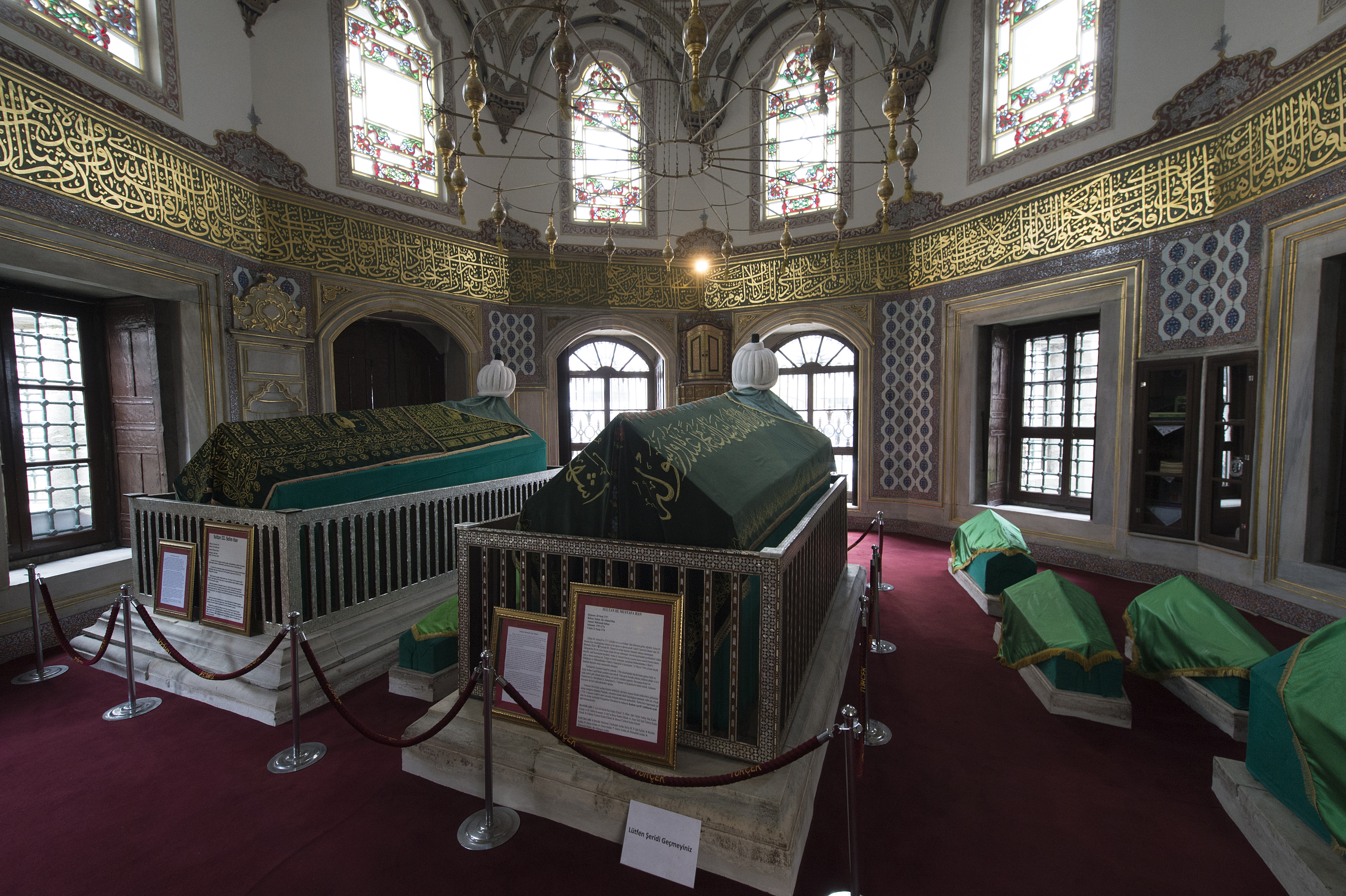
The complex has not survived intact. The 1766 Istanbul earthquake damaged the mosque and surrounding buildings, and according to the architectural historian Ünver Rüstem, a fire in 1783 caused further harm. A complete restoration that same year, attributed by Doğan Kuban to the architect Seyit Mustafa Agha, preserved the original appearance. The mausoleum's facade was updated with new marble window frames in the early 19th century. The complex's madrasa burned down in 1911 and was never rebuilt; the Tayyare Apartments, constructed in 1922 on the empty madrasa lot next door, have since become a five-star hotel. The mausoleum on Ordu Street holds the cenotaphs of Mustafa III, Selim III, and several of Mustafa's daughters, including Hibetullah and Fatma Sultan. The interior is decorated with reused İznik tiles from the 16th century, salvaged from earlier buildings.
Visiting
The mosque sits on Ordu Street in the Fatih district, on the south side of the historic peninsula, easily reached from Sultanahmet by tram. Compared to the Sultanahmet or Süleymaniye Mosques, the Laleli is quiet, a working neighborhood mosque rather than a tourist landmark, and that is part of its character. Visitors should observe normal mosque etiquette: shoes off, modest dress, respectful silence during prayer times. The colored marble interior is best seen on a sunny day, when the windows do their work. After the visit, walk down the ramp to the substructure shops or sit by the central courtyard fountain in the morning, when the muezzin's call carries clearly through the surrounding streets.
From the Air
Located at 41.01 degrees N, 28.957 degrees E, in the Laleli neighborhood of the Fatih district on Istanbul's historic peninsula. From above, look for the central dome and twin minarets between the larger Beyazıt Mosque to the east and the Aksaray junction to the west, just inland from the Sea of Marmara coast. Istanbul Airport (LTFM) lies 22nm northwest, Sabiha Gökçen (LTFJ) 18nm southeast.