Lamaling Monastery
At the entrance gate of Lamaling Monastery, flanking the stone lions, stand two large wooden carvings of male and female genitalia. The sight startles visitors expecting conventional Buddhist iconography, but it announces something essential about this place: Lamaling belongs to the Nyingma, the "Ancient Ones" of Tibetan Buddhism, whose lineages reach back to the 7th-century arrival of Buddhism in Tibet and who absorbed traditions from the native Bon religion, including the veneration of nature and fertility as forces that ward off evil. This blending of the sacred and the primal, the Buddhist and the pre-Buddhist, defines a monastery that is unlike any other in the Nyingchi River valley.
The Daughter Who Rebuilt
The original Lamaling was destroyed. During the 1960s, the small replacement temple that had been built on flat land below the original hilltop site was also destroyed, and Dudjom Rinpoche's son, Dorje Pasang, was killed. The ruins of the old monastery are still visible on the hillside, reachable by a forty-five-minute trek that passes a small chapel containing a statue of Dorje Julut and an old photograph of Rinpoche. In 1989, the late Dudjom Rinpoche's daughter, Semo Dechen, and her husband, Lama Chonyi Rinpoche, returned and began reconstruction. What they built was not a replica of the old monastery but something new: the Zangdrok Pelri Monastery, an exquisite complex with extensive gardens, constructed on the hillside and accessible by a motorable road from the valley below. The rebuilding was an act of both devotion and defiance, restoring a lineage that others had tried to erase.
Eight Walls, Four Colors
The new monastery announces its distinctiveness through its architecture. It is octagonal, rising four stories to a height of about twenty meters, crowned by a prominent gilded pagoda. The construction is primarily wood, with curved eaves that shift from twenty-angled at the lower level to octagonal on the upper floors, their beams painted in radiant colors. The fusion of Han Chinese and Tibetan architectural styles creates a building that belongs fully to neither tradition but draws from both. Long strings of wooden prayer beads drape the facade. The four exterior walls are painted white, blue, red, and green against the backdrop of golden dragon-shaped upturned eaves. Inside, the main prayer hall contains a kora circuit and four protector chapels, one in each corner. The original image of Mehotara Heruka, salvaged from the old monastery, and a footprint attributed to Padmasambhava are preserved here alongside newer statues cast by artisans from Chamdo using traditional metal-casting techniques.
Where Monks and Nuns Chant Together
Lamaling holds another distinction rare in Tibetan monasteries: monks and nuns recite the scriptures together in the main prayer hall. Religious services are held on the 10th, 15th, and 25th day of each lunar month in an adjoining building that houses a large statue of Sakyamuni. Pilgrims circumambulate both this building and the main temple as part of the kora ritual, walking the circuit that connects the sacred spaces. The chapels house sculptures of Amitabha, Avalokiteshvara, and Vajrapani on the lower floors, with a four-armed Avalokiteshvara and two statues of Manjushri on the top floor. A Dorje Trole stupa built in 1987 stands to the west of the old ruined temple, and mountain goats brought from Tsodzong Monastery graze in the courtyard. The monastery sits 1.5 kilometers south of the older Buchu Monastery, the two forming a pair of sacred sites in a valley framed by snow-capped mountains and pristine lakes.
The Valley of the Ancient Ones
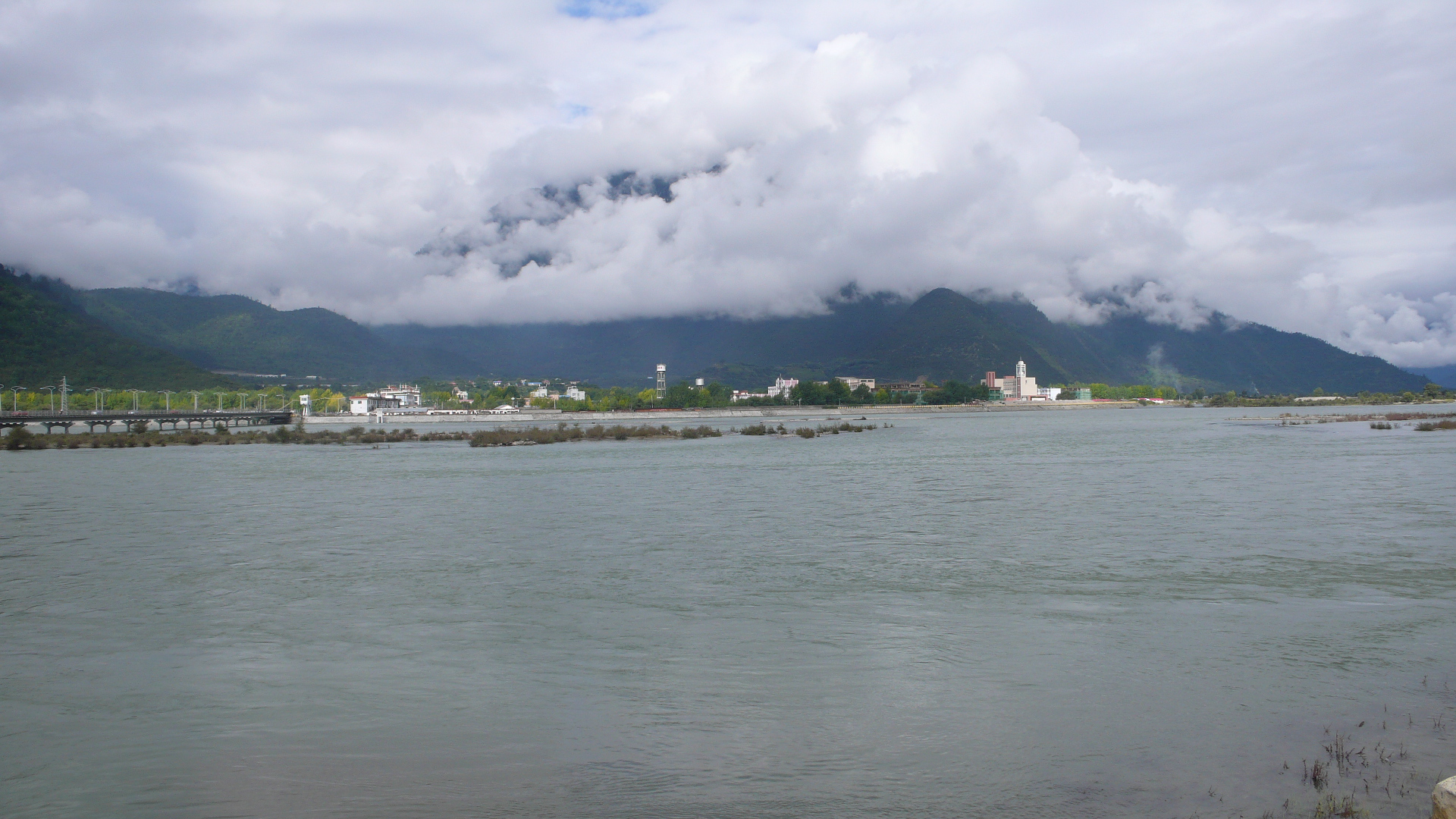
Lamaling sits in the Nyingchi River valley, about thirty kilometers west of Bayi town, surrounded by the landscapes that define southeastern Tibet: snow-covered mountains, alpine lakes, and forests that give way to cultivated village land. Two routes connect the monastery to Lhasa. The eastern route passes through Basum Lake and Bayi town before reaching Burqug village. The southern route loops through Nyingchi, Mainling, and Shannan, offering a circular journey through some of Tibet's most varied terrain. The Nyingma sect's presence here is fitting. The Ancient Ones have always been the branch of Tibetan Buddhism most attuned to landscape and place, most willing to see divinity in rivers and mountains and trees. At Lamaling, where Bon fertility carvings guard the gate and the footprint of Padmasambhava is pressed into stone, the land and the faith are not separate things but the same thing, expressed in wood and paint and prayer.
From the Air
Located at 29.46N, 94.39E in the Nyingchi River valley of southeastern Tibet, approximately 30 km west of Bayi town. The monastery sits on a hillside at moderate elevation for Tibet, in a relatively lush valley surrounded by snow-capped peaks. From altitude, look for the distinctive octagonal gilded pagoda amid green forested hillsides. Nearest airport is Nyingchi Mainling Airport (ZUNZ), approximately 40 km to the southeast. The Nyingchi valley is one of the lower-altitude regions of Tibet, making for somewhat less extreme flying conditions, though mountain turbulence remains common.