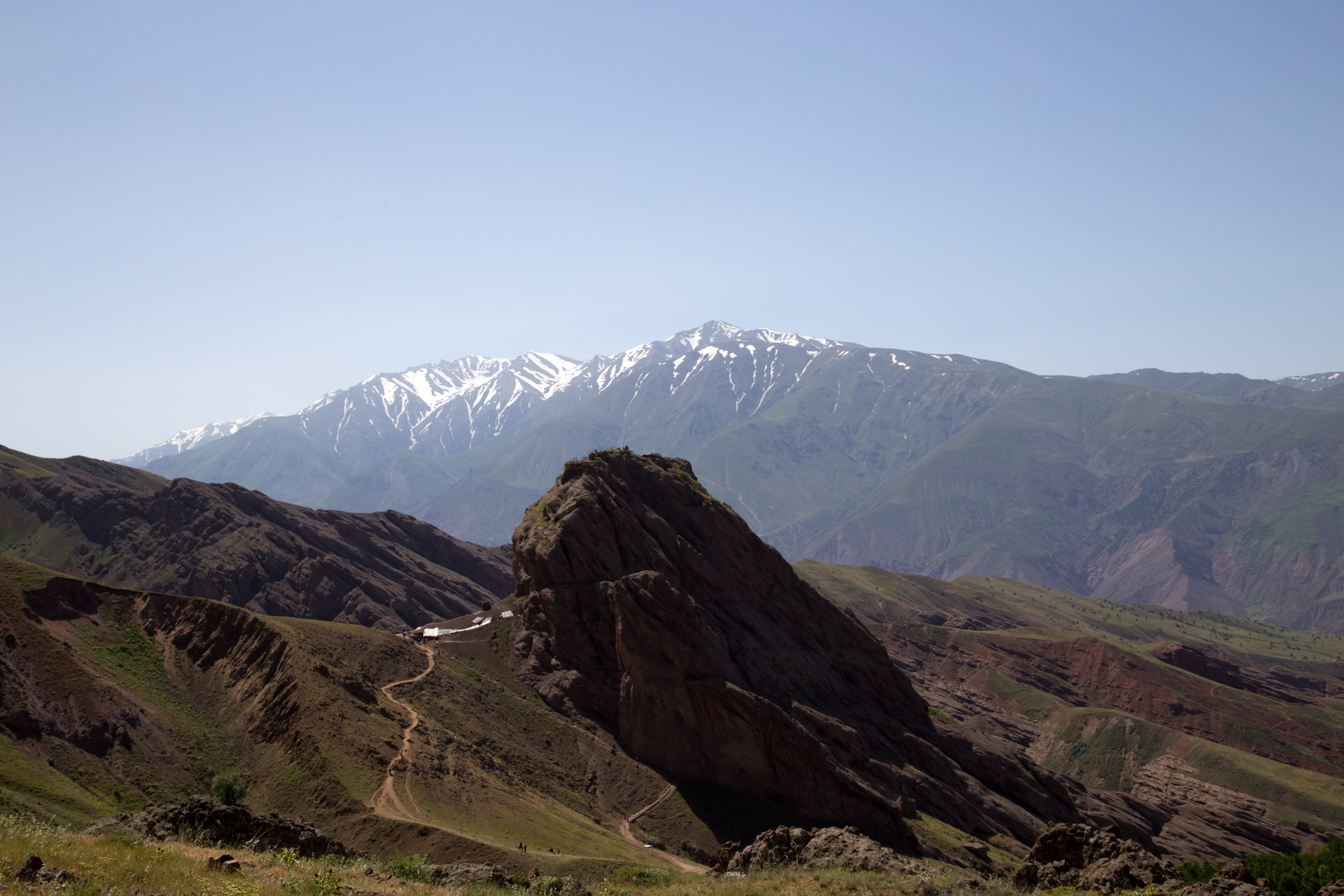
Lambsar Castle
They refused to surrender. In 1256, when Hulagu Khan captured the Ismaili Imam Rukn ad-Din Khurshah and forced him to order his followers to lay down their arms, the garrison at Lambsar sent back its answer: no. For a full year, this fortress in the central Alborz mountains held out against the largest military force on Earth. It took a cholera epidemic to do what tens of thousands of Mongol soldiers could not. Lambsar was probably the largest and most heavily fortified of all the Ismaili castles, and its ruins still cling to a ridgeline 120 kilometers northwest of Tehran, a monument to defiance carried past the point of survival.
The Assassin's Stronghold
Hassan-i Sabbah, the founder of the Nizari Ismaili state, understood that his movement would survive only if it controlled territory that armies could not easily take. He built a network of mountain fortresses across Persia and Syria, each perched on terrain so rugged that conventional siege warfare was nearly impossible. Lambsar was the crown of this network. Kiya Buzurg Ummid, appointed governor by Hassan-i Sabbah himself, captured the castle from a local ruler named Rasamuj and rebuilt it into a major stronghold using local labor. When Kiya Buzurg Ummid succeeded Hassan-i Sabbah as leader of the Ismaili state in 1124, he governed from the knowledge that Lambsar was the fallback -- the fortress that would hold when others could not.
A Fortress Shaped by Stone and Air
The ruins reveal the logic of the site. Deep valleys drop away on the east and west, making approach from those directions impossible. Only the north and south faces offer any path in, and both involve climbing a slope with a 150-meter elevation change stretched over 480 meters. The castle spans more than 190 meters in width. Two-layered parapets built from massive stones rise 10 meters high. The main building on the northern end has walls 1.2 meters thick, cut from solid stone. Water reservoirs and grain stores occupy the south and southeast -- provisions for the long sieges that the builders clearly expected. A water supply system, whose engineering details have not fully survived, kept the garrison alive through extended isolation. On the north side, a large central building with four smaller extensions faces east, overlooking the approach that any attacker would have to climb.
The Year of Refusal
By 1256, the Mongol Empire had decided that the Nizari Ismaili state had to be destroyed entirely. Hulagu Khan, dissatisfied with his commanders' progress, personally took command of one of the largest armies ever assembled by the Mongol Empire and marched on the Ismaili heartland. The fortress of Meymoon-Dej fell first, and the captured Imam Khurshah was compelled to issue surrender orders to his remaining strongholds. Alamut complied. Gerdkuh did not. Lambsar did not. Through the rest of 1256 and into the winter, the garrison endured. The Mongols could not scale the walls. They could not starve out the defenders quickly enough. But cholera could. The disease swept through the fortress, killing defenders by the score. In January 1257, Lambsar finally fell -- not to assault, but to epidemic. Hulagu's response was merciless. He ordered the fortress demolished and every survivor beheaded, whether they had been soldiers or simply the sick who had somehow clung to life.
Echoes in the Alborz
The Mongols intended Lambsar's destruction to be total and final. It was not. In 1275, small groups of Ismailis who had survived the invasions attempted to recapture the nearby fortress of Alamut, and again in 1389 -- more than a century later -- another attempt was made. These efforts were short-lived, but they testify to the enduring pull these mountain strongholds held on the Ismaili imagination. Today, only ruins remain of Lambsar. The great parapets have crumbled. The water system is silent. But the topography that made the fortress so formidable has not changed. The valleys still drop away into shadow, the ridgeline still commands the surrounding landscape, and the climb from the valley floor still demands effort. The stones that Hulagu ordered pulled down still lie where they fell, scattered across a slope that remembers what happened here.
From the Air
Located at 36.548N, 50.227E in the central Alborz mountain range, approximately 120 km northwest of Tehran. The fortress ruins sit on a prominent ridgeline visible from altitude, with deep valleys on either side. The site is roughly 30 km northeast of Alamut Castle. Nearest major airport is Tehran Imam Khomeini International Airport (OIIE), about 150 km to the southeast. Qazvin Airport (OIIK) is closer at approximately 50 km southwest. The Alborz range runs east-west here, and the castle's ridge is best identified by approaching from the south, where the dramatic elevation change from the valley floor is most apparent. Expect mountainous terrain with variable visibility.