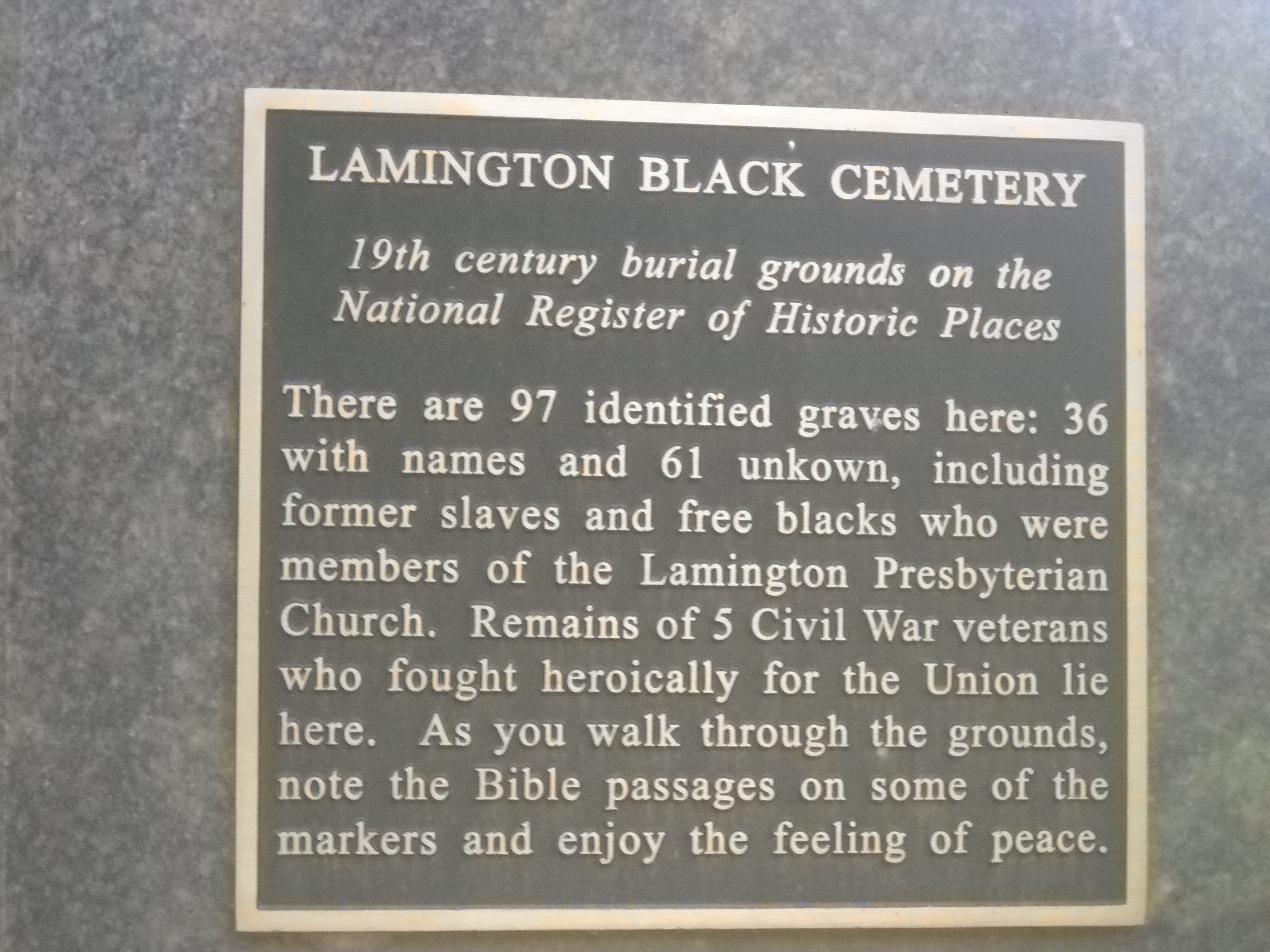
Lamington Black Cemetery
Sixty of the graves have no names. They are marked, when they are marked at all, by plain fieldstones with no inscriptions, the kind of stones a family would carry from a nearby field because a carved headstone was beyond their means. The Lamington Black Cemetery sits on Cowperthwaite Road in Bedminster Township, New Jersey, a small parcel within the Lamington Historic District. It holds 97 known graves. The earliest confirmed burial is Samuel Lane, interred in 1848, though burials of enslaved people may have taken place here before 1844. The cemetery was formally established in 1857, but the ground was sacred long before any official date.
Before the Headstones
New Jersey's history with slavery is often overlooked, obscured by the state's northern geography and its eventual position on the Union side of the Civil War. But enslaved people lived and labored throughout Somerset County well into the 19th century. New Jersey was the last northern state to pass an emancipation act, in 1804, and that law freed no one immediately. It provided for gradual abolition, meaning children born to enslaved mothers after July 4, 1804, would serve their mother's enslaver until age 25 for males and 21 for females. The last enslaved people in New Jersey were not freed until the Thirteenth Amendment in 1865. The Lamington Black Cemetery exists because the African American community in Bedminster needed a place to bury their dead, and the churchyard cemeteries of the era were segregated. The burials that may predate 1844 represent people who lived and died in bondage in a state that calls itself the Garden State.
Soldiers in Colored Troops
Among the 97 graves, at least five belong to veterans of the United States Colored Troops, the designation for African American regiments during the Civil War. One of these men was William H. Van Horn, a private in Company H of the 43rd Regiment, U.S. Colored Troops. The 43rd Regiment was organized in Philadelphia in 1864 and served in Virginia during the final campaigns of the war. That Van Horn returned to Bedminster Township and was buried in this cemetery speaks to the deep roots of the Black community in Lamington, roots that preceded the war and endured after it. These soldiers fought for the Union while their home state had only recently, and grudgingly, completed its own abolition of slavery. Their graves, marked with military designations, stand among the anonymous fieldstones of community members whose names have been lost to time.
Fieldstones and Memory
Of the 97 known graves, only 37 bear markers, and many of those are uncarved fieldstones. The absence of inscriptions does not indicate indifference. It reflects poverty. Carved headstones cost money that formerly enslaved families and their descendants often did not have. The fieldstones were acts of care, placed deliberately to mark where a person lay, even if the family could not afford to carve a name. Over time, the connection between stone and identity erodes. Without inscriptions, without church records, without family members who remember, a grave becomes anonymous. The Lamington Black Cemetery is also known as the Cowperthwaite African American Cemetery, a dual naming that reflects the layers of community identity attached to the site.
A Place on the Register
The Lamington Historic District was listed on the National Register of Historic Places on June 21, 1984, and the cemetery is a contributing property within that district. This designation offers a measure of protection and recognition, but the real preservation is more local and more personal. The cemetery is a tangible link to the African American community that built lives in Somerset County under conditions that ranged from enslavement to segregation to the slow, incomplete progress that followed. Walking among the fieldstones, you confront a history that New Jersey does not always tell about itself: that this was a place where people were held in bondage, where emancipation came late and reluctantly, and where a community persisted despite all of it. The 97 graves are not relics. They are evidence of lives fully lived, even when the historical record left most of them unnamed.
From the Air
Located at 40.66°N, 74.71°W on Cowperthwaite Road in the Lamington section of Bedminster Township, Somerset County, New Jersey. The cemetery is a small, tree-shaded parcel within the Lamington Historic District. Nearest airports include Somerset Airport (KSMQ, 7 nm SE) and Morristown Municipal Airport (KMMU, 16 nm NE). Best viewed at 1,500-2,000 ft AGL, though the cemetery itself is small and not easily distinguished from the air. The surrounding Lamington village provides context.