Landing at Kip's Bay
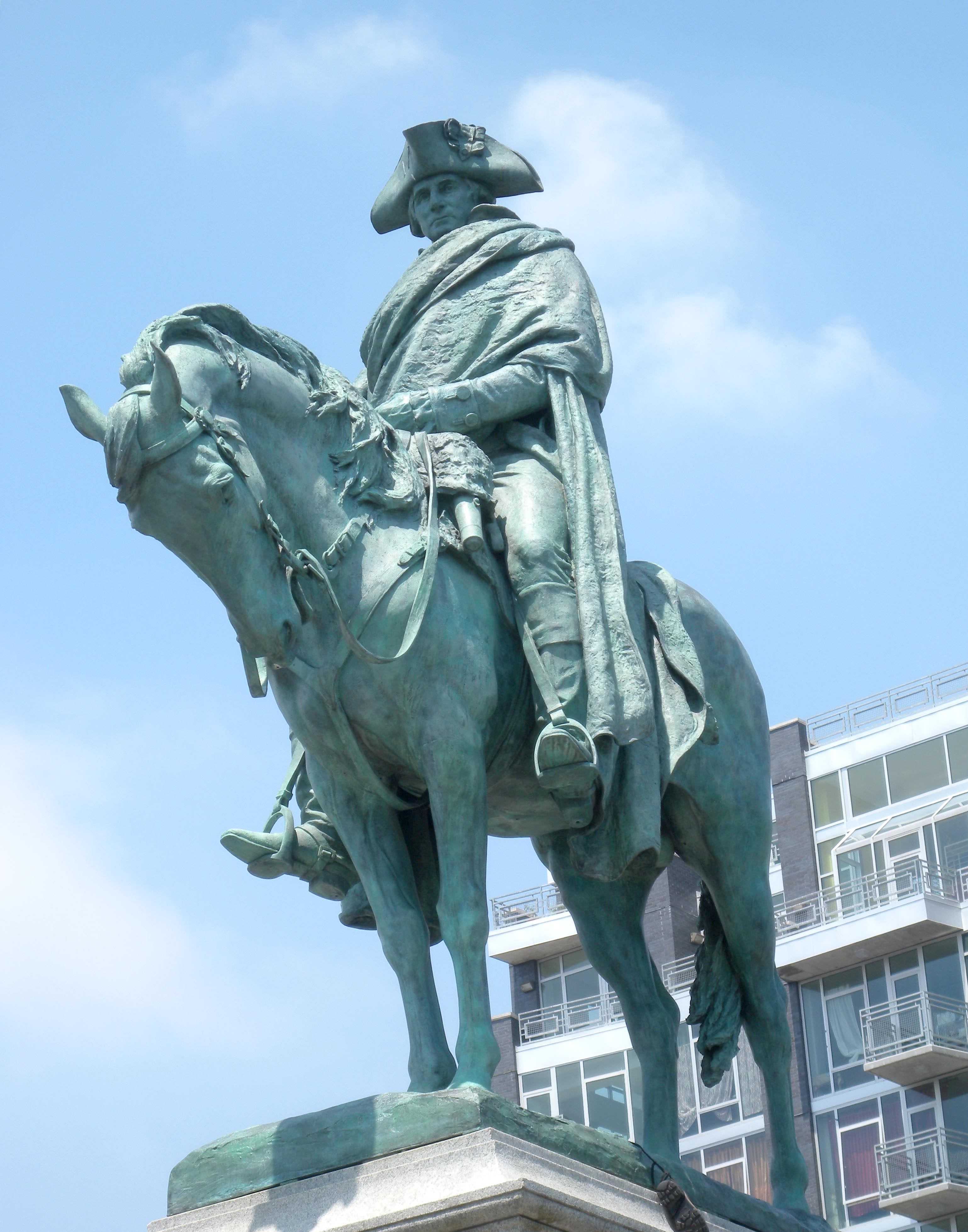
George Washington struck his own officers with a riding crop. It was September 15, 1776, the day was oppressively hot, and the commander of the Continental Army had just watched his militia abandon their trenches in blind panic as eighty British flatboats crossed the East River toward Manhattan. Washington rode to within a hundred yards of the advancing enemy, so consumed by rage that one of his men had to grab his horse's reins and drag him to safety. The cove where the British landed, Kip's Bay, no longer exists -- it was filled in long ago, buried beneath the grid of Midtown streets somewhere between 32nd and 38th. But in 1776, it was deep water close to shore, ringed by meadows perfect for mustering an invasion force, and it became the hinge on which the entire New York campaign turned.
A City Washington Could Not Hold
The British had been closing in on Manhattan for weeks. After their victory at the Battle of Long Island on August 27, Washington managed a daring overnight evacuation of 9,000 troops across the East River to York Island, as Manhattan was then called. But the army that arrived was broken in spirit. Militia whose summertime enlistments had expired simply walked home. Soldiers openly wished for General Charles Lee to replace Washington. In desperation, Washington wrote to Congress asking whether New York City -- then just the southern tip of the island -- should be burned to deny it to the British. Congress said no, but also told him he need not defend it. General Nathanael Greene, recently returned from illness, urged immediate withdrawal. Without Long Island, he argued, New York could not be held, and another defeat would be catastrophic.
The First Submarine and Last Preparations
While Washington spread his forces thin along Manhattan's shores, he authorized a remarkable act of desperation. On September 7, Sergeant Ezra Lee piloted the submersible Turtle against Admiral Howe's flagship Eagle -- the first documented case of submarine warfare. The drill struck an iron plate it could not penetrate, and Lee surfaced without attaching his explosives. Pursued by British boats, he released his payload, which detonated harmlessly in the East River. Meanwhile, General Howe assembled flatboats at the mouth of Newtown Creek on Long Island, while warships carrying 148 cannons moved into position along the East River. By September 14, every horse and wagon in the American camp was employed in what one officer called a 'grand military exertion,' frantically moving ammunition, supplies, and wounded men northward.
Eighty Boats Across the Water
At dawn on September 15, the Royal Navy sent ships noisily up the Hudson as a diversion. Washington saw through it. Then came silence -- the British ships anchored off Kip's Bay lay quiet while the militia waited in shallow ditches onshore. Around 10 a.m., General Sir Henry Clinton ordered the crossing. More than eighty flatboats carrying 4,000 British and Hessian soldiers, standing shoulder to shoulder, pushed off from Long Island. When they landed, the militia broke and ran. Hessian soldiers bayoneted Americans trying to surrender. Two thousand Continental reinforcements arrived from the north, took one look at the chaos, and fled too. By late afternoon, 9,000 more British troops had come ashore. A British officer recorded seeing a Hessian sever a prisoner's head and mount it on a pole in the entrenchments.
Putnam's Desperate March
The landing split Washington's forces. Nearly a third of his army, under General Israel Putnam, was still south of the invasion point in lower Manhattan. If Clinton had pushed west to the Hudson, Putnam's men would have been trapped. But Howe ordered Clinton to halt at the Inclenberg -- present-day Murray Hill -- and wait for reinforcements. That pause saved the Continental Army. Putnam rode south and led his troops on a forced march up the Hudson shore, guided by his young aide Aaron Burr. They abandoned everything that would slow them down. Only the last companies in the column skirmished with advancing British troops, including Alexander Hamilton's artillery battery. When Putnam's exhausted men stumbled into the main camp at Harlem after dark, they were greeted by cheers. They had been given up for lost.
Shame and Redemption
Washington called his army's performance 'shameful' and 'scandalous.' The British were welcomed into New York City by its remaining residents, who tore down the Continental flag and raised the Union Jack. Howe had captured the city quickly and with minimal bloodshed -- exactly what he wanted. But the next day, September 16, changed the mood entirely. American and British outposts clashed below Washington's lines on Harlem Heights, and the skirmish escalated into a running battle lasting several hours. For the first time in the campaign, Continental troops held their own against elite British soldiers. The morale boost was enormous. The two armies settled into positions on Manhattan that barely changed for two months, but the British would hold New York City itself for the next seven years, until the war's end.
From the Air
Kip's Bay was located on Manhattan's East River shoreline at approximately 40.736°N, 73.975°W, in the area between present-day 32nd and 38th Streets, extending west to roughly Second Avenue. The bay was filled in during the 19th century. Nearby airports include LaGuardia (KLGA) to the northeast and Newark Liberty (KEWR) to the southwest. At 2,000-3,000 feet, the midtown Manhattan grid is clearly visible -- the invasion site sits in the dense urban landscape east of the Empire State Building.