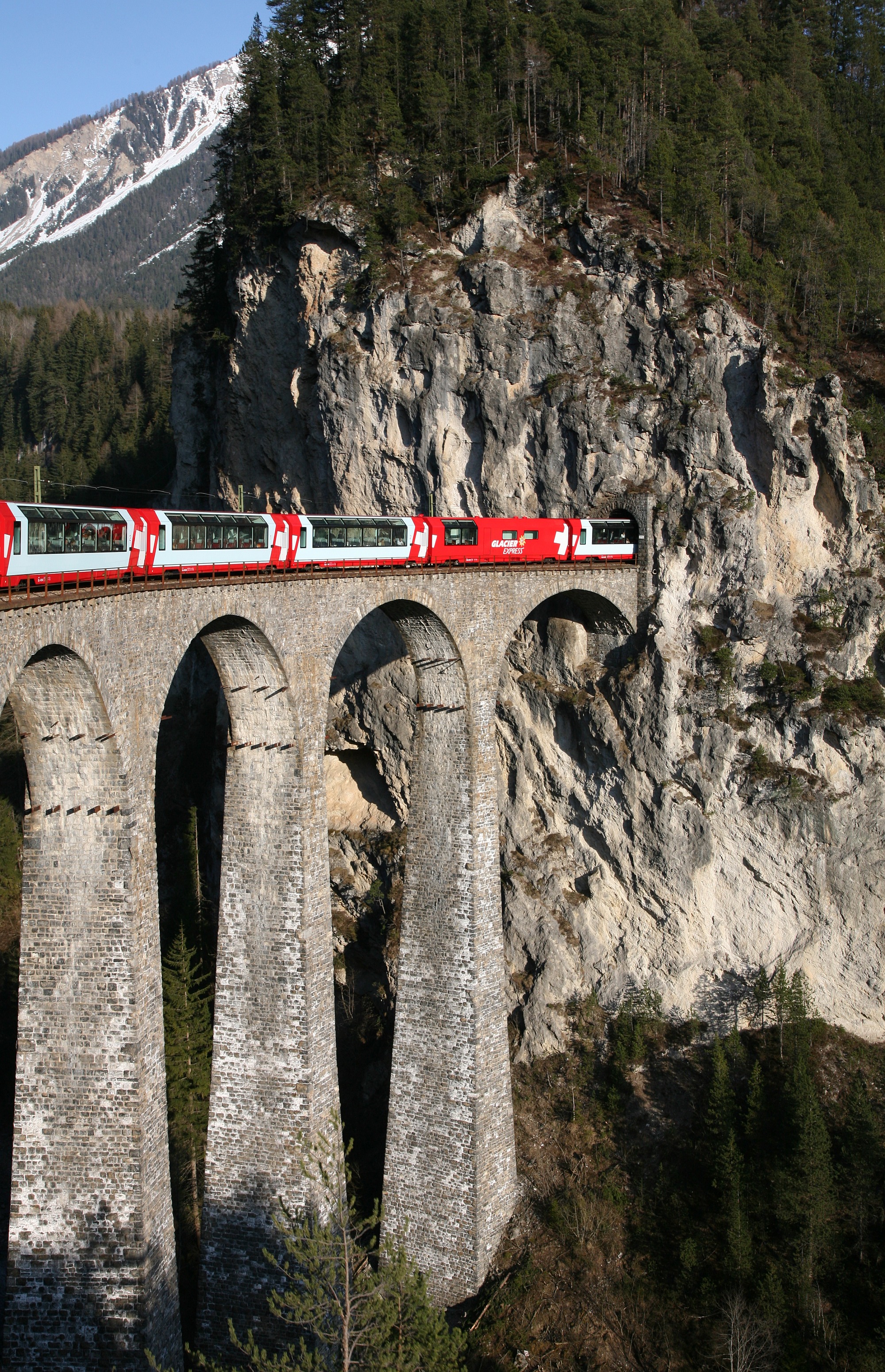
Landwasser Viaduct
The front of the train disappears into solid rock. That is what passengers see as they cross the Landwasser Viaduct on the Rhaetian Railway: their own locomotive swallowed by a tunnel portal carved into a sheer cliff face at the far end of a curving bridge 65 meters above the gorge floor. No approach ramp, no gentle transition -- just six limestone arches tracing an elegant curve through the air, then darkness. It is one of the most photographed railway structures in the world, and one of the few that looks more improbable in person than in pictures.
Built Without Scaffolding
Alexander Acatos designed the viaduct, and the construction firm Muller & Zeerleder built it between 1901 and 1902 for the Rhaetian Railway. The technical achievement is remarkable for its era: the builders erected the structure without conventional scaffolding, relying instead on two cranes to position the approximately 9,200 cubic meters of dolomitic limestone masonry. The viaduct's six arch spans, each 20 meters wide, rest on five towering pillars. The arches are flat rather than semicircular, giving the structure a distinctly modern profile despite its early-20th-century origins. A single railway track crosses it on a 2 percent gradient, carrying the Albula Railway line between Tiefencastel and Filisur at the 63-kilometer mark from Thusis.
The Cliff and the Tunnel
What makes the Landwasser Viaduct singular is its southeastern end. The last arch terminates against a vertical rock wall, and the tracks plunge directly into the 216-meter-long Landwasser Tunnel without any horizontal transition. The tunnel portal was deliberately aligned with the viaduct during construction -- the cliff was the fixed point, and the bridge was designed to meet it. For passengers approaching from Tiefencastel and Alvaneu, the sequence is theatrical. The Schmittentobel Viaduct appears first, itself a considerable structure, building anticipation. Then the Landwasser Viaduct swings into view, and as the train curves across it, riders on the right side can watch the locomotive ahead of them vanish into the mountain. The height -- 65 meters above the Landwasser river -- adds vertigo to the spectacle.
A Railway Worth Protecting
The Landwasser Viaduct is the signature structure of the Albula Railway, but the entire line is extraordinary. In 2008, UNESCO inscribed the Albula and Bernina railway lines as a World Heritage Site, recognizing them as outstanding examples of early-20th-century railway engineering in a high mountain environment. The Rhaetian Railway, which has owned and operated the viaduct since its construction, still runs regular service across it. The Glacier Express and Bernina Express, two of Switzerland's most famous scenic trains, cross the viaduct as part of their routes through the Graubunden Alps. In 2009, the viaduct underwent its first renovation since 1902 -- more than a century of Alpine winters, temperature swings, and the vibration of passing trains before anyone judged the original masonry needed attention.
The View From Above
From the air, the viaduct's curve is what catches the eye. It does not cross the gorge in a straight line but arcs through it, following the geometry dictated by the tunnel alignment and the terrain. The dark limestone contrasts sharply with the green valley walls in summer and the white snowfields in winter. Occasionally a red Rhaetian Railway train can be seen threading across it, a bright punctuation mark against the stone. The structure has appeared in films -- most memorably as a dramatically reimagined bridge in the 1997 animated film Anastasia, and in the opening minutes of A Cure for Wellness. But no cinematic version captures what the real viaduct offers: the combination of engineering precision, geological drama, and the audacity of building a curved bridge 65 meters in the air and aiming it at a hole in a cliff.
From the Air
Located at 46.68N, 9.68E in the canton of Graubunden, Switzerland, spanning the Landwasser gorge between Schmitten and Filisur on the Albula Railway. The curved viaduct is visible from the air as a distinctive arc of dark limestone against the valley. Look for the tunnel portal at the southeastern end where the bridge meets vertical rock. Nearest airports include Samedan/Engadin (LSZS) approximately 40 km southeast and Zurich (LSZH) approximately 120 km northwest. Best viewed at 3,000-6,000 feet to appreciate the curve, the pillar height, and the dramatic cliff-face tunnel entrance.